

 登录
登录
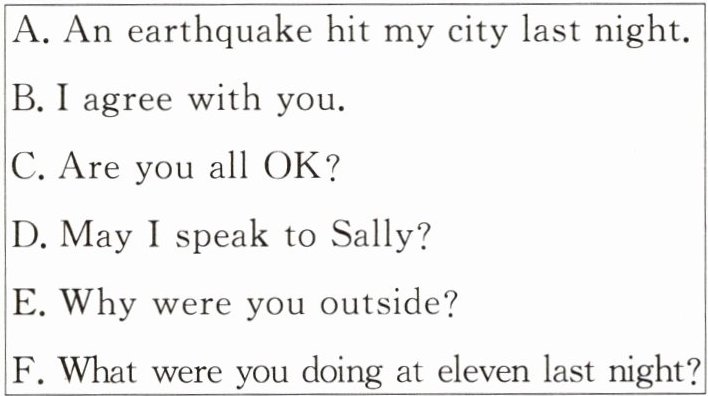
(E)从下面的方框中选择合适的句子,填到横线上,使对话意思完整。
A:Hello! 1
B:This is Sally speaking.
A:Hi, Sally, this is Tom. 2
B:At eleven last night? I was outside with my family.
A: 3
B: 4
A:Sorry for the news. 5
B:Yeah, luckily, we are all OK. Thanks for asking.
A:Thank goodness you are fine.
B:Safety always comes first.
A: 6
1.
(F)从方框中选择合适的句子,填到横线上,使对话意思完整。
A:Hi, Lisa! I heard you went to Canada last month. 1
B:It was great! I learnt a lot about Canadian culture.
A:Really? What's the most interesting thing you learnt?
B:Well, Canadian people love saying "sorry". 2
A:That's funny! Did you try any special food there?
B:Yes! I ate "poutine"—it's fries with cheese and gravy(肉汤). 3
A:Sounds delicious! What about greeting customs? How do people greet each other in Canada?
B: 4
A:I see. 5
B:Oh, and when you visit someone's home, you should bring a small gift.
A: 6
B:You're welcome!
1.
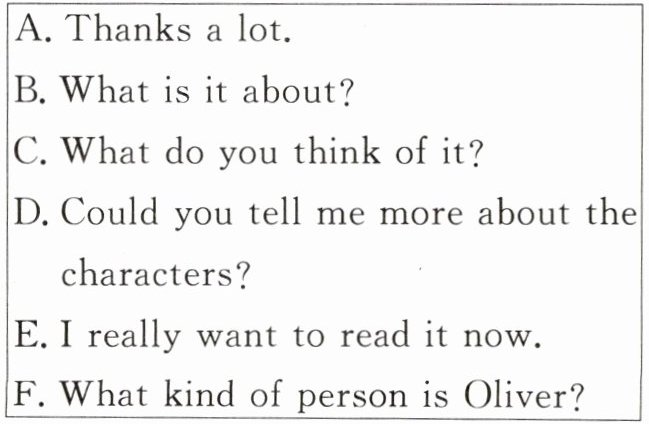
(G)从方框中选择合适的句子,填到横线上,使对话意思完整。
A:Hi, David! I heard you just finished your book report.
B:Yes, that's right. I read Oliver Twist.
A:Oliver Twist? 1
B:It's a famous novel by Charles Dickens. It's about an orphan(孤儿的) boy named Oliver in London.
A:Oh, that sounds interesting. 2
B:I think it's a wonderful but sad book. Dickens really shows us the hard life of poor children in that time.
A:That's deep. 3
B:Oliver is a very kind boy. Even though he faces many difficulties, he never loses his goodness.
A:It's amazing that he keeps his kindness. 4
B:Sure! There are many other characters, like the cruel Fagin and the kind-hearted Mr. Brownlow.
A:Wow. 5
B:Of course. I'll bring it to you tomorrow.
A: 6
1.
4.
A:Hello! 1
D
B:This is Sally speaking.
A:Hi, Sally, this is Tom. 2
F
I called you but nobody answered.B:At eleven last night? I was outside with my family.
A: 3
E
What happened?B: 4
A
We got out of the apartment building to keep safe.A:Sorry for the news. 5
C
B:Yeah, luckily, we are all OK. Thanks for asking.
A:Thank goodness you are fine.
B:Safety always comes first.
A: 6
B
1.
D
2. F
3. E
4. A
5. C
6. B
(F)从方框中选择合适的句子,填到横线上,使对话意思完整。
A:Hi, Lisa! I heard you went to Canada last month. 1
B
B:It was great! I learnt a lot about Canadian culture.
A:Really? What's the most interesting thing you learnt?
B:Well, Canadian people love saying "sorry". 2
E
A:That's funny! Did you try any special food there?
B:Yes! I ate "poutine"—it's fries with cheese and gravy(肉汤). 3
A
A:Sounds delicious! What about greeting customs? How do people greet each other in Canada?
B: 4
F
Friends often hug, and strangers usually shake hands.A:I see. 5
C
B:Oh, and when you visit someone's home, you should bring a small gift.
A: 6
D
Thanks for telling me so much!B:You're welcome!
1.
B
2. E
3. A
4. F
5. C
6. D
(G)从方框中选择合适的句子,填到横线上,使对话意思完整。
A:Hi, David! I heard you just finished your book report.
B:Yes, that's right. I read Oliver Twist.
A:Oliver Twist? 1
B
B:It's a famous novel by Charles Dickens. It's about an orphan(孤儿的) boy named Oliver in London.
A:Oh, that sounds interesting. 2
C
B:I think it's a wonderful but sad book. Dickens really shows us the hard life of poor children in that time.
A:That's deep. 3
F
B:Oliver is a very kind boy. Even though he faces many difficulties, he never loses his goodness.
A:It's amazing that he keeps his kindness. 4
D
B:Sure! There are many other characters, like the cruel Fagin and the kind-hearted Mr. Brownlow.
A:Wow. 5
E
Can I borrow it?B:Of course. I'll bring it to you tomorrow.
A: 6
A
1.
B
2. C
3. F
4.
D
5. E
6. A
答案
(E)1.D 2.F 3.E 4.A 5.C 6.B
(F)1.B 2.E 3.A 4.F 5.C 6.D
(G)1.B 2.C 3.F 4.D 5.E 6.A
(F)1.B 2.E 3.A 4.F 5.C 6.D
(G)1.B 2.C 3.F 4.D 5.E 6.A
解析
【分析】
这类补全对话题需先通读整个对话,明确话题主线,再分析每处空格前后的语境(如问候、询问情况、回应事件、延续话题等),结合英语日常交际用语的固定表达和逻辑关联,匹配对应选项,最后验证对话是否通顺合理。
【解析】
(E)1. 由答语“This is Sally speaking.”可知是打电话场景,对应打电话的开头表述,选D;2. 结合答语“At eleven last night?”可知是询问昨晚打电话的时间,选F;3. 得知对方昨晚外出,选E承接语境;4. 解释外出原因(保障安全),选A;5. 回应对方安全的庆幸,选C;6. 对话收尾表述,选B。
(F)1. 答语“It was great!”是对旅行的评价,对应询问旅行感受的表述,选B;2. 承接“加拿大人爱说‘sorry’”的话题,选E;3. 描述食物的感受,选A;4. 回答问候方式的问题,选F;5. 补充其他习俗,选C;6. 对话收尾表述,选D。
(G)1. 答语是介绍《雾都孤儿》,对应询问书籍基本信息的表述,选B;2. 评价书籍的内容,选C;3. 询问书中人物特点,选F;4. 询问其他角色,选D;5. 表达对书籍的兴趣,选E;6. 回应借书相关的感谢,选A。
【答案】
(E)1.D 2.F 3.E 4.A 5.C 6.B;(F)1.B 2.E 3.A 4.F 5.C 6.D;(G)1.B 2.C 3.F 4.D 5.E 6.A
【知识点】
英语日常交际用语、补全对话技巧
【点评】
本题围绕打电话、旅行、书籍等日常话题设置补全对话,考查学生的英语语境理解与交际运用能力,需结合上下文逻辑匹配选项,难度适中。
【难度系数】
0.7
这类补全对话题需先通读整个对话,明确话题主线,再分析每处空格前后的语境(如问候、询问情况、回应事件、延续话题等),结合英语日常交际用语的固定表达和逻辑关联,匹配对应选项,最后验证对话是否通顺合理。
【解析】
(E)1. 由答语“This is Sally speaking.”可知是打电话场景,对应打电话的开头表述,选D;2. 结合答语“At eleven last night?”可知是询问昨晚打电话的时间,选F;3. 得知对方昨晚外出,选E承接语境;4. 解释外出原因(保障安全),选A;5. 回应对方安全的庆幸,选C;6. 对话收尾表述,选B。
(F)1. 答语“It was great!”是对旅行的评价,对应询问旅行感受的表述,选B;2. 承接“加拿大人爱说‘sorry’”的话题,选E;3. 描述食物的感受,选A;4. 回答问候方式的问题,选F;5. 补充其他习俗,选C;6. 对话收尾表述,选D。
(G)1. 答语是介绍《雾都孤儿》,对应询问书籍基本信息的表述,选B;2. 评价书籍的内容,选C;3. 询问书中人物特点,选F;4. 询问其他角色,选D;5. 表达对书籍的兴趣,选E;6. 回应借书相关的感谢,选A。
【答案】
(E)1.D 2.F 3.E 4.A 5.C 6.B;(F)1.B 2.E 3.A 4.F 5.C 6.D;(G)1.B 2.C 3.F 4.D 5.E 6.A
【知识点】
英语日常交际用语、补全对话技巧
【点评】
本题围绕打电话、旅行、书籍等日常话题设置补全对话,考查学生的英语语境理解与交际运用能力,需结合上下文逻辑匹配选项,难度适中。
【难度系数】
0.7
