

 登录
二、阅读理解。
根据短文内容,从题中所给的A、B、C、D四个选项中选出最佳选项。
Zhuang is one of the ethnic groups(民族) in China. The following text may help you learn more about their art and culture.
| How many people? | 19,568,546 | Where do they live? | Most Zhuang people live in southern China, especially in Guangxi and Yunnan. |
| --- | --- | --- | --- |
| The Big Singing Festival
Many Zhuang people like singing even more than talking. They sing songs while walking, farming and doing housework. On the third day of the third lunar month, the Zhuang people usually hold a big singing festival. Thousands of singers get together to compete(竞争) to be the "king" or "queen" of singing. Many singers are young men and women, and they often sing Liu Sanjie's love songs. It's a good chance for them to get to know each other. Maybe he or she can find his or her future wife or husband there. |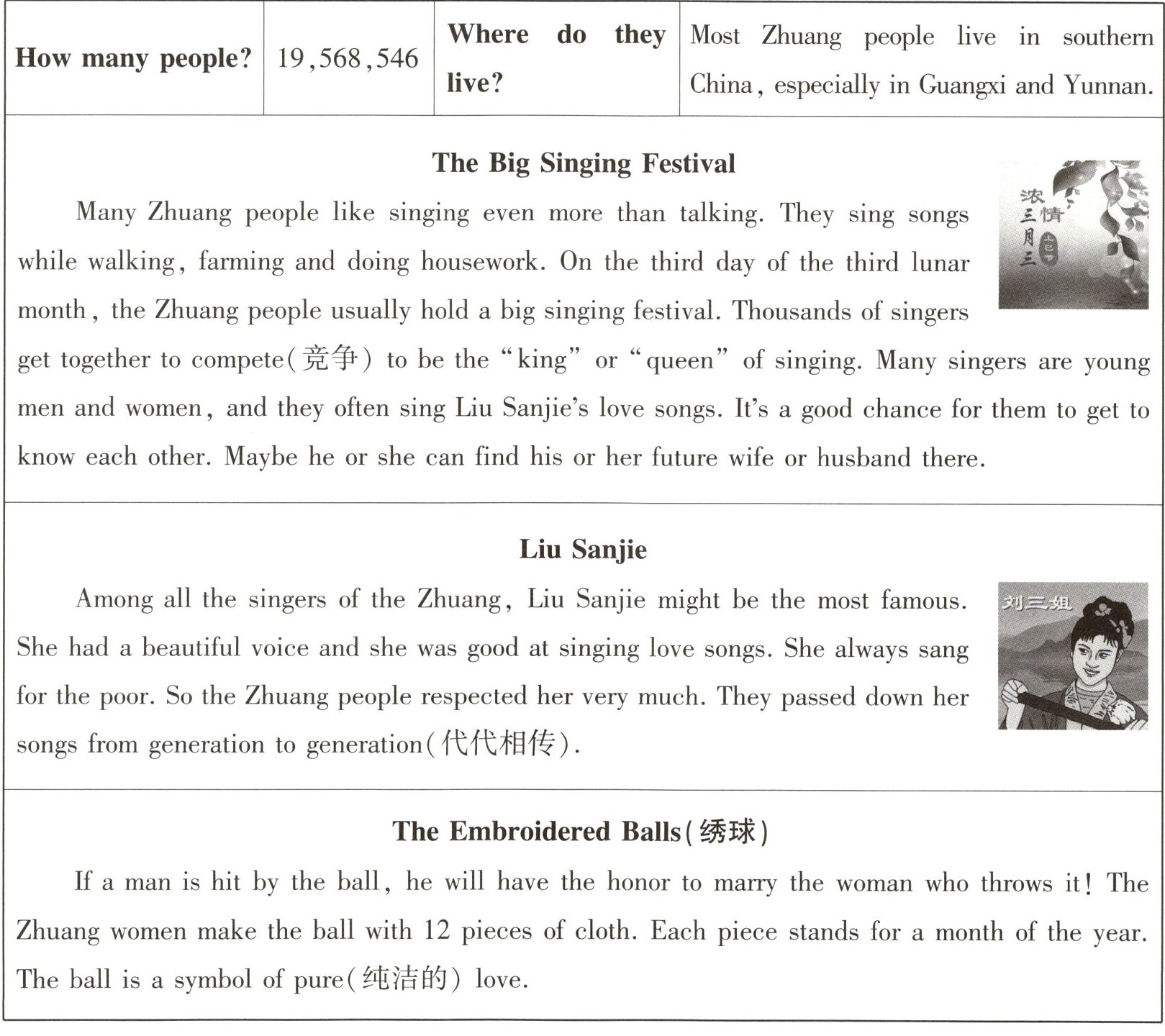
Liu Sanjie
Among all the singers of the Zhuang, Liu Sanjie might be the most famous. She had a beautiful voice and she was good at singing love songs. She always sang for the poor. So the Zhuang people respected her very much. They passed down her songs from generation to generation(代代相传). | The Embroidered Balls(绣球)
If a man is hit by the ball, he will have the honor to marry the woman who throws it! The Zhuang women make the ball with 12 pieces of cloth. Each piece stands for a month of the year. The ball is a symbol of pure(纯洁的) love. |
(
A. In northern China.
B. In Guangzhou.
C. In Hunan.
D. In Guangxi and Yunnan.
(
A. The Zhuang people hold it on the third day of every month.
B. The singers are all young men and women.
C. They often sing Liu Sanjie's songs in the singing festival.
D. The singers must find a future husband or wife in the singing festival.
(
A. She had a loud voice.
B. She always sang for the poor people.
C. She was good at singing songs about friends.
D. The Zhuang people don't sing Liu Sanjie's songs now.
(
A. Pure love.
B. Beautiful voice.
C. Close teammates.
D. Valuable friendship.
(
A. To introduce Liu Sanjie.
B. To invite people to come to Guangxi.
C. To introduce the art and culture of the Zhuang.
D. To encourage people to take part in the singing festival.
根据短文内容,从题中所给的A、B、C、D四个选项中选出最佳选项。
Zhuang is one of the ethnic groups(民族) in China. The following text may help you learn more about their art and culture.
| How many people? | 19,568,546 | Where do they live? | Most Zhuang people live in southern China, especially in Guangxi and Yunnan. |
| --- | --- | --- | --- |
| The Big Singing Festival
Many Zhuang people like singing even more than talking. They sing songs while walking, farming and doing housework. On the third day of the third lunar month, the Zhuang people usually hold a big singing festival. Thousands of singers get together to compete(竞争) to be the "king" or "queen" of singing. Many singers are young men and women, and they often sing Liu Sanjie's love songs. It's a good chance for them to get to know each other. Maybe he or she can find his or her future wife or husband there. |
Liu Sanjie
Among all the singers of the Zhuang, Liu Sanjie might be the most famous. She had a beautiful voice and she was good at singing love songs. She always sang for the poor. So the Zhuang people respected her very much. They passed down her songs from generation to generation(代代相传). | The Embroidered Balls(绣球)
If a man is hit by the ball, he will have the honor to marry the woman who throws it! The Zhuang women make the ball with 12 pieces of cloth. Each piece stands for a month of the year. The ball is a symbol of pure(纯洁的) love. |
(
D
)1. Where do most of Zhuang people live?A. In northern China.
B. In Guangzhou.
C. In Hunan.
D. In Guangxi and Yunnan.
(
C
)2. Which of the following is TRUE about the big singing festival?A. The Zhuang people hold it on the third day of every month.
B. The singers are all young men and women.
C. They often sing Liu Sanjie's songs in the singing festival.
D. The singers must find a future husband or wife in the singing festival.
(
B
)3. What do we know about Liu Sanjie?A. She had a loud voice.
B. She always sang for the poor people.
C. She was good at singing songs about friends.
D. The Zhuang people don't sing Liu Sanjie's songs now.
(
A
)4. What do the embroidered balls stand for?A. Pure love.
B. Beautiful voice.
C. Close teammates.
D. Valuable friendship.
(
C
)5. What's the writer's purpose in writing the text?A. To introduce Liu Sanjie.
B. To invite people to come to Guangxi.
C. To introduce the art and culture of the Zhuang.
D. To encourage people to take part in the singing festival.
答案
1. D
2. C
3. B
4. A
5. C
2. C
3. B
4. A
5. C
解析
【分析】本题为关于壮族文化的阅读理解题,包含5道细节理解题。解题时需先通读全文把握主旨,再针对每个小题的关键词,回到原文定位对应信息,将选项与原文内容逐一比对,排除错误选项,选出最佳答案。
【解析】
1. 第1题:根据题干关键词“where most Zhuang people live”,定位到原文表格中“Most Zhuang people live in southern China, especially in Guangxi and Yunnan.”,可知答案为D。
2. 第2题:根据题干关键词“big singing festival”,定位到原文“The Big Singing Festival”部分:A选项错误,节日是农历三月初三而非每月第三天;B选项错误,原文是“Many singers are young men and women”并非所有歌手都是年轻人;C选项正确,原文提到“they often sing Liu Sanjie's love songs”;D选项错误,原文是“Maybe he or she can find...”(可能)而非“must”(必须),故答案为C。
3. 第3题:根据题干关键词“Liu Sanjie”,定位到原文“Liu Sanjie”部分:A选项错误,原文是“beautiful voice”而非“loud voice”;B选项正确,原文明确“She always sang for the poor.”;C选项错误,她擅长唱爱情歌曲而非朋友相关;D选项错误,原文提到“passed down her songs from generation to generation”,故答案为B。
4. 第4题:根据题干关键词“embroidered balls”,定位到原文“The Embroidered Balls”部分最后一句“The ball is a symbol of pure love.”,可知答案为A。
5. 第5题:根据原文开头“learn more about their art and culture”,可知作者的写作目的是介绍壮族的艺术和文化,故答案为C。
【答案】1.D 2.C 3.B 4.A 5.C
【知识点】阅读理解、民族文化常识
【点评】本题围绕壮族文化展开,主要考查细节信息的查找与理解,难度适中,学生只要仔细定位原文对应内容即可正确作答。
【难度系数】0.7
