

 登录
登录
四、课堂上,老师组织大家讨论好习惯与坏习惯。阅读短文,选择正确的答案。
Good habits or bad habits?
We often talk about good habits and bad habits, but do you really know whether(是否) they are good or bad?
Everyone thinks brushing teeth is a good habit, but sometimes it's not. Ken wants to keep his teeth healthy, so he brushes them for 15 minutes after every meal. But he finds his teeth are getting worse—he brushes them too much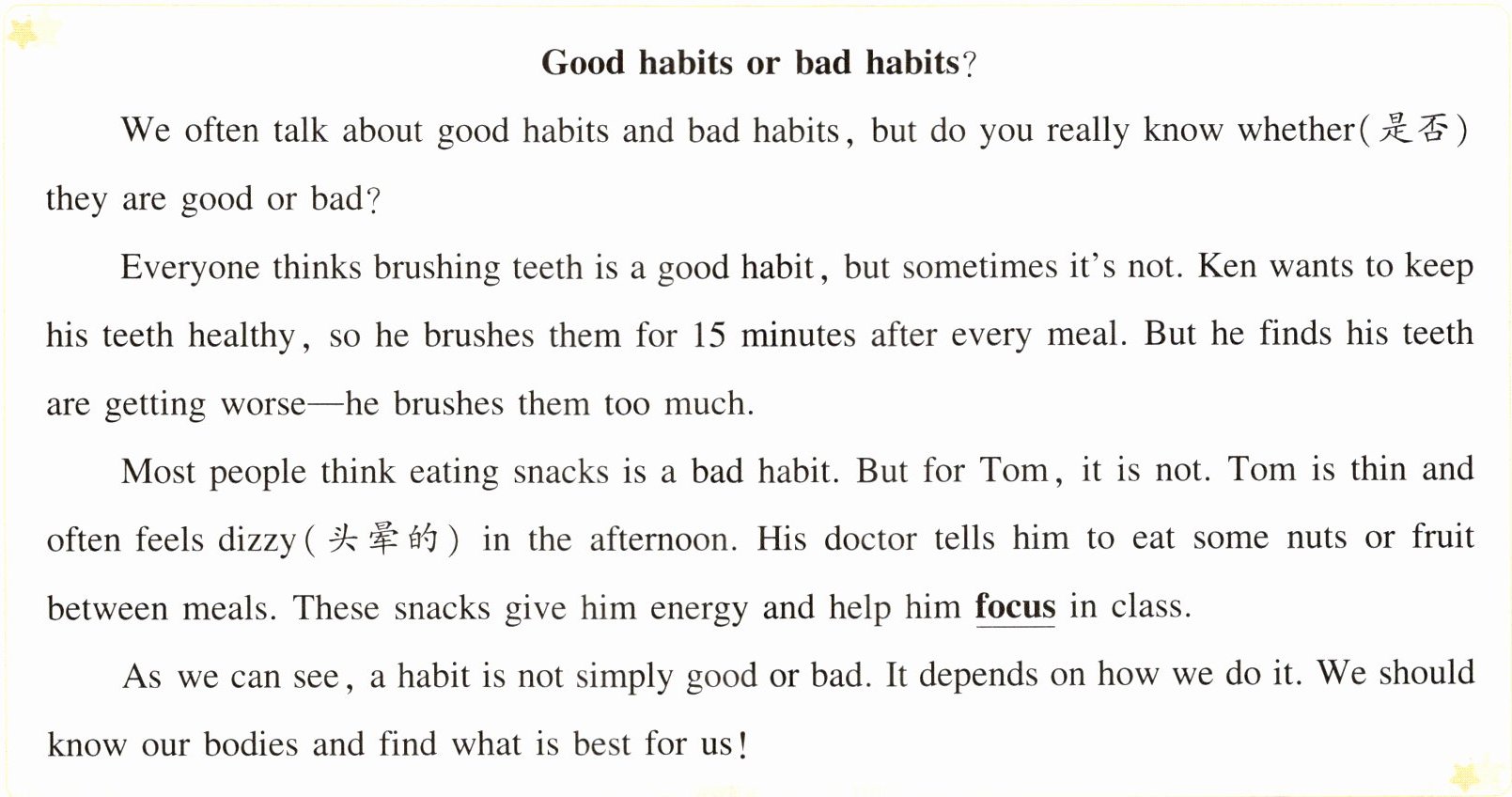
Most people think eating snacks is a bad habit. But for Tom, it is not. Tom is thin and often feels dizzy(头晕的) in the afternoon. His doctor tells him to eat some nuts or fruit between meals. These snacks give him energy and help him focus in class.
As we can see, a habit is not simply good or bad. It depends on how we do it. We should know our bodies and find what is best for us!
(
A. Because he never brushes his teeth.
B. Because he brushes his teeth for too long every time.
C. Because he eats too much candy.
(
A. Nuts and fruit.
B. Candy and cakes.
C. Chips and cola.
(
A. Happy.
B. Dizzy.
C. Full.
(
A. 走神
B. 集中注意力
C. 休息
(
A. Brushing teeth is always a good habit.
B. Eating snacks is always a bad habit.
C. A habit is not just good or bad. It depends on how we do it.
Good habits or bad habits?
We often talk about good habits and bad habits, but do you really know whether(是否) they are good or bad?
Everyone thinks brushing teeth is a good habit, but sometimes it's not. Ken wants to keep his teeth healthy, so he brushes them for 15 minutes after every meal. But he finds his teeth are getting worse—he brushes them too much
Most people think eating snacks is a bad habit. But for Tom, it is not. Tom is thin and often feels dizzy(头晕的) in the afternoon. His doctor tells him to eat some nuts or fruit between meals. These snacks give him energy and help him focus in class.
As we can see, a habit is not simply good or bad. It depends on how we do it. We should know our bodies and find what is best for us!
(
B
)1. Why are Ken's teeth getting worse?A. Because he never brushes his teeth.
B. Because he brushes his teeth for too long every time.
C. Because he eats too much candy.
(
A
)2. What does the doctor ask Tom to eat between meals?A. Nuts and fruit.
B. Candy and cakes.
C. Chips and cola.
(
B
)3. How does Tom feel in the afternoon without snacks?A. Happy.
B. Dizzy.
C. Full.
(
B
)4. The underlined word "focus" means "B
" in Chinese.A. 走神
B. 集中注意力
C. 休息
(
C
)5. What can we learn from the passage?A. Brushing teeth is always a good habit.
B. Eating snacks is always a bad habit.
C. A habit is not just good or bad. It depends on how we do it.
答案
1. B 2. A 3. B 4. B 5. C
解析
【分析】这是一篇关于习惯好坏的英语阅读理解题,解题思路为:先通读短文掌握主旨大意,再针对每道题的题干关键词回原文定位对应内容;细节理解题直接查找原文信息,词义猜测题结合上下文语境推断词义,最后匹配选项得出答案。
【解析】1. 第1题:根据题干关键词“Ken's teeth getting worse”定位到原文第二段,由“he brushes them too much”(结合前文每次刷15分钟)可知,Ken牙齿变差是因为每次刷牙时间太长,对应选项B。
2. 第2题:根据题干关键词“doctor ask Tom to eat between meals”定位到原文第三段,由“His doctor tells him to eat some nuts or fruit between meals”可知,医生让Tom在两餐间吃坚果和水果,对应选项A。
3. 第3题:根据题干关键词“Tom feel in the afternoon without snacks”定位到原文第三段,由“Tom is thin and often feels dizzy in the afternoon”可知,Tom下午不吃零食会头晕,对应选项B。
4. 第4题:词义猜测题,结合原文“These snacks give him energy and help him focus in class”,零食提供能量,帮助课堂上的状态,“focus”意为“集中注意力”,对应选项B。
5. 第5题:根据题干“learn from the passage”定位到原文最后一段,由“A habit is not simply good or bad. It depends on how we do it”可知,习惯不只是好或坏,取决于如何做,对应选项C。
【答案】1.B 2.A 3.B 4.B 5.C
【知识点】阅读理解、细节理解、词义猜测
【点评】短文通过具体事例说明习惯的好坏并非绝对,题目侧重考查学生查找细节和推断词义的能力,贴近日常学习生活,难度适中。
【难度系数】0.6
【解析】1. 第1题:根据题干关键词“Ken's teeth getting worse”定位到原文第二段,由“he brushes them too much”(结合前文每次刷15分钟)可知,Ken牙齿变差是因为每次刷牙时间太长,对应选项B。
2. 第2题:根据题干关键词“doctor ask Tom to eat between meals”定位到原文第三段,由“His doctor tells him to eat some nuts or fruit between meals”可知,医生让Tom在两餐间吃坚果和水果,对应选项A。
3. 第3题:根据题干关键词“Tom feel in the afternoon without snacks”定位到原文第三段,由“Tom is thin and often feels dizzy in the afternoon”可知,Tom下午不吃零食会头晕,对应选项B。
4. 第4题:词义猜测题,结合原文“These snacks give him energy and help him focus in class”,零食提供能量,帮助课堂上的状态,“focus”意为“集中注意力”,对应选项B。
5. 第5题:根据题干“learn from the passage”定位到原文最后一段,由“A habit is not simply good or bad. It depends on how we do it”可知,习惯不只是好或坏,取决于如何做,对应选项C。
【答案】1.B 2.A 3.B 4.B 5.C
【知识点】阅读理解、细节理解、词义猜测
【点评】短文通过具体事例说明习惯的好坏并非绝对,题目侧重考查学生查找细节和推断词义的能力,贴近日常学习生活,难度适中。
【难度系数】0.6
