

 登录
登录
Ⅰ. 根据句意及汉语提示写单词
1. Don't
2. How do you go to the
3. The genie looks
4. It's great to hear your
5. The lady has a bowl of
1. Don't
litter
(乱扔). We must keep our school clean and tidy.2. How do you go to the
theatre
(剧院)?3. The genie looks
ugly
(丑陋的) when it becomes angry.4. It's great to hear your
voice
(声音). How's everything going there?5. The lady has a bowl of
porridge
(粥) and two pieces of bread for dinner.答案
Ⅰ.1. litter 2. theatre 3. ugly 4. voice
5. porridge
5. porridge
解析
【分析】
本题要求根据句意及汉语提示填写正确的英语单词,解题时需结合语境判断单词的词性、形式,再匹配对应的汉语释义词汇,注意常用词汇的固定表达和拼写规范。
【解析】
1. 祈使句否定形式“Don't”后接动词原形,“乱扔”对应的英语动词是litter;
2. “剧院”对应的英语名词是theatre;
3. 此处需形容词作表语,“丑陋的”对应的形容词是ugly;
4. 此处指人的声音,对应名词voice;
5. “粥”对应的不可数名词是porridge。
【答案】
Ⅰ.1. litter 2. theatre 3. ugly 4. voice 5. porridge
【知识点】
英语单词拼写、根据汉语提示写单词
【点评】
本题考查基础英语核心词汇的运用,结合简单语境填写单词,侧重词汇的识记与基础运用,难度较低。
【难度系数】
0.8
本题要求根据句意及汉语提示填写正确的英语单词,解题时需结合语境判断单词的词性、形式,再匹配对应的汉语释义词汇,注意常用词汇的固定表达和拼写规范。
【解析】
1. 祈使句否定形式“Don't”后接动词原形,“乱扔”对应的英语动词是litter;
2. “剧院”对应的英语名词是theatre;
3. 此处需形容词作表语,“丑陋的”对应的形容词是ugly;
4. 此处指人的声音,对应名词voice;
5. “粥”对应的不可数名词是porridge。
【答案】
Ⅰ.1. litter 2. theatre 3. ugly 4. voice 5. porridge
【知识点】
英语单词拼写、根据汉语提示写单词
【点评】
本题考查基础英语核心词汇的运用,结合简单语境填写单词,侧重词汇的识记与基础运用,难度较低。
【难度系数】
0.8
Ⅱ.按要求完成下列句子
1. No photos here.(改为同义句)
2. I'd like to try Gongbao chicken.(改为一般疑问句)
3. I visited the art museum on Friday.(改为否定句)
I
4. Are Lucy and Lily playing chess now?(做肯定回答)
5. They like tigers because they are strong and brave.(对画线部分提问)
1. No photos here.(改为同义句)
Don't
take
photos here.2. I'd like to try Gongbao chicken.(改为一般疑问句)
Would
you
like
to try Gongbao chicken?3. I visited the art museum on Friday.(改为否定句)
I
didn't
visit
the art museum on Friday.4. Are Lucy and Lily playing chess now?(做肯定回答)
Yes
, they
are
.5. They like tigers because they are strong and brave.(对画线部分提问)
Why
do
they like tigers?答案
Ⅱ.1. Don't take 2. Would you like 3. didn't visit 4. Yes; they are 5. Why do
解析
【分析】本题为英语句型转换题,需根据不同句式的转换规则逐一解答:1. 原句“No photos”是表禁止的祈使句,同义表达为“Don't + 动词原形”结构;2. “I'd like”是“I would like”的缩写,变一般疑问句时需将助动词would提前,主语转换为you;3. 一般过去时的句子变否定句,需在主语后加助动词didn't,谓语动词还原为原形;4. 现在进行时的一般疑问句肯定回答,需用“Yes + 对应主语 + be动词”;5. 对原因状语提问需用特殊疑问词Why,结合原句时态和主语确定助动词。
【解析】1. “No photos here.”的同义句为“Don't take photos here.”,故填Don't take;2. “I'd like to...”变一般疑问句,将would提前,主语换为you,故填Would you like;3. 一般过去时visited变否定,加didn't,动词还原为visit,故填didn't visit;4. 问句主语是Lucy and Lily(复数),肯定回答为Yes, they are;5. 对原因提问用Why,原句是一般现在时,主语they,助动词用do,故填Why do。
【答案】Ⅱ.1. Don't take 2. Would you like 3. didn't visit 4. Yes; they are 5. Why do
【知识点】祈使句、动词时态、特殊疑问句
【点评】本题考查初中英语基础句型转换,涵盖祈使句、不同时态的句式变化及特殊疑问句提问,属于核心基础题型,需掌握各类句式的转换规则。
【难度系数】0.8
【解析】1. “No photos here.”的同义句为“Don't take photos here.”,故填Don't take;2. “I'd like to...”变一般疑问句,将would提前,主语换为you,故填Would you like;3. 一般过去时visited变否定,加didn't,动词还原为visit,故填didn't visit;4. 问句主语是Lucy and Lily(复数),肯定回答为Yes, they are;5. 对原因提问用Why,原句是一般现在时,主语they,助动词用do,故填Why do。
【答案】Ⅱ.1. Don't take 2. Would you like 3. didn't visit 4. Yes; they are 5. Why do
【知识点】祈使句、动词时态、特殊疑问句
【点评】本题考查初中英语基础句型转换,涵盖祈使句、不同时态的句式变化及特殊疑问句提问,属于核心基础题型,需掌握各类句式的转换规则。
【难度系数】0.8
Ⅲ.选择合适的选项补全对话(有两项多余)
A: Hi, my name's Li Lei. It's my first day at our school.
B: Hi, Li Lei.
A: 1.
B: First, we have to wear the school uniform every day. 2.
A: I see. 3.
B: Yes, you can, but you can't listen to music in the classroom or hallways.
A: 4.
B: You'd better not. If you do so, you must hand it in to your headteacher.
A: What else?
B: 5.
A: Thank you, Daming.
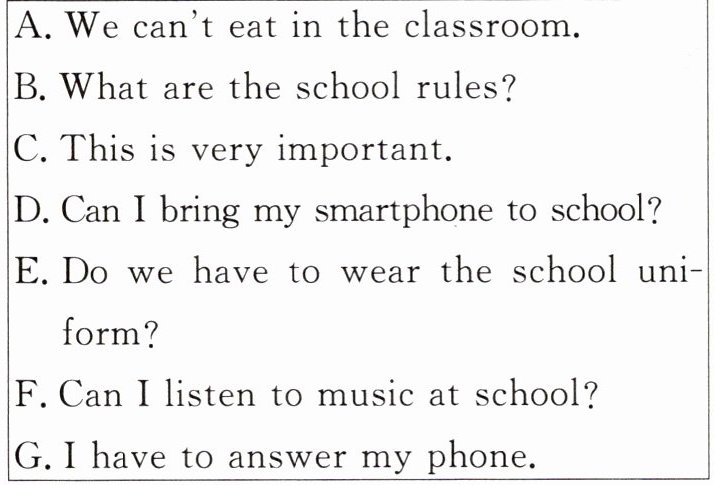
A: Hi, my name's Li Lei. It's my first day at our school.
B: Hi, Li Lei.
A: 1.
B
B: First, we have to wear the school uniform every day. 2.
C
A: I see. 3.
F
B: Yes, you can, but you can't listen to music in the classroom or hallways.
A: 4.
D
B: You'd better not. If you do so, you must hand it in to your headteacher.
A: What else?
B: 5.
A
But we can eat in the dining hall.A: Thank you, Daming.
答案
Ⅲ.1. B 2. C 3. F 4. D 5. A
解析
【分析】
首先通读对话,理解语境:A是新生,第一天到学校,向B询问学校规则。解题思路是结合上下文的问答逻辑,匹配选项。1处A刚到学校,会先问学校规则,对应B选项;2处B提到穿校服,接着补充这很重要,对应C选项;3处B回答“can”且提到不能在教室或走廊听音乐,说明A问的是能否在学校听音乐,对应F选项;4处B说最好不要,要交班主任,说明A问的是能否带手机,对应D选项;5处后面说可以在餐厅吃,前面是不能在教室吃东西,对应A选项。
【解析】
1. 根据下文B的回答“First, we have to wear the school uniform every day.”可知,A在询问学校规则,对应选项B。
2. 上文提到必须穿校服,此处补充说明穿校服这件事很重要,对应选项C。
3. 下文B回答“Yes, you can, but you can't listen to music in the classroom or hallways.”,说明A问的是能否在学校听音乐,对应选项F。
4. 下文B说“You'd better not. If you do so, you must hand it in to your headteacher.”,说明A问的是能否带手机,对应选项D。
5. 下文说可以在餐厅吃,此处表示不能在教室吃东西,对应选项A。
【答案】
1.B 2.C 3.F 4.D 5.A
【知识点】
学校规则表达、一般疑问句、日常交际用语
【点评】
本题是补全对话,围绕学校规则展开,考查学生对日常交际用语的运用能力,需结合上下文语境匹配合适的句子。
【难度系数】
0.4
首先通读对话,理解语境:A是新生,第一天到学校,向B询问学校规则。解题思路是结合上下文的问答逻辑,匹配选项。1处A刚到学校,会先问学校规则,对应B选项;2处B提到穿校服,接着补充这很重要,对应C选项;3处B回答“can”且提到不能在教室或走廊听音乐,说明A问的是能否在学校听音乐,对应F选项;4处B说最好不要,要交班主任,说明A问的是能否带手机,对应D选项;5处后面说可以在餐厅吃,前面是不能在教室吃东西,对应A选项。
【解析】
1. 根据下文B的回答“First, we have to wear the school uniform every day.”可知,A在询问学校规则,对应选项B。
2. 上文提到必须穿校服,此处补充说明穿校服这件事很重要,对应选项C。
3. 下文B回答“Yes, you can, but you can't listen to music in the classroom or hallways.”,说明A问的是能否在学校听音乐,对应选项F。
4. 下文B说“You'd better not. If you do so, you must hand it in to your headteacher.”,说明A问的是能否带手机,对应选项D。
5. 下文说可以在餐厅吃,此处表示不能在教室吃东西,对应选项A。
【答案】
1.B 2.C 3.F 4.D 5.A
【知识点】
学校规则表达、一般疑问句、日常交际用语
【点评】
本题是补全对话,围绕学校规则展开,考查学生对日常交际用语的运用能力,需结合上下文语境匹配合适的句子。
【难度系数】
0.4
Ⅳ. 阅读理解
A long time ago, there were no elephants in China. One day, a Chinese king got an elephant.
People were very happy to see this big animal. Everyone carefully watched it and had a question: How much does it weigh(重)? But they didn't know how to weigh it. At that time, no scales in China were big enough to weigh such a big animal.
The king had a seven-year-old son called Cao Chong. He said, "Father, I know the way to weigh it." The ministers(大臣) didn't believe the boy. But after he told them his idea, they all thought it was a good one.
"Here's what you do," said the boy. "Let the elephant stand in a big boat on the water. Draw a line on the side of the boat at the water level. Then bring it to the bank(河边) and let the elephant off. Bring a lot of big stones, put the stones on the boat until the boat sinks(沉) to the same water level. Then take the stones out of the boat and weigh them one by one. Add up the weight of each stone. Now you know how much the elephant weighs."
"Wonderful! Wonderful!" shouted the ministers. Soon everyone in the country knew that the king had a clever son.
(
(
A. How to weigh the elephant.
B. When to put the stones on the boat.
C. Where to find lots of stones.
D. What to do to help the elephant.
(
A. He was 6 years old then.
B. He told the way to the ministers.
C. He brought all the stones.
D. He thought his father was clever.
(
A. It's difficult to go boating.
B. One must work hard for his dream.
C. Children can do great things.
D. Never use an elephant for easy things.
(
A. Excited.
B. Clever.
C. Silly.
D. Wonderful.
A long time ago, there were no elephants in China. One day, a Chinese king got an elephant.
People were very happy to see this big animal. Everyone carefully watched it and had a question: How much does it weigh(重)? But they didn't know how to weigh it. At that time, no scales in China were big enough to weigh such a big animal.
The king had a seven-year-old son called Cao Chong. He said, "Father, I know the way to weigh it." The ministers(大臣) didn't believe the boy. But after he told them his idea, they all thought it was a good one.
"Here's what you do," said the boy. "Let the elephant stand in a big boat on the water. Draw a line on the side of the boat at the water level. Then bring it to the bank(河边) and let the elephant off. Bring a lot of big stones, put the stones on the boat until the boat sinks(沉) to the same water level. Then take the stones out of the boat and weigh them one by one. Add up the weight of each stone. Now you know how much the elephant weighs."
"Wonderful! Wonderful!" shouted the ministers. Soon everyone in the country knew that the king had a clever son.
(
B
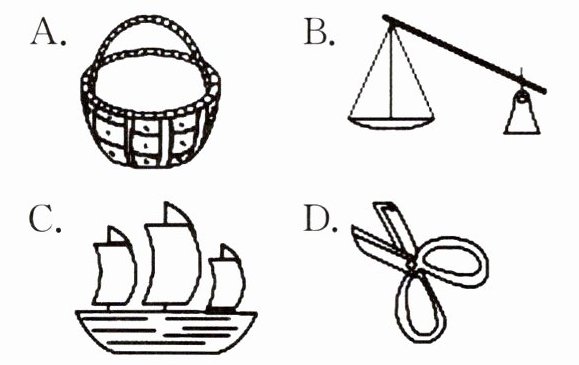
)1. Which of the following pictures can be a "scale"?(
A
)2. What is Paragraph 4 about?A. How to weigh the elephant.
B. When to put the stones on the boat.
C. Where to find lots of stones.
D. What to do to help the elephant.
(
B
)3. What can we know about Cao Chong?A. He was 6 years old then.
B. He told the way to the ministers.
C. He brought all the stones.
D. He thought his father was clever.
(
C
)4. What does the story want to tell us?A. It's difficult to go boating.
B. One must work hard for his dream.
C. Children can do great things.
D. Never use an elephant for easy things.
(
B
)5. What do you think of Cao Chong?A. Excited.
B. Clever.
C. Silly.
D. Wonderful.
答案
Ⅳ.1. B 【解析】根据"At that time, no scales in China were big enough to weigh such a big animal."可知,当时,中国没有足够大的……来称重这么庞大的动物,可以推断"scale"意为"秤"。故选 B。
2. A 【解析】根据"Here's what you do... Now you know how much the elephant weighs."可知,该段介绍了给大象称重的方法。故选 A。
3. B 【解析】根据"The ministers(大臣) didn't believe the boy. But after he told them his i-dea, they all thought it was a good one."可知,曹冲把给大象称重的方法告诉了大臣们。故选 B。
4. C 【解析】根据短文内容可知,大臣们原本不相信小孩能解决这个问题,但当曹冲说出方法后,他们都拍手叫好,告诉我们孩子也能做出了不起的事。故选 C。
5. B 【解析】根据"Soon everyone in the coun-try knew that the king had a clever son."可知,很快全国的人都知道了国王有一个聪明的儿子。故选 B。
2. A 【解析】根据"Here's what you do... Now you know how much the elephant weighs."可知,该段介绍了给大象称重的方法。故选 A。
3. B 【解析】根据"The ministers(大臣) didn't believe the boy. But after he told them his i-dea, they all thought it was a good one."可知,曹冲把给大象称重的方法告诉了大臣们。故选 B。
4. C 【解析】根据短文内容可知,大臣们原本不相信小孩能解决这个问题,但当曹冲说出方法后,他们都拍手叫好,告诉我们孩子也能做出了不起的事。故选 C。
5. B 【解析】根据"Soon everyone in the coun-try knew that the king had a clever son."可知,很快全国的人都知道了国王有一个聪明的儿子。故选 B。
解析
【分析】
本题为阅读理解题,需结合原文内容逐一分析各小题:第1题需猜测“scale”的含义,结合原文提到的没有足够大的工具称大象,对应选项中的秤;第2题需判断第四段的主旨,该段详细介绍了称大象的具体步骤;第3题需查找关于曹冲的细节,原文明确提到他告诉大臣们称象的方法;第4题需理解故事主旨,故事体现小孩也能解决难题;第5题需评价曹冲,原文直接点明他是聪明的儿子。
【解析】
1. 根据原文“At that time, no scales in China were big enough to weigh such a big animal”可知,“scale”意为“秤”,选项中B是杆秤,符合词义,故选B。
2. 第四段详细介绍了让大象上船标记水位、换石头至相同水位、称石头重量的步骤,即称大象的方法,故选A。
3. 根据原文“The ministers didn't believe the boy. But after he told them his idea, they all thought it was a good one”可知,曹冲把称象的方法告诉了大臣们,故选B。
4. 故事讲述年幼的曹冲想出称大象的巧妙方法,说明孩子也能做出了不起的事,故选C。
5. 根据原文“Soon everyone in the country knew that the king had a clever son”可知,曹冲是聪明的,故选B。
【答案】
1.B 2.A 3.B 4.C 5.B
【知识点】
阅读理解、细节理解、主旨大意
【点评】
本题围绕曹冲称象的经典故事设题,考查学生对词汇含义、段落主旨、细节信息及人物评价的理解,题型常规,难度适中,能有效考查学生的阅读理解能力。
【难度系数】
0.6
本题为阅读理解题,需结合原文内容逐一分析各小题:第1题需猜测“scale”的含义,结合原文提到的没有足够大的工具称大象,对应选项中的秤;第2题需判断第四段的主旨,该段详细介绍了称大象的具体步骤;第3题需查找关于曹冲的细节,原文明确提到他告诉大臣们称象的方法;第4题需理解故事主旨,故事体现小孩也能解决难题;第5题需评价曹冲,原文直接点明他是聪明的儿子。
【解析】
1. 根据原文“At that time, no scales in China were big enough to weigh such a big animal”可知,“scale”意为“秤”,选项中B是杆秤,符合词义,故选B。
2. 第四段详细介绍了让大象上船标记水位、换石头至相同水位、称石头重量的步骤,即称大象的方法,故选A。
3. 根据原文“The ministers didn't believe the boy. But after he told them his idea, they all thought it was a good one”可知,曹冲把称象的方法告诉了大臣们,故选B。
4. 故事讲述年幼的曹冲想出称大象的巧妙方法,说明孩子也能做出了不起的事,故选C。
5. 根据原文“Soon everyone in the country knew that the king had a clever son”可知,曹冲是聪明的,故选B。
【答案】
1.B 2.A 3.B 4.C 5.B
【知识点】
阅读理解、细节理解、主旨大意
【点评】
本题围绕曹冲称象的经典故事设题,考查学生对词汇含义、段落主旨、细节信息及人物评价的理解,题型常规,难度适中,能有效考查学生的阅读理解能力。
【难度系数】
0.6
