

 登录
登录
【典例1】如图所示,电源两端电压为12 V并保持不变,电阻$R_2$的阻值为$8\ \Omega$。当开关S闭合时,电压表示数为4 V。求:
(1)电阻$R_2$消耗的电功率$P_2$;
(2)电阻$R_1$消耗的电功率$P_1$;
(3)整个电路消耗的电功率$P$。
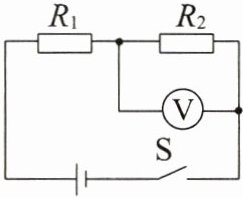
[规范答题]解:(1)通过$R_2$的电流$I_2=\frac{U_2}{R_2}=\frac{4\ \mathrm{V}}{8\ \Omega}=0.5\ \mathrm{A}$
电阻$R_2$消耗的电功率$P_2=U_2I_2=4\ \mathrm{V}×0.5\ \mathrm{A}=2\ \mathrm{W}$
(2)因为$R_1$与$R_2$串联,所以$U_1=U-U_2=12\ \mathrm{V}-4\ \mathrm{V}=8\ \mathrm{V},I_1=I_2=0.5\ \mathrm{A}$
电阻$R_1$消耗的电功率$P_1=U_1I_1=8\ \mathrm{V}×0.5\ \mathrm{A}=4\ \mathrm{W}$
(3)整个电路消耗的电功率$P=P_1+P_2=4\ \mathrm{W}+2\ \mathrm{W}=6\ \mathrm{W}$
答:(1)电阻$R_2$消耗的电功率$P_2$为$2\ \mathrm{W}$。
(2)电阻$R_1$消耗的电功率$P_1$为$4\ \mathrm{W}$。
(3)整个电路消耗的电功率$P$为$6\ \mathrm{W}$。
(1)电阻$R_2$消耗的电功率$P_2$;
(2)电阻$R_1$消耗的电功率$P_1$;
(3)整个电路消耗的电功率$P$。
[规范答题]解:(1)通过$R_2$的电流$I_2=\frac{U_2}{R_2}=\frac{4\ \mathrm{V}}{8\ \Omega}=0.5\ \mathrm{A}$
电阻$R_2$消耗的电功率$P_2=U_2I_2=4\ \mathrm{V}×0.5\ \mathrm{A}=2\ \mathrm{W}$
(2)因为$R_1$与$R_2$串联,所以$U_1=U-U_2=12\ \mathrm{V}-4\ \mathrm{V}=8\ \mathrm{V},I_1=I_2=0.5\ \mathrm{A}$
电阻$R_1$消耗的电功率$P_1=U_1I_1=8\ \mathrm{V}×0.5\ \mathrm{A}=4\ \mathrm{W}$
(3)整个电路消耗的电功率$P=P_1+P_2=4\ \mathrm{W}+2\ \mathrm{W}=6\ \mathrm{W}$
答:(1)电阻$R_2$消耗的电功率$P_2$为$2\ \mathrm{W}$。
(2)电阻$R_1$消耗的电功率$P_1$为$4\ \mathrm{W}$。
(3)整个电路消耗的电功率$P$为$6\ \mathrm{W}$。
答案
解:(1) 通过$R_2$的电流$I_2=\frac{U_2}{R_2}=\frac{4\ \mathrm{V}}{8\ \Omega}=0.5\ \mathrm{A}$
电阻$R_2$消耗的电功率$P_2=U_2I_2=4\ \mathrm{V}×0.5\ \mathrm{A}=2\ \mathrm{W}$
(2) 因为$R_1$与$R_2$串联,所以$R_1$两端电压$U_1=U-U_2=12\ \mathrm{V}-4\ \mathrm{V}=8\ \mathrm{V}$,电路电流$I_1=I_2=0.5\ \mathrm{A}$
电阻$R_1$消耗的电功率$P_1=U_1I_1=8\ \mathrm{V}×0.5\ \mathrm{A}=4\ \mathrm{W}$
(3) 整个电路消耗的电功率$P=P_1+P_2=4\ \mathrm{W}+2\ \mathrm{W}=6\ \mathrm{W}$
答:(1) 电阻$R_2$消耗的电功率$P_2$为$2\ \mathrm{W}$。
(2) 电阻$R_1$消耗的电功率$P_1$为$4\ \mathrm{W}$。
(3) 整个电路消耗的电功率$P$为$6\ \mathrm{W}$。
电阻$R_2$消耗的电功率$P_2=U_2I_2=4\ \mathrm{V}×0.5\ \mathrm{A}=2\ \mathrm{W}$
(2) 因为$R_1$与$R_2$串联,所以$R_1$两端电压$U_1=U-U_2=12\ \mathrm{V}-4\ \mathrm{V}=8\ \mathrm{V}$,电路电流$I_1=I_2=0.5\ \mathrm{A}$
电阻$R_1$消耗的电功率$P_1=U_1I_1=8\ \mathrm{V}×0.5\ \mathrm{A}=4\ \mathrm{W}$
(3) 整个电路消耗的电功率$P=P_1+P_2=4\ \mathrm{W}+2\ \mathrm{W}=6\ \mathrm{W}$
答:(1) 电阻$R_2$消耗的电功率$P_2$为$2\ \mathrm{W}$。
(2) 电阻$R_1$消耗的电功率$P_1$为$4\ \mathrm{W}$。
(3) 整个电路消耗的电功率$P$为$6\ \mathrm{W}$。
【变式1】如图所示,已知$R_1$的阻值为20 Ω,在闭合开关S的情况下,断开$S_1$时电流表的读数是0.15 A,再闭合$S_1$时电流表读数是0.27 A,则电源的电压为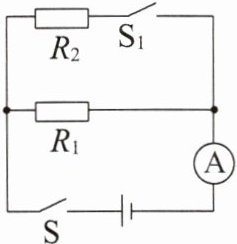
3
V,电阻$R_2$的阻值为25
Ω,电路的总功率为0.81
W。答案
闭合开关S的情况下,断开$S_1$时,电路是$R_1$的简单电路,电路中的电流为$I_1=0.15\ \mathrm{A}$,电源的电压为$U=I_1R_1=0.15\ \mathrm{A}×20\ \Omega=3\ \mathrm{V}$。再闭合$S_1$时,$R_1$、$R_2$并联,电流表测干路电流,通过$R_2$的电流为$I_2=I-I_1=0.27\ \mathrm{A}-0.15\ \mathrm{A}=0.12\ \mathrm{A}$,电阻$R_2$的阻值为$R_2=\frac{U}{I_2}=\frac{3\ \mathrm{V}}{0.12\ \mathrm{A}}=25\ \Omega$。电路的总功率为$P_{\mathrm{总}}=UI=3\ \mathrm{V}×0.27\ \mathrm{A}=0.81\ \mathrm{W}$。
