

 登录
二、阅读理解(每小题2分,满分30分)
A
标题:生活技能 体裁:应用文 难度:★★★ 建议用时:6分钟 正确率:/3
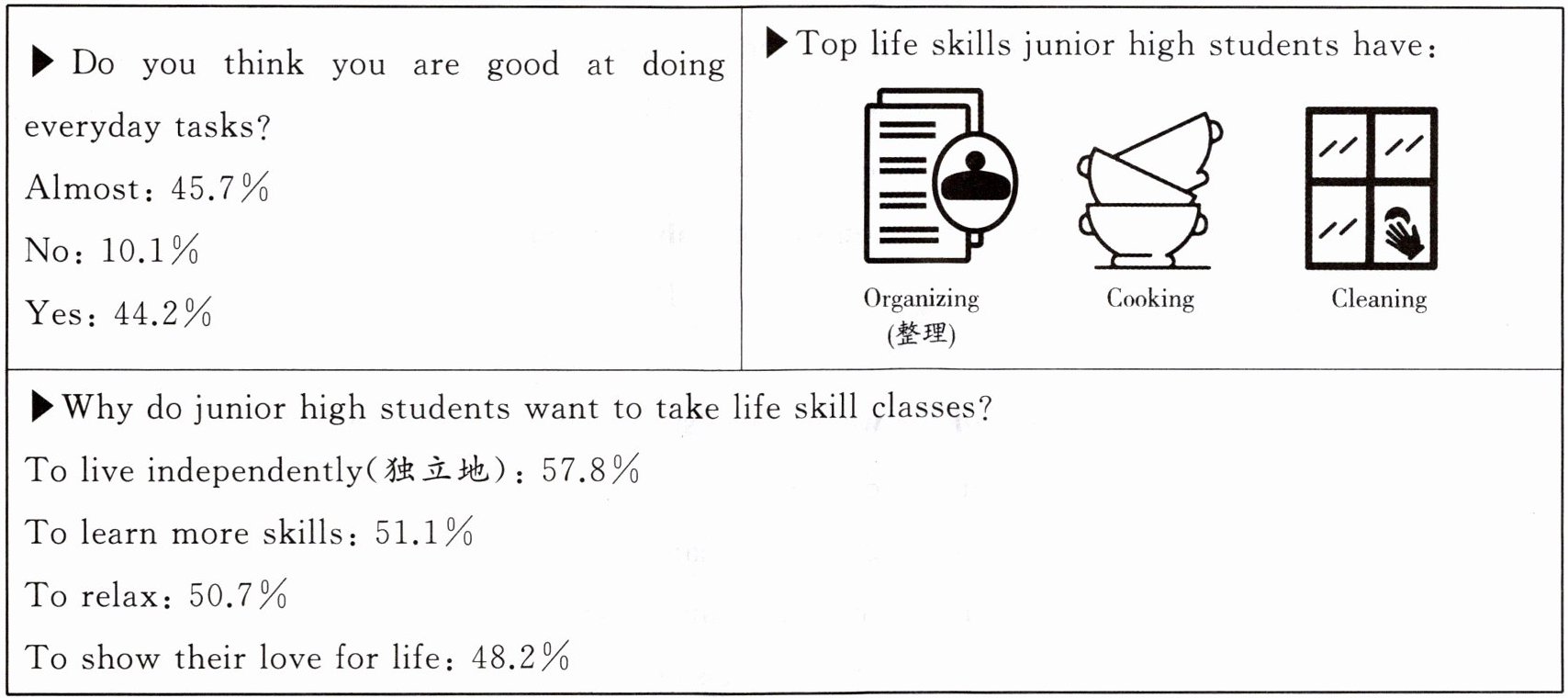
新语篇 调查问卷 Some junior high students want to take life skill classes. They want to do well in their everyday tasks, like planning time, doing housework, learning some social skills and learning to be safe. Here is a survey(调查) about it.
(
A. 10.1%.
B. 44.2%.
C. 45.7%.
D. 48.2%.
(
A. To relax.
B. To learn more skills.
C. To live independently.
D. To show their love for life.
(
A. Students are good at planning their time.
B. Learning to be safe is not junior high students' life skill.
C. Cooking is one of the top life skills of junior high students.
D. Some students don't take life skill classes because they want to relax.
A
标题:生活技能 体裁:应用文 难度:★★★ 建议用时:6分钟 正确率:/3
新语篇 调查问卷 Some junior high students want to take life skill classes. They want to do well in their everyday tasks, like planning time, doing housework, learning some social skills and learning to be safe. Here is a survey(调查) about it.
(
B
)16. How many students are surely good at doing everyday tasks according to the survey?A. 10.1%.
B. 44.2%.
C. 45.7%.
D. 48.2%.
(
C
)17. Which reason is for the most junior high students to take life skill classes?A. To relax.
B. To learn more skills.
C. To live independently.
D. To show their love for life.
(
C
)18. Which of the following is RIGHT according to the passage?A. Students are good at planning their time.
B. Learning to be safe is not junior high students' life skill.
C. Cooking is one of the top life skills of junior high students.
D. Some students don't take life skill classes because they want to relax.
答案
【语篇解读】本文是一篇应用文,主要围绕一些初中生想要参加生活技能课程展开,通过一项调查展示了学生对自身日常任务能力的自我评价、拥有的顶级生活技能以及想要参加生活技能课程的原因,呈现了初中生在生活技能方面的现状与需求。
16. B 细节理解题。根据"▶Do you think you are good at doing everyday tasks?"部分的内容"Yes: 44.2%"可知,认为自己肯定擅长做日常任务的学生占比为44.2%。故选B。
17. C 推理判断题。根据"▶Why do junior high students want to take life skill classes?"部分,对比各项原因的占比"To live independently: 57.8%; To learn more skills: 51.1%; To relax: 50.7%; To show their love for life: 48.2%",可以看出占比最高的是"To live independently",为57.8%。故选C。
18. C 判断正误题。如图2所示,Cooking is one of the top life skills of junior high students.。故选C。
B
标题:休息的重要性 体裁:记叙文 难度:★★★ 建议用时:7分钟 正确率: /4
Once again, my experiment(实验) failed to work. I felt hopeless. A few months earlier when I started the project, I was confident. I believed I could make it if I worked hard enough. So I spent over 10 hours in the lab every day. When the experiment failed(失败), I simply worked harder. Yet here I was, working harder than ever—but not getting anywhere. I didn't know what to do.
It was late in the evening. One other person was still in the lab, and he noticed my worried look. He came over and asked how I was doing. I told him about my problems. After we talked through the experiment, he said, “I think it's time to go home and get some sleep. Taking a break is also hard work, you know,” he said with a smile.
Those words opened my eyes. I no longer overworked myself in the lab. I felt less worried and my research started to progress(进展).
A few years later, my professor(教授) and I were talking about an age-old problem at a cafe. As he finished his coffee, he said, “We need to work smarter, not harder.” I felt kind of surprised. I never heard my professor say anything like this.
Our conversation that day helps me understand that exciting ideas seldom come from a mind under pressure(压力). My best ideas always come after I have allowed my mind to relax—whether that's cooking a nice dinner or going on long hikes with my brother.
(
A. About 5 hours.
B. More than 10 hours.
C. Less than 8 hours.
D. No more than 10 hours.
(
A. The writer's experiment failed to work.
B. The writer didn't get anything through hard work.
C. Exciting ideas never come from a mind under pressure.
D. The writer never heard of the professor say anything like this.
(
A. Eating some delicious food at home.
B. Going on a long hike with his brother.
C. Talking with his friends about his work.
D. Playing computer games on the internet.
(
A. Health is the most important thing.
B. We need to work harder, not smarter.
C. We should work harder when we fail.
D. Taking a break is also important for work.
标题:休息的重要性 体裁:记叙文 难度:★★★ 建议用时:7分钟 正确率: /4
Once again, my experiment(实验) failed to work. I felt hopeless. A few months earlier when I started the project, I was confident. I believed I could make it if I worked hard enough. So I spent over 10 hours in the lab every day. When the experiment failed(失败), I simply worked harder. Yet here I was, working harder than ever—but not getting anywhere. I didn't know what to do.
It was late in the evening. One other person was still in the lab, and he noticed my worried look. He came over and asked how I was doing. I told him about my problems. After we talked through the experiment, he said, “I think it's time to go home and get some sleep. Taking a break is also hard work, you know,” he said with a smile.
Those words opened my eyes. I no longer overworked myself in the lab. I felt less worried and my research started to progress(进展).
A few years later, my professor(教授) and I were talking about an age-old problem at a cafe. As he finished his coffee, he said, “We need to work smarter, not harder.” I felt kind of surprised. I never heard my professor say anything like this.
Our conversation that day helps me understand that exciting ideas seldom come from a mind under pressure(压力). My best ideas always come after I have allowed my mind to relax—whether that's cooking a nice dinner or going on long hikes with my brother.
(
B
)19. How many hours did the writer spend in the lab every day?A. About 5 hours.
B. More than 10 hours.
C. Less than 8 hours.
D. No more than 10 hours.
(
D
)20. 语言能力 理解能力 Why did the writer feel “surprised” in Paragraph 4?A. The writer's experiment failed to work.
B. The writer didn't get anything through hard work.
C. Exciting ideas never come from a mind under pressure.
D. The writer never heard of the professor say anything like this.
(
B
)21. Which of the following is a good way for the writer to relax his mind?A. Eating some delicious food at home.
B. Going on a long hike with his brother.
C. Talking with his friends about his work.
D. Playing computer games on the internet.
(
D
)22. 语言能力 归纳能力 What can we learn from the writer's story?A. Health is the most important thing.
B. We need to work harder, not smarter.
C. We should work harder when we fail.
D. Taking a break is also important for work.
答案
【语篇解读】本文是一篇记叙文。作者通过讲述自己的经历告诉我们:休息好也是勤奋工作的一部分。
19. B 细节理解题。根据"So I spent over 10 hours in the lab every day."可知,作者每天在实验室工作超过十个小时。故选B。
20. D 细节理解题。根据"I felt kind of surprised. I never heard my professor say anything like this."可知,作者从来没有听过教授说过这样的话,所以感到惊讶。故选D。
21. B 细节理解题。根据"My best ideas always come after I have allowed my mind to relax—whether that's cooking a nice dinner or going on long hikes with my brother."可知,作者通过做一顿美味的晚餐,或者和哥哥/弟弟去远足来放松大脑。故选B。
22. D 主旨大意题。通读全文可知,作者通过讲述自身经历告诉我们:休息好也是勤奋工作的一部分。故选D。
