

 登录
登录
四、阅读理解
(At the museum)
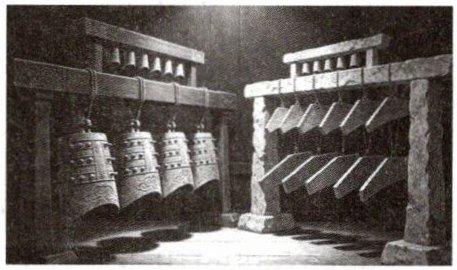
Emma: (Pointing) Wow! Look at those bronze(青铜的)bells, like a huge music tower. What are they called?
Wang Tao: They're bianzhong. And the ones next to them are bianqing, which are made of jade or stone. They're both ancient Chinese musical instruments.
Emma: I bet they don't sound the same. The bronze ones must make a loud and powerful sound, while bianqing sound softer and clearer, like tapping a glass.
Wang Tao: You're right. The video here shows how musicians play them together. Listen! Their sounds mix well, creating a sense of harmony(和谐)—exactly what we need for our concert!
Emma: (Tapping the screen) Let's try the virtual(虚拟的)sound game! The bronze bells go "BOOM", and bianqing ring "DING". Perfect for our school concert piece! If only we could play the real ones...
Wang Tao: (Smiling) You wish! Back then, only the upper class were allowed to use them. The bianzhong of Marquis Yi of Zeng(曾侯乙编钟)is a fine example. It was the symbol of power and status and it played an important role in state ceremonies and formal events.
Emma: It's amazing how these ancient bells hold so much history!
Wang Tao: (Nodding) Exactly! They showed the values of ancient Chinese culture, like harmony, order, and respect for tradition. Even today, they "speak" to us about how ancient Chinese viewed the world.
Emma: Maybe we can base our school concert piece on their sounds! A modern mix with ancient "BOOM" and "DING"!
Wang Tao: Great! We'll be the first to bring 2,000-year-old music to the school stage.
(
A. They were made in the shape of a tower.
B. They can be played with bianzhong.
C. They can be used for making wishes.
D. They were widely used in ancient China.
(
A. To tell a moving story.
B. To discover a hidden secret.
C. To prove its role as an upper-class symbol.
D. To introduce the long history of bianzhong.
(
① materials ② sounds ③ inventors ④ values ⑤ weights
A. ①②③ B. ①②④ C. ②④⑤ D. ②③④
(
A. To have a Chinese history class.
B. To play ancient musical instruments.
C. To collect ideas for their school concert.
D. To finish homework about ancient culture.
(
A. Tired. B. Nervous. C. Proud. D. Surprised.
(At the museum)
Emma: (Pointing) Wow! Look at those bronze(青铜的)bells, like a huge music tower. What are they called?
Wang Tao: They're bianzhong. And the ones next to them are bianqing, which are made of jade or stone. They're both ancient Chinese musical instruments.
Emma: I bet they don't sound the same. The bronze ones must make a loud and powerful sound, while bianqing sound softer and clearer, like tapping a glass.
Wang Tao: You're right. The video here shows how musicians play them together. Listen! Their sounds mix well, creating a sense of harmony(和谐)—exactly what we need for our concert!
Emma: (Tapping the screen) Let's try the virtual(虚拟的)sound game! The bronze bells go "BOOM", and bianqing ring "DING". Perfect for our school concert piece! If only we could play the real ones...
Wang Tao: (Smiling) You wish! Back then, only the upper class were allowed to use them. The bianzhong of Marquis Yi of Zeng(曾侯乙编钟)is a fine example. It was the symbol of power and status and it played an important role in state ceremonies and formal events.
Emma: It's amazing how these ancient bells hold so much history!
Wang Tao: (Nodding) Exactly! They showed the values of ancient Chinese culture, like harmony, order, and respect for tradition. Even today, they "speak" to us about how ancient Chinese viewed the world.
Emma: Maybe we can base our school concert piece on their sounds! A modern mix with ancient "BOOM" and "DING"!
Wang Tao: Great! We'll be the first to bring 2,000-year-old music to the school stage.
(
B
) 1. What do we know about bianqing?A. They were made in the shape of a tower.
B. They can be played with bianzhong.
C. They can be used for making wishes.
D. They were widely used in ancient China.
(
C
) 2. Why is the bianzhong of Marquis Yi of Zeng mentioned?A. To tell a moving story.
B. To discover a hidden secret.
C. To prove its role as an upper-class symbol.
D. To introduce the long history of bianzhong.
(
B
) 3. What does Wang Tao introduce about bianzhong and bianqing?① materials ② sounds ③ inventors ④ values ⑤ weights
A. ①②③ B. ①②④ C. ②④⑤ D. ②③④
(
C
) 4. Why do Emma and Wang Tao go to the museum?A. To have a Chinese history class.
B. To play ancient musical instruments.
C. To collect ideas for their school concert.
D. To finish homework about ancient culture.
(
C
) 5. How does Wang Tao feel during the visit?A. Tired. B. Nervous. C. Proud. D. Surprised.
答案
1. B 2. C 3. B 4. C 5. C
解析
【分析】本题为英语阅读理解题,围绕博物馆中中国古代乐器编钟、编磬的对话展开,解题思路是先通读对话理解大意,再针对每个小题的问题,回原文定位相关语句,逐一分析选项,排除与原文不符的错误选项,确定正确答案。
【解析】
1. 细节理解题:根据原文“the video here shows how musicians play them together”可知,编钟和编磬可一起演奏,故B正确;A选项编钟像音乐塔而非编磬,C选项未提及编磬用于许愿,D选项原文仅说古代上层可使用,并非广泛使用,排除A、C、D,选B。
2. 推理判断题:根据原文“Back then, only the upper class were allowed to use them. The bianzhong of Marquis Yi of Zeng is a fine example.”可知,曾侯乙编钟是上层阶级使用的例证,证明其作为上层阶级象征的作用,故选C。
3. 细节理解题:原文提到编钟材料是青铜、编磬是玉/石(①);编钟声音洪亮、编磬柔和(②);古代文化价值观如和谐等(④),未提及发明者和重量,故①②④正确,选B。
4. 推理判断题:根据Emma所说“perfect for our school concert piece”可知,两人去博物馆是为学校音乐会寻找灵感,故选C。
5. 推理判断题:Wang Tao提到编钟的历史,还说“we'll be the first to bring 2,000-year-old music to the school stage”,体现出他的自豪之情,故选C。
【答案】1.B 2.C 3.B 4.C 5.C
【知识点】英语阅读理解、细节定位、推理判断
【点评】本题以博物馆对话为载体,考查学生对英语阅读材料的细节查找与推理能力,话题贴近学生生活(学校音乐会),融入中国传统文化,兼具知识性与趣味性,难度适中。
【难度系数】0.6
【解析】
1. 细节理解题:根据原文“the video here shows how musicians play them together”可知,编钟和编磬可一起演奏,故B正确;A选项编钟像音乐塔而非编磬,C选项未提及编磬用于许愿,D选项原文仅说古代上层可使用,并非广泛使用,排除A、C、D,选B。
2. 推理判断题:根据原文“Back then, only the upper class were allowed to use them. The bianzhong of Marquis Yi of Zeng is a fine example.”可知,曾侯乙编钟是上层阶级使用的例证,证明其作为上层阶级象征的作用,故选C。
3. 细节理解题:原文提到编钟材料是青铜、编磬是玉/石(①);编钟声音洪亮、编磬柔和(②);古代文化价值观如和谐等(④),未提及发明者和重量,故①②④正确,选B。
4. 推理判断题:根据Emma所说“perfect for our school concert piece”可知,两人去博物馆是为学校音乐会寻找灵感,故选C。
5. 推理判断题:Wang Tao提到编钟的历史,还说“we'll be the first to bring 2,000-year-old music to the school stage”,体现出他的自豪之情,故选C。
【答案】1.B 2.C 3.B 4.C 5.C
【知识点】英语阅读理解、细节定位、推理判断
【点评】本题以博物馆对话为载体,考查学生对英语阅读材料的细节查找与推理能力,话题贴近学生生活(学校音乐会),融入中国传统文化,兼具知识性与趣味性,难度适中。
【难度系数】0.6
