

 登录
Ⅰ. Listen and choose the words you hear.
(
(
(
(
(
A
)1. A. /breɪk/ B. /blæk/ C. /'brʌðə/(
B
)2. A. /flʌd/ B. /frʌnt/ C. /fruːt/(
A
)3. A. /frɒg/ B. /flæt/ C. /flaɪt/(
B
)4. A. /breɪv/ B. /brɪŋ/ C. /bluː/答案
1. A
2. B
3. A
4. B
2. B
3. A
4. B
Ⅱ. Listen and choose the best answers.
(
A. In 2004.
B. In 2008.
C. In 2010.
(
A. Historical photos.
B. Notebook records.
C. Emergency cars.
(
A. The story of the little boy.
B. How this museum was built.
C. How to keep safe in earthquakes.
(
B
)1. When did the terrible earthquake hit Wenchuan?A. In 2004.
B. In 2008.
C. In 2010.
(
A
)2. What can visitors see in the museum?A. Historical photos.
B. Notebook records.
C. Emergency cars.
(
A
)3. What will the speaker talk about next?A. The story of the little boy.
B. How this museum was built.
C. How to keep safe in earthquakes.
答案
1. B
2. A
3. A
2. A
3. A
Ⅲ. Complete the sentences with proper words according to the Chinese given.
1. You can watch short
2. The
3. Scientists are trying to find out the
4. He gave us a clear
5. Many volunteers
6. The
7. The museum opens from 9 am to 5 pm on
1. You can watch short
videos
(视频)to learn more about the museum.2. The
railway
(铁路)connects many small towns in Sichuan.3. Scientists are trying to find out the
cause
(起因)of the natural disaster.4. He gave us a clear
introduction
(介绍)to the history of the museum.5. Many volunteers
searched
(搜寻)for useful things after the earthquake.6. The
terrible
(糟糕)weather stopped people from visiting the museum.7. The museum opens from 9 am to 5 pm on
weekdays
(工作日).答案
1. videos
2. railway
3. cause
4. introduction
5. searched
6. terrible
7. weekdays
2. railway
3. cause
4. introduction
5. searched
6. terrible
7. weekdays
解析
【分析】
本题要求根据中文提示填写合适的英语单词,需结合句子语境、词性、单复数、时态等规则确定单词的正确形式。逐个分析每个句子的需求:1. 需填“视频”的复数形式(表类别);2. 需填“铁路”的单数名词(作主语);3. 需填“起因”的单数名词;4. 需填“介绍”的单数名词(被a修饰);5. 需填“搜寻”的过去式(由after the earthquake判断时态);6. 需填形容词修饰“weather”;7. 需填“工作日”的复数名词(固定搭配on weekdays)。
【解析】
1. 句意:你可以看短视频来更多了解博物馆。“视频”对应单词video,此处用复数表类别,故填videos;
2. 句意:这条铁路连接四川的许多小镇。“铁路”对应单词railway,谓语connects为第三人称单数,主语用单数,故填railway;
3. 句意:科学家正试图找出这场自然灾害的起因。“起因”对应单词cause,the后用单数,故填cause;
4. 句意:他给我们清晰介绍了博物馆的历史。“介绍”对应单词introduction,a后用单数,故填introduction;
5. 句意:地震后许多志愿者搜寻有用的东西。由after the earthquake可知为过去时态,“搜寻”对应单词search,过去式为searched,故填searched;
6. 句意:糟糕的天气阻止人们参观博物馆。“糟糕”对应形容词terrible,修饰名词weather,故填terrible;
7. 句意:博物馆工作日的开放时间是上午9点到下午5点。“工作日”对应单词weekdays,固定搭配on weekdays,故填weekdays。
【答案】
1. videos
2. railway
3. cause
4. introduction
5. searched
6. terrible
7. weekdays
【知识点】
英语词汇运用、名词单复数、动词时态
【点评】
本题考查根据中文提示填写英语单词,涉及基础词汇的拼写及语境中的形式变化,难度适中,适合巩固基础词汇的运用。
【难度系数】
0.6
Ⅳ. Read and answer the questions.
In China, small earthquakes and rainstorms may happen occasionally, so practical disaster warning tools are very important to keep people safe. These tools are simple to use, mostly free of charge, and have a simple appearance, but each has small drawbacks(缺点) that we need to pay attention to.
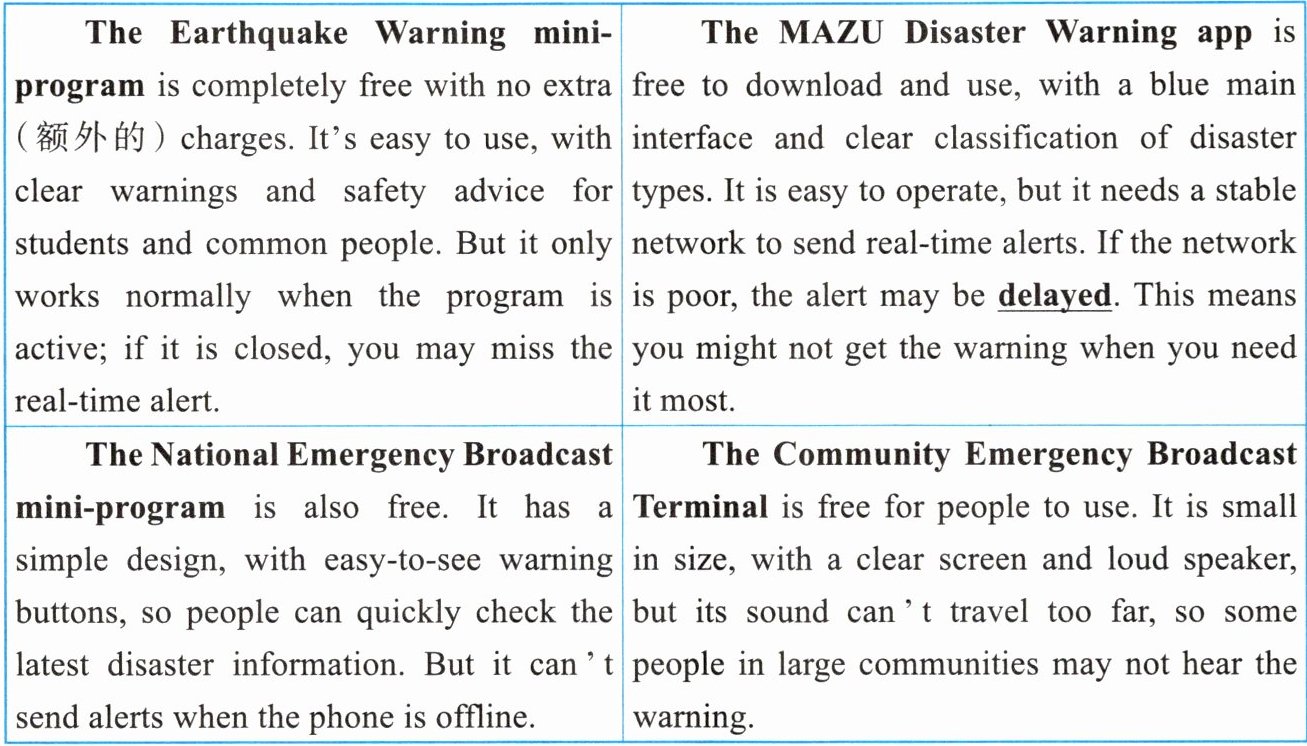
()1. What is the drawback for the Earthquake Warning mini-program?
A. It asks people to pay.
B. It gives warnings with no advice.
C. It only works when the program is running.
D. Its warnings are not clear for many students.
()2. What can we infer from the passage?
A. People need to pay to use some of the tools.
B. All the tools are difficult to use for students.
C. The tools may help people stay safe in disasters.
D. The Community Emergency Broadcast Terminal works well in all ways.
()3. What does the underlined word “delayed” in Paragraph 2 probably mean?
A. Sent early. B. Sent late. C. Sent quickly. D. Sent clearly.
()4. What’s the main idea of the passage?
A. How to deal with natural disasters.
B. How to use disaster warning tools.
C. Why natural disasters happen in China.
D. Four useful disaster warning tools in China.
5. Imagine you are in a school dormitory(寝室) when an earthquake happens. Which disaster warning tool would be the most helpful for you? Why?
In China, small earthquakes and rainstorms may happen occasionally, so practical disaster warning tools are very important to keep people safe. These tools are simple to use, mostly free of charge, and have a simple appearance, but each has small drawbacks(缺点) that we need to pay attention to.
()1. What is the drawback for the Earthquake Warning mini-program?
A. It asks people to pay.
B. It gives warnings with no advice.
C. It only works when the program is running.
D. Its warnings are not clear for many students.
()2. What can we infer from the passage?
A. People need to pay to use some of the tools.
B. All the tools are difficult to use for students.
C. The tools may help people stay safe in disasters.
D. The Community Emergency Broadcast Terminal works well in all ways.
()3. What does the underlined word “delayed” in Paragraph 2 probably mean?
A. Sent early. B. Sent late. C. Sent quickly. D. Sent clearly.
()4. What’s the main idea of the passage?
A. How to deal with natural disasters.
B. How to use disaster warning tools.
C. Why natural disasters happen in China.
D. Four useful disaster warning tools in China.
5. Imagine you are in a school dormitory(寝室) when an earthquake happens. Which disaster warning tool would be the most helpful for you? Why?
答案
1. C
2. C
3. B
4. D
5. One possible version: The Community Emergency Broadcast Terminal would be the best choice because it has a loud speaker, so everyone in the dormitory can hear the warning even if they don't have their phones.
2. C
3. B
4. D
5. One possible version: The Community Emergency Broadcast Terminal would be the best choice because it has a loud speaker, so everyone in the dormitory can hear the warning even if they don't have their phones.
解析
【分析】
首先通读全文,明确文章介绍了中国的四种灾害预警工具的特点与优缺点。解题时,针对不同题型采用对应方法:细节题需回到原文定位对应信息,逐一排除错误选项;推理题结合原文合理推断,避免主观臆断;词义猜测题结合上下文语境推测词义;主旨题归纳各段核心内容提炼主旨;开放性问题结合题干场景匹配工具特点作答。
【解析】
1. 细节理解题:根据原文第一段最后一句“But it only works normally when the program is active; if it is closed, you may miss the real-time alert.”可知,地震预警小程序仅在运行时正常工作,关闭时会错过警报,对应选项C。A与原文“完全免费”不符;B与原文“有清晰的警告和安全建议”不符;D与原文“清晰的警告”不符,故选C。
2. 推理判断题:根据原文开头“实用的灾害预警工具对保障人们安全非常重要”可推断,这些工具能帮助人们在灾害中保障安全,对应选项C。A与原文“大多免费”不符;B与原文“使用简单”不符;D与原文“声音传不远”不符,故选C。
3. 词义猜测题:根据前文“需要稳定网络发送实时警报”及后文“最需要时可能收不到警报”可知,网络差时警报会延迟发送,“delayed”意为“延迟的”,对应选项B。A“提前发送”、C“快速发送”、D“清晰发送”均不符合语境,故选B。
4. 主旨大意题:全文围绕四种中国的灾害预警工具展开介绍,对应选项D。A“如何应对自然灾害”、B“如何使用灾害预警工具”、C“中国自然灾害发生的原因”均不是文章主旨,故选D。
5. 开放性问题:结合题干“学校寝室”场景,社区应急广播终端有大喇叭,无需手机,寝室里的人都能听到警报,因此选择该工具,理由合理即可。
【答案】
1. C 2. C 3. B 4. D 5. One possible version: The Community Emergency Broadcast Terminal would be the best choice because it has a loud speaker, so everyone in the dormitory can hear the warning even if they don't have their phones.
【知识点】
英语阅读理解、英文书面表达
【点评】
本题为信息类阅读理解,考查学生快速定位信息、逻辑推理、词义猜测及主旨归纳的能力,开放性问题结合实际场景,注重知识应用,整体难度适中。
【难度系数】
0.6
