

 登录
登录
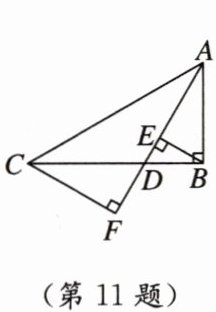
11. 如图,已知在$Rt△ ABC$中,$∠ ABC=90°$,点D沿BC自B向C运动(点D与点B,C不重合),作$BE⊥ AD$于E,$CF⊥ AD$,交AD的延长线于F,则随着点D的运动,$BE+CF$的值 (
A.不变
B.逐渐增大
C.逐渐减小
D.先变大,再变小
 (第11题)
C
)A.不变
B.逐渐增大
C.逐渐减小
D.先变大,再变小
(第11题)答案
11.C 【点拨】$\because BE⊥ AD$ 于 $E$,$CF⊥ AD$ 于 $F$,$\therefore CF// BE$,
$\therefore ∠ DCF=∠ DBE$. 设 $∠ DCF=∠ DBE=α,\therefore CF=DC· \cosα,BE=DB· \cosα,\therefore BE+CF=(DB+DC)\cosα=BC· \cosα.\because ∠ ABC=90°,\therefore 0°<α<90°$. 又 $\because$ 点 $D$ 自 $B$ 向 $C$ 运动时,$α$ 是逐渐增大的,$\therefore \cosα$ 的值是逐渐减小的,$\therefore BE+CF=BC· \cosα$ 的值是逐渐减小的. 故选 C.
$\therefore ∠ DCF=∠ DBE$. 设 $∠ DCF=∠ DBE=α,\therefore CF=DC· \cosα,BE=DB· \cosα,\therefore BE+CF=(DB+DC)\cosα=BC· \cosα.\because ∠ ABC=90°,\therefore 0°<α<90°$. 又 $\because$ 点 $D$ 自 $B$ 向 $C$ 运动时,$α$ 是逐渐增大的,$\therefore \cosα$ 的值是逐渐减小的,$\therefore BE+CF=BC· \cosα$ 的值是逐渐减小的. 故选 C.
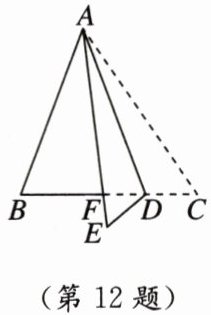
12. 2025·常州 新考法·对称法 如图,在$△ ABC$中,$\tan C=\dfrac{4}{3}$,D是边BC上一点,将$△ ACD$沿AD翻折得到$△ AED$,使线段AE,BC相交于点F,若$CF=5$,$EF=2$,则$AC=$
$\frac{21}{2}$
。答案
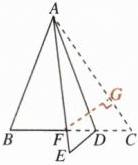
12.$\frac{21}{2}$ 【点拨】如图,过点 $F$ 作 $FG⊥ AC$ 于点 $G$,则 $\tan C=\frac{FG}{CG}=\frac{4}{3}$,设 $FG=4x$,则 $CG=3x,\therefore CF=\sqrt{CG^2+FG^2}=5x=5$,解得 $x=1$, 则 $FG=4,CG=3$, 由翻折得 $AC=AE$,设 $AC=AE=y$, 则 $AG=AC-CG=y-3$,$AF=AE-EF=y-2$, 在$Rt△ AFG$ 中,$AF^2=AG^2+FG^2$, 即 $(y-2)^2=(y-3)^2+4^2$, 解得 $y=\frac{21}{2}$, 即 $AC=\frac{21}{2}$.
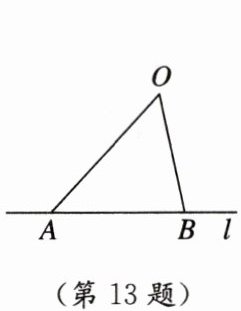
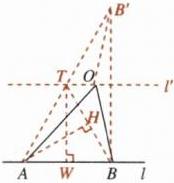
13. 如图,已知点O是直线l外一点,点O到直线l的距离是4,点A,B是直线l上的两个动点,且$\cos∠ AOB=\frac{3}{5}$,则线段AB的长的最小值为
4
.答案
13.4 【点拨】如图,过点 $O$ 作直线 $l'//$ 直线 $l$, 则直线 $l$ 与直线 $l'$ 之间的距离为 4, 作点 $B$ 关于直线 $l'$ 的对称点 $B'$, 连接 $OB',BB',AB',AB'$ 交直线 $l'$ 于点 $T$, 连接 $BT$. 过点 $A$ 作 $AH⊥ BT$ 于 $H$, 过点 $T$ 作 $TW⊥ AB$ 于 $W$. 由作图易得 $BB'⊥ l'$, $BB'⊥ l$. 在 $Rt△ ABB'$ 中,$AB=\sqrt{AB'^2-BB'^2}=\sqrt{AB'^2-64}$,$\therefore AB'$ 的值最小时, $AB$ 的值最小. $\because OA+OB=OA+OB'≥ AB'$,$\therefore$ 当 $A,O,B'$ 共线时, $AB'$ 的值最小, 此时 $AB$ 的值最小. $\because$ 直线 $l'$ 垂直平分线段 $BB'$,$\therefore TB=TB',\therefore ∠ TBB'=∠ TB'B$. $\because ∠ TBA+∠ TBB'=90°$, $∠ TAB+∠ TB'B=90°$,$\therefore ∠ TAB=∠ TBA,\therefore TA=TB$. $\because$ 此时 $\cos∠ AOB=\cos∠ ATB=\frac{3}{5}$,
$\therefore \frac{TH}{TA}=\frac{3}{5}$,$\therefore$ 可以设 $TH=3k$, $AT=TB=5k$,$\therefore BH=TB-TH=2k$,
$\therefore AH=\sqrt{AT^2-TH^2}=4k$,$\therefore AB=\sqrt{AH^2+BH^2}=\sqrt{(4k)^2+(2k)^2}=2\sqrt{5}k$.$\because S_{△ TAB}=\frac{1}{2}· AB· TW=\frac{1}{2}· TB· AH$,$\therefore \frac{1}{2}×2\sqrt{5}k×4=\frac{1}{2}×5k×4k$, 解得 $k=\frac{2\sqrt{5}}{5}$,$\therefore$ 线段 $AB$ 的长的最小值为 $2\sqrt{5}×\frac{2\sqrt{5}}{5}=4$, 故答案为 4.
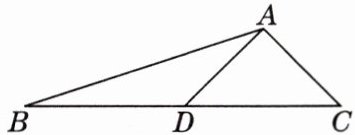
14. 新考法 化斜为直法 如图,AD是$△ ABC$的中线,$\tan B=\dfrac{1}{3}$,$\cos C=\dfrac{\sqrt{2}}{2}$,$AC=\sqrt{2}$.求:
(1)$BC$的长;
(2)$\sin ∠ ADC$的值.
(1)$BC$的长;
(2)$\sin ∠ ADC$的值.
答案
14.【解】(1)如图,过点 $A$ 作 $AE⊥ BC$ 于点 $E$.
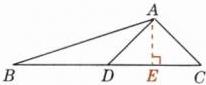
$\because \cos C=\frac{\sqrt{2}}{2},\therefore ∠ C=45°$.
在Rt△ACE中,$CE=AC· \cos C=\sqrt{2}×\frac{\sqrt{2}}{2}=1$,$AE=AC· \sin C=\sqrt{2}×\frac{\sqrt{2}}{2}=1$.
在Rt△ABE中,$\because \tan B=\frac{1}{3}$,即$\frac{AE}{BE}=\frac{1}{3}$,
$\therefore BE=3AE=3.\therefore BC=BE+CE=4$.
(2)$\because AD$ 是$△ ABC$ 的中线,$\therefore CD=\frac{1}{2}BC=2$.
$\therefore DE=CD-CE=1$.
$\because AE⊥ BC,AE=1,\therefore ∠ ADC=45°$.
$\therefore \sin ∠ ADC=\frac{\sqrt{2}}{2}$.
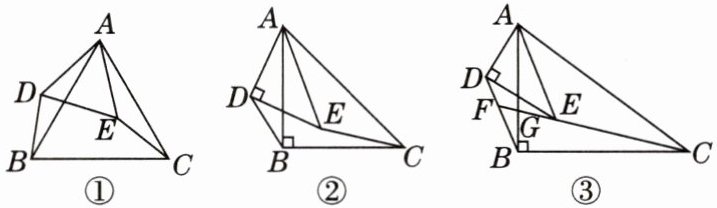
15. 新考法 类比探究法 (1)【问题呈现】如图①,$△ ABC$和$△ ADE$都是等边三角形,连接$BD$,$CE$.求证:$BD=CE$;
(2)【类比探究】如图②,$△ ABC$和$△ ADE$都是等腰直角三角形,$∠ ABC=∠ ADE=90°$.连接$BD$,$CE$.请直接写出$\frac{BD}{CE}$的值;
(3)【拓展提升】如图③,$△ ABC$和$△ ADE$都是直角三角形,$∠ ABC=∠ ADE=90°$,且$\frac{AB}{BC}=\frac{AD}{DE}=\frac{3}{4}$.连接$BD$,$CE$.
①求$\frac{BD}{CE}$的值;
②延长$CE$交$BD$于点$F$,交$AB$于点$G$.求$\sin∠ BFC$的值.
(2)【类比探究】如图②,$△ ABC$和$△ ADE$都是等腰直角三角形,$∠ ABC=∠ ADE=90°$.连接$BD$,$CE$.请直接写出$\frac{BD}{CE}$的值;
(3)【拓展提升】如图③,$△ ABC$和$△ ADE$都是直角三角形,$∠ ABC=∠ ADE=90°$,且$\frac{AB}{BC}=\frac{AD}{DE}=\frac{3}{4}$.连接$BD$,$CE$.
①求$\frac{BD}{CE}$的值;
②延长$CE$交$BD$于点$F$,交$AB$于点$G$.求$\sin∠ BFC$的值.
答案
15.(1)【证明】$\because △ ABC$ 和 $△ ADE$ 都是等边三角形,
$\therefore AD=AE,AB=AC,∠ DAE=∠ BAC=60°$.
$\therefore ∠ DAE-∠ BAE=∠ BAC-∠ BAE$,
即$∠ BAD=∠ CAE$.
$\therefore △ BAD≌ △ CAE(\mathrm{SAS}).\therefore BD=CE$.
(2)【解】$\frac{BD}{CE}=\frac{\sqrt{2}}{2}$. 【点拨】$\because △ ABC$ 和 $△ ADE$ 都是等腰直角三角形,且 $∠ ABC=∠ ADE=90°,\therefore \frac{AD}{AE}=\frac{AB}{AC}=\frac{\sqrt{2}}{2}$,$∠ DAE=∠ BAC=45°,\therefore ∠ DAE-∠ BAE=∠ BAC-∠ BAE$,即$∠ BAD=∠ CAE,\therefore △ BAD∽ △ CAE,\therefore \frac{BD}{CE}=\frac{AB}{AC}=\frac{\sqrt{2}}{2}$.
(3)【解】① $\because \frac{AB}{BC}=\frac{AD}{DE}=\frac{3}{4},\therefore \frac{AB}{AD}=\frac{BC}{DE}$. 又 $\because ∠ ABC=∠ ADE=90°,\therefore △ ABC∽ △ ADE,\therefore ∠ BAC=∠ DAE$,
$\therefore$ 易得 $∠ BAD=∠ CAE$. 易证得 $\frac{AB}{AC}=\frac{AD}{AE}=\frac{3}{5}$,
$\therefore △ BAD∽ △ CAE,\therefore \frac{BD}{CE}=\frac{AD}{AE}=\frac{3}{5}$.
② 由①知$△ BAD∽ △ CAE,\therefore ∠ ABD=∠ ACE$.
又 $\because ∠ BGF=∠ AGC,\therefore ∠ BFC=∠ BAC$.
易证得 $\frac{BC}{AC}=\frac{4}{5}$,
$\therefore \sin∠ BFC=\sin∠ BAC=\frac{BC}{AC}=\frac{4}{5}$.
$\therefore AD=AE,AB=AC,∠ DAE=∠ BAC=60°$.
$\therefore ∠ DAE-∠ BAE=∠ BAC-∠ BAE$,
即$∠ BAD=∠ CAE$.
$\therefore △ BAD≌ △ CAE(\mathrm{SAS}).\therefore BD=CE$.
(2)【解】$\frac{BD}{CE}=\frac{\sqrt{2}}{2}$. 【点拨】$\because △ ABC$ 和 $△ ADE$ 都是等腰直角三角形,且 $∠ ABC=∠ ADE=90°,\therefore \frac{AD}{AE}=\frac{AB}{AC}=\frac{\sqrt{2}}{2}$,$∠ DAE=∠ BAC=45°,\therefore ∠ DAE-∠ BAE=∠ BAC-∠ BAE$,即$∠ BAD=∠ CAE,\therefore △ BAD∽ △ CAE,\therefore \frac{BD}{CE}=\frac{AB}{AC}=\frac{\sqrt{2}}{2}$.
(3)【解】① $\because \frac{AB}{BC}=\frac{AD}{DE}=\frac{3}{4},\therefore \frac{AB}{AD}=\frac{BC}{DE}$. 又 $\because ∠ ABC=∠ ADE=90°,\therefore △ ABC∽ △ ADE,\therefore ∠ BAC=∠ DAE$,
$\therefore$ 易得 $∠ BAD=∠ CAE$. 易证得 $\frac{AB}{AC}=\frac{AD}{AE}=\frac{3}{5}$,
$\therefore △ BAD∽ △ CAE,\therefore \frac{BD}{CE}=\frac{AD}{AE}=\frac{3}{5}$.
② 由①知$△ BAD∽ △ CAE,\therefore ∠ ABD=∠ ACE$.
又 $\because ∠ BGF=∠ AGC,\therefore ∠ BFC=∠ BAC$.
易证得 $\frac{BC}{AC}=\frac{4}{5}$,
$\therefore \sin∠ BFC=\sin∠ BAC=\frac{BC}{AC}=\frac{4}{5}$.
