

 登录
登录
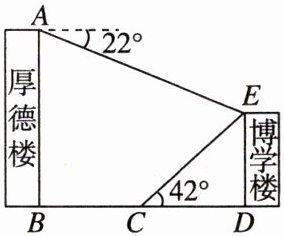
5. [2025青岛] 学校综合实践小组测量博学楼的高度.如图,点A,B,C,D,E在同一平面内,点B,C,D在同一水平线上,一组成员从19 m高的厚德楼顶部A测得博学楼的顶部E的俯角为$22°$,另一组成员沿BD方向从厚德楼底部B点向博学楼走15 m到达C点,在C点测得博学楼顶部E的仰角为$42°$,求博学楼DE的高度.(参考数据:$\sin22°\approx\frac{3}{8},\cos22°\approx\frac{15}{16},\tan22°\approx\frac{2}{5},\sin42°\approx\frac{27}{40},\cos42°\approx\frac{3}{4},\tan42°\approx\frac{9}{10}$)
答案
如图
 ,过点 $E$ 作 $EF⊥ AB$ 于点 $F$,由题意得,$∠ 1=∠ 2=22°$,$∠ 3=42°$,$BC=15\ \mathrm{m}$,$AB=19\ \mathrm{m}$,
$\because ∠ CDE = ∠ EFB = ∠ ABD = 90°$,
$\therefore$ 四边形 $FBDE$ 是矩形,$\therefore FB=DE$,$EF=BD$,
在 $\mathrm{Rt}△AFE$ 中,$\because \tan∠ 2=\dfrac{AF}{EF}$,
$\therefore \dfrac{AF}{EF}\approx \dfrac{2}{5}$,
$\therefore$ 设 $AF\approx 2x\ \mathrm{m}$,$EF\approx 5x\ \mathrm{m}$,则 $CD=BD-BC=EF-BC\approx (5x-15)\mathrm{m}$,$ED=BF=AB-AF\approx (19-2x)\mathrm{m}$,
在 $\mathrm{Rt}△ECD$ 中,$\because \tan∠ 3=\dfrac{ED}{CD}$,
$\therefore \dfrac{9}{10}\approx \dfrac{19-2x}{5x-15}$,解得 $x\approx 5$,$\therefore DE\approx 19-2× 5=9(\mathrm{m})$.
答:博学楼 $DE$ 的高度约为 $9\ \mathrm{m}$.
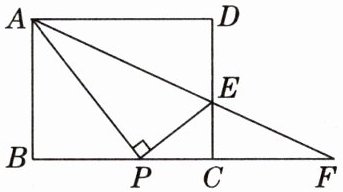
6. 如图,在矩形ABCD中,AB=4,AD=5,P是射线BC上的一个动点,过点P作PE⊥AP,交射线DC于点E,射线AE交射线BC于点F,设BP=a.
(1)当点P在线段BC上时(点P与点B,C都不重合),试用含a的代数式表示CE的长;
(2)当a=3时,连接DF,试判断四边形APFD的形状,并说明理由;
(3)当$\tan∠ PAE=\frac{1}{2}$时,求a的值.
(1)当点P在线段BC上时(点P与点B,C都不重合),试用含a的代数式表示CE的长;
(2)当a=3时,连接DF,试判断四边形APFD的形状,并说明理由;
(3)当$\tan∠ PAE=\frac{1}{2}$时,求a的值.
答案
(1) $\because$ 四边形 $ABCD$ 是矩形,
$\therefore AB=CD=4$,$BC=AD=5$,$∠ B = ∠ BCD = 90°$.
$\because BP=a$,$\therefore PC=5-a$. $\because AP⊥ PE$,$\therefore ∠ APE=90°$.
$\therefore ∠ APB + ∠ CPE = 90°$.
$\because ∠ APB + ∠ BAP = 90°$,
$\therefore ∠ CPE = ∠ BAP. \therefore △ ABP ∽ △ PCE$.
$\therefore \dfrac{BP}{CE} = \dfrac{AB}{PC}. \therefore CE = \dfrac{BP· PC}{AB} = \dfrac{a· (5-a)}{4} = \dfrac{-a^2+5a}{4}$.
(2) 四边形 $APFD$ 是菱形. 理由如下:
当 $a=3$ 时,$BP=3$,$PC=2$,$CE=\dfrac{-3^2+5× 3}{4}=\dfrac{3}{2}$,
$\therefore DE=DC-CE=\dfrac{5}{2}$.
$\because$ 四边形 $ABCD$ 是矩形,$\therefore AD// BF$.
$\therefore ∠ EAD = ∠ EFC$,$∠ ADE = ∠ ECF$.
$\therefore △ AED ∽ △ FEC. \therefore \dfrac{AD}{CF} = \dfrac{DE}{CE}. \therefore CF=3$.
$\therefore PF=PC+CF=5. \therefore PF=AD$.
$\therefore$ 四边形 $APFD$ 是平行四边形.
在 $\mathrm{Rt}△APB$ 中,$AB=4$,$BP=3$,$∠ B=90°$,
$\therefore AP=5=PF. \therefore$ 四边形 $APFD$ 是菱形.
(3) 根据 $\tan ∠ PAE = \dfrac{1}{2}$,得 $\dfrac{AP}{PE}=2$.
易得 $△ ABP ∽ △ PCE$,$\therefore \dfrac{AB}{PC} = \dfrac{AP}{PE}=2$.
$\because PC=5-a$ 或 $PC=a-5$,
$\therefore \dfrac{4}{5-a}=2$ 或 $\dfrac{4}{a-5}=2$,解得 $a=3$ 或 $a=7$.
$\therefore AB=CD=4$,$BC=AD=5$,$∠ B = ∠ BCD = 90°$.
$\because BP=a$,$\therefore PC=5-a$. $\because AP⊥ PE$,$\therefore ∠ APE=90°$.
$\therefore ∠ APB + ∠ CPE = 90°$.
$\because ∠ APB + ∠ BAP = 90°$,
$\therefore ∠ CPE = ∠ BAP. \therefore △ ABP ∽ △ PCE$.
$\therefore \dfrac{BP}{CE} = \dfrac{AB}{PC}. \therefore CE = \dfrac{BP· PC}{AB} = \dfrac{a· (5-a)}{4} = \dfrac{-a^2+5a}{4}$.
(2) 四边形 $APFD$ 是菱形. 理由如下:
当 $a=3$ 时,$BP=3$,$PC=2$,$CE=\dfrac{-3^2+5× 3}{4}=\dfrac{3}{2}$,
$\therefore DE=DC-CE=\dfrac{5}{2}$.
$\because$ 四边形 $ABCD$ 是矩形,$\therefore AD// BF$.
$\therefore ∠ EAD = ∠ EFC$,$∠ ADE = ∠ ECF$.
$\therefore △ AED ∽ △ FEC. \therefore \dfrac{AD}{CF} = \dfrac{DE}{CE}. \therefore CF=3$.
$\therefore PF=PC+CF=5. \therefore PF=AD$.
$\therefore$ 四边形 $APFD$ 是平行四边形.
在 $\mathrm{Rt}△APB$ 中,$AB=4$,$BP=3$,$∠ B=90°$,
$\therefore AP=5=PF. \therefore$ 四边形 $APFD$ 是菱形.
(3) 根据 $\tan ∠ PAE = \dfrac{1}{2}$,得 $\dfrac{AP}{PE}=2$.
易得 $△ ABP ∽ △ PCE$,$\therefore \dfrac{AB}{PC} = \dfrac{AP}{PE}=2$.
$\because PC=5-a$ 或 $PC=a-5$,
$\therefore \dfrac{4}{5-a}=2$ 或 $\dfrac{4}{a-5}=2$,解得 $a=3$ 或 $a=7$.
