

 登录
B)看图,并根据上下文提示,补全下列对话,每空填一词。
Simon and Daniel are going to study at No. 1 Middle School this September. Today they go to visit this school.
Simon: Do you know the way to our middle school, Daniel? 7.
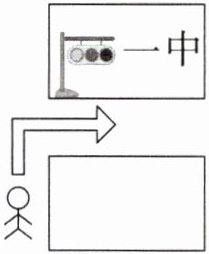
Daniel: I don't know. Let's 8.
Simon: OK. Excuse me, sir, can you 9.
Man: Sure. Walk on and then turn 10.
Simon: Yes. Thank you very much. Let's go, Daniel.
Daniel: Here we are. Look! The students are 12.
Simon: Yes. Football is popular in this school.
Daniel: Good. I like football. It's my 13.
Guard: Hello, boys! 14.
Simon: Hi, sir! We're going to be new students at this school soon. Can we go inside and have a look?
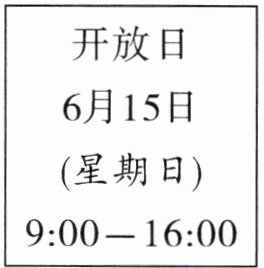
Guard: 15.
Simon: OK. Thank you. Let's come tomorrow, Daniel.
Daniel: All right.
Simon and Daniel are going to study at No. 1 Middle School this September. Today they go to visit this school.
Simon: Do you know the way to our middle school, Daniel? 7.
How
do we get there?Daniel: I don't know. Let's 8.
ask
someone.Simon: OK. Excuse me, sir, can you 9.
tell
us the way to No. 1 Middle School?Man: Sure. Walk on and then turn 10.
right
at the first corner. The school is on your 11. left
. See?Simon: Yes. Thank you very much. Let's go, Daniel.
Daniel: Here we are. Look! The students are 12.
playing
football there.Simon: Yes. Football is popular in this school.
Daniel: Good. I like football. It's my 13.
favourite
.Guard: Hello, boys! 14.
Why
are you standing here?Simon: Hi, sir! We're going to be new students at this school soon. Can we go inside and have a look?
Guard: 15.
Welcome
to our school! But I can't let you in now. Tomorrow is 16. Sunday
. It's our Open Day. Come 17. between
9 am and 4 pm.Simon: OK. Thank you. Let's come tomorrow, Daniel.
Daniel: All right.
答案
7. How 8. ask 9. tell 10. right 11. left
12. playing 13. favourite 14. Why
15. Welcome 16. Sunday 17. between
12. playing 13. favourite 14. Why
15. Welcome 16. Sunday 17. between
解析
【分析】
先通读对话,理解Simon和Daniel参观新学校时问路、到达校园及与保安交流的完整语境,结合每句的语法结构、固定搭配和日常交际用语,逐一确定每个空的单词。
【解析】
7. 询问出行方式,用疑问词How,句意为“我们怎么到那里?”。
8. let's后接动词原形,结合语境“不知道路,要问别人”,填ask,构成“ask someone”(问某人)。
9. 问路的固定表达“tell sb the way”(告诉某人路),符合此处请求指路的语境,填tell。
10. 常用方位表达“turn right”(右转),结合指路场景,填right。
11. 承接上句方位指引,说明学校的位置,填left,构成“on your left”(在你的左边)。
12. 现在进行时结构为“be+doing”,“play football”(踢足球)的现在分词是playing,符合“正在踢足球”的语境。
13. 结合前文“喜欢足球”,此处表示“它是我的最爱”,填favourite。
14. 保安询问两人站在这里的原因,用疑问词Why。
15. 固定交际用语“Welcome to...”(欢迎来到……),用于迎接来访者,填Welcome。
16. 结合后文“开放日”的语境,填Sunday,说明开放日的时间。
17. 时间范围的固定搭配“between...and...”(在……和……之间),符合“9点到4点之间”的表达,填between。
【答案】
7. How 8. ask 9. tell 10. right 11. left 12. playing 13. favourite 14. Why 15. Welcome 16. Sunday 17. between
【知识点】
补全对话、固定搭配、现在进行时
【点评】
本题围绕校园参观的日常交际场景展开,考查基础的日常用语、固定搭配和语法知识,贴近学生生活,难度适中。
【难度系数】
0.6
五、阅读理解。
A)读短文,根据上下文和首字母提示,补全短文,每空一词。
Chinese lanterns have a long history. In ancient(古代的) China, people 1. u
A)读短文,根据上下文和首字母提示,补全短文,每空一词。
Chinese lanterns have a long history. In ancient(古代的) China, people 1. u
sed
the lanterns to get light. During the Tang Dynasty(朝代), people 2. made
lanterns to celebrate(庆祝) their peaceful and happy life. From then on, lanterns 3. became
popular in different parts of China. Now the lanterns are often hung up in holidays and festivals, such as the 4. Spring
Festival, the Lantern Festival and the 5. National
Day. We can see them in many places of the world, even in Western 6. countries
.答案
1. used 2. made 3. became 4. Spring
5. National 6. countries
5. National 6. countries
解析
【分析】
本题为短文首字母填空题,需先通读短文理解中国灯笼的历史主题,再结合每个空的语境、时态(涉及古代、唐代,用一般过去时)、首字母提示推导答案。
【解析】
1. 句意:古代中国人们用灯笼来照明。时态为一般过去时,结合首字母u,填used;
2. 句意:唐代人们制作灯笼庆祝和平幸福的生活。时态为一般过去时,结合首字母m,填made;
3. 句意:从那时起,灯笼在中国各地变得流行。时态为一般过去时,结合首字母b,填became;
4. 句意:现在灯笼常在节假日悬挂,比如春节。固定节日表达,结合首字母S,填Spring;
5. 句意:……和国庆节。固定节日表达,结合首字母N,填National;
6. 句意:甚至在西方国家。需用名词复数,结合首字母c,填countries。
【答案】
1. used 2. made 3. became 4. Spring 5. National 6. countries
【知识点】
首字母填空、一般过去式、节日词汇
【点评】
本题围绕中国灯笼的历史展开,考查学生对上下文的理解、一般过去式的运用及常见节日词汇的掌握,属于基础题型,难度适中。
【难度系数】
0.7
B)阅读短文,根据短文内容,选择正确的答案。
What do you think of shared bikes(共享单车)? Here's an interview(采访) of Amy's family.
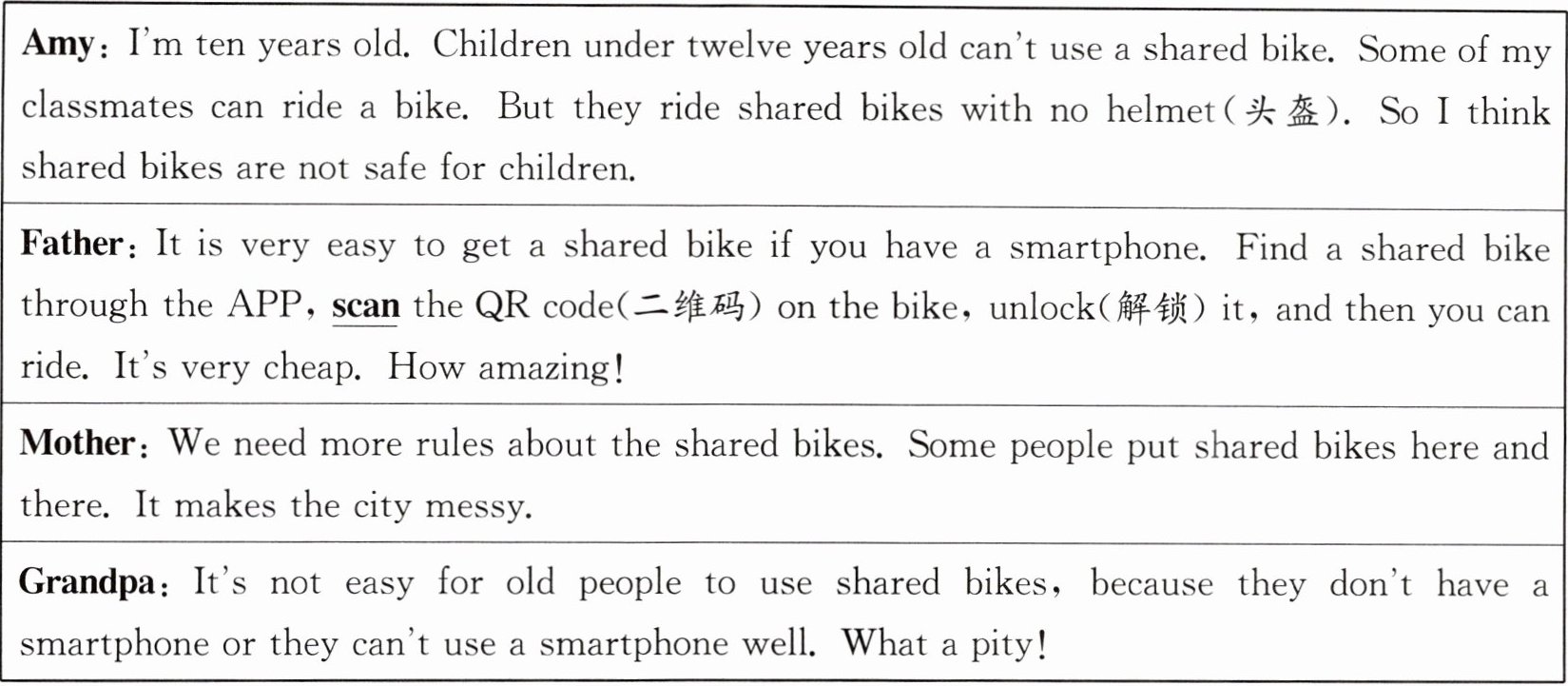
(
A. it is very cheap B. she is only ten years old C. there's no helmet on the shared bike
(
A. clean up B. look out for C. use a phone to read
(
A. Father B. Mother C. Grandpa
(
A. easy B. wonderful C. difficult
(
A. "What a pity!" B. "How amazing!" C. "It makes the city messy."
What do you think of shared bikes(共享单车)? Here's an interview(采访) of Amy's family.
(
B
)7. Amy can't ride the shared bike, because she is only ten years old
.A. it is very cheap B. she is only ten years old C. there's no helmet on the shared bike
(
C
)8. The word "scan" in the passage means "use a phone to read
".A. clean up B. look out for C. use a phone to read
(
B
)9. Mother
thinks shared bikes need better rules.A. Father B. Mother C. Grandpa
(
C
)10. Grandpa thinks old people can't use smartphones well, so it's difficult
for them to use shared bikes.A. easy B. wonderful C. difficult
(
B
)11. Which sentence shows "Shared bikes are good for our life."?A. "What a pity!" B. "How amazing!" C. "It makes the city messy."
答案
7~11 B C B C B
7. 短文中Amy提到“Children under twelve years old can't use a shared bike.”,可知她今年10岁,因此不能骑共享单车的原因是年龄未满12岁。故选B。
8. 父亲在描述使用共享单车时说“scan the QR code”,结合上下文,扫描二维码是指用手机读取二维码以解锁单车。故选C。
9. 母亲说“We need more rules about the shared bikes.”,可知母亲认为需要更多关于共享单车的规则。故选B。
10. 祖父说“It's not easy for old people to use shared bikes”,可知对老人来说用共享单车很难。故选C。
11. 父亲说“How amazing!”,是对共享单车的积极评价,认为它便宜、方便,对生活有好处。故选B。
解析
【分析】
本题为英语阅读理解题,需根据短文内容逐一分析各题目:
1. 第7题:定位Amy的发言,找到她不能骑共享单车的原因,原文提到“Children under twelve years old can't use a shared bike.”,结合Amy自述10岁,即可选出答案。
2. 第8题:词义猜测题,定位“scan”所在句子,结合父亲描述的共享单车使用步骤和常识,判断该词含义。
3. 第9题:细节题,定位谁提出需要更多规则,找到对应人物的发言即可。
4. 第10题:细节题,定位祖父的发言,找到他对老人使用共享单车的评价,对应选项。
5. 第11题:分析各选项句子的感情色彩,找到体现共享单车对生活有益的积极评价语句。
【解析】
7. 根据Amy的发言,她10岁,原文明确“Children under twelve years old can't use a shared bike.”,因此她不能骑共享单车是因为年龄未满12岁,对应选项B。
8. 父亲描述使用共享单车时提到“scan the QR code”,结合常识,“scan”在此处意为“用手机读取(二维码)”,对应选项C。
9. 母亲的发言中“We need more rules about the shared bikes.”表明她认为共享单车需要更好的规则,对应选项B。
10. 祖父说“It's not easy for old people to use shared bikes”,“not easy”即“difficult”,对应选项C。
11. 分析选项:A是遗憾语气,B是积极赞叹,体现共享单车的便利性,C是负面评价,因此选B。
【答案】7.B 8.C 9.B 10.C 11.B
【知识点】英语阅读理解,细节理解,词义猜测
【点评】本题围绕共享单车话题,考查学生提取关键信息、猜测词义、判断观点的能力,属于基础阅读理解题,难度适中。
【难度系数】0.7
