

 登录
五 阅读短文,完成任务。
Our home in space
Earth is our home planet. It is beautiful.
1.
In the daytime, we can see the Sun and white clouds floating(漂浮) in the sky. We can see birds flying too.
At night, we can see the Moon and many twinkling stars. Some “moving stars” are not real(真实的) stars—they are man-made satellites. They travel around Earth and help us a lot.
2.
We can look at photos from the space station. From there, we can see Earth very well—we can see its blue oceans and white clouds. It looks like a pretty blue marble.
Space is large and interesting and Earth is our best home.
任务一:根据短文内容,将合适的小标题编号写在段落前的横线上。
A. What can we see from outer space? B. What can we see on Earth?
任务二:猜一猜并圈出画线单词“man-made”的意思:A. 天然的 B. 人造的
任务三☆:假如你是空间站里的航天员,请根据短文并查阅资料,画出你可能会拍到的画面并说一说。

From outer space, I can see Earth very well.
It looks like a .
I can see
.
Our home in space
Earth is our home planet. It is beautiful.
1.
B
In the daytime, we can see the Sun and white clouds floating(漂浮) in the sky. We can see birds flying too.
At night, we can see the Moon and many twinkling stars. Some “moving stars” are not real(真实的) stars—they are man-made satellites. They travel around Earth and help us a lot.
2.
A
We can look at photos from the space station. From there, we can see Earth very well—we can see its blue oceans and white clouds. It looks like a pretty blue marble.
Space is large and interesting and Earth is our best home.
任务一:根据短文内容,将合适的小标题编号写在段落前的横线上。
A. What can we see from outer space? B. What can we see on Earth?
任务二:猜一猜并圈出画线单词“man-made”的意思:A. 天然的 B. 人造的
任务三☆:假如你是空间站里的航天员,请根据短文并查阅资料,画出你可能会拍到的画面并说一说。
From outer space, I can see Earth very well.
It looks like a .
I can see
.
答案
任务一:1. B 2. A
任务二:B
任务三:略
任务二:B
任务三:略
解析
【分析】首先处理任务一,需匹配段落与小标题:第1段描述白天、夜晚在地球上能看到的事物(太阳、白云、鸟、月亮、星星、人造卫星),对应B选项“在地球上能看到什么”;第2段描述从空间站(外太空)看到的地球景象,对应A选项“从外太空能看到什么”。任务二的“man-made”所在句子说明它不是真星星,是绕地球运行的,结合常识可知是“人造的”,选B。任务三根据短文内容,从外太空看地球像蓝色弹珠,能看到蓝色海洋和白色云朵。
【解析】任务一:第1段围绕“在地球上(白天、夜晚)能看到的事物”展开,对应小标题B;第2段围绕“从外太空(空间站)能看到的地球景象”展开,对应小标题A,故答案为1.B,2.A。任务二:“man-made”所在句提到它不是真星星,是绕地球运行的,结合词义可知是“人造的”,选B。任务三:根据短文“ It looks like a pretty blue marble. We can see its blue oceans and white clouds.”,可知应填blue marble;its blue oceans and white clouds。
【答案】任务一:1.B 2.A;任务二:B;任务三:blue marble;its blue oceans and white clouds
【知识点】英语阅读理解、词义猜测、信息匹配
【点评】本题为基础英语阅读题,考查学生对短文内容的理解与信息提取能力,题型常规,难度适中。
【难度系数】0.6
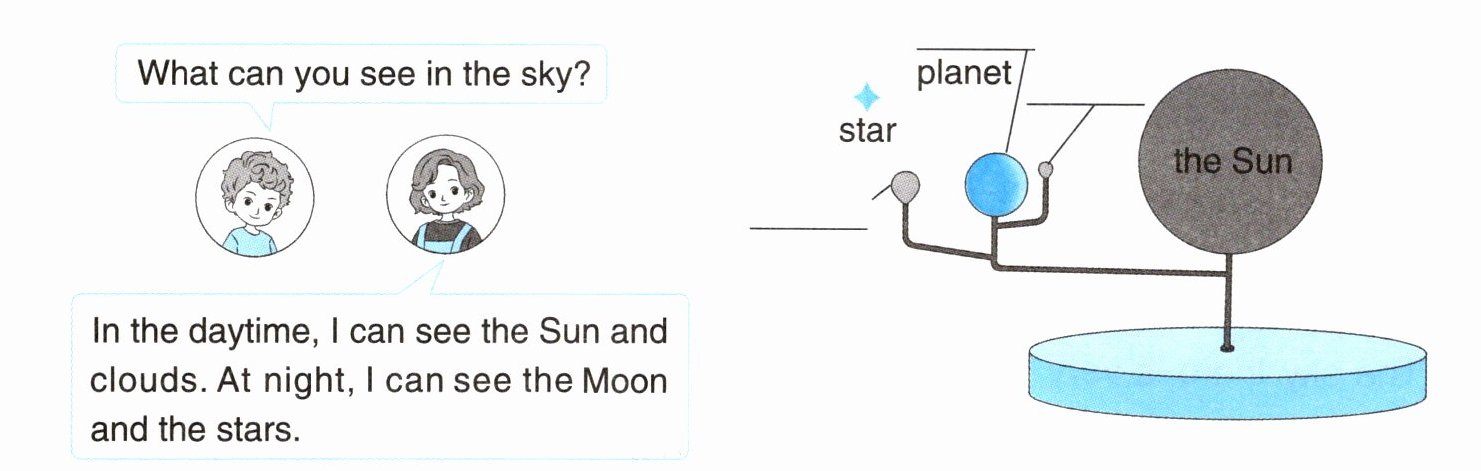
六 你能整理好下面的“知识图”吗? 试一试吧!
What can we see in the sky?
Project Task: Make sky riddles for your partners to guess space things.
What can we see in the sky?
Project Task: Make sky riddles for your partners to guess space things.
答案
从左到右:the Moon;Earth;satellite
解析
【分析】首先观察知识图中的天体模型,明确各位置对应的天体:最左侧的小天体是月球(the Moon),中间蓝色天体标注为行星(planet),对应地球(Earth),最右侧的小天体是卫星(satellite),按从左到右顺序整理即可。
【解析】根据图中天体模型的位置与标注,从左到右依次对应:最左侧为月球(the Moon),中间蓝色行星为地球(Earth),最右侧小天体为卫星(satellite),据此填写答案。
【答案】the Moon;Earth;satellite
【知识点】天体名称、太阳系天体认知
【点评】本题考查对天空中常见天体的识别,属于基础科学常识类题目,需学生掌握月球、地球、卫星等天体的基本概念。
【难度系数】0.2
【解析】根据图中天体模型的位置与标注,从左到右依次对应:最左侧为月球(the Moon),中间蓝色行星为地球(Earth),最右侧小天体为卫星(satellite),据此填写答案。
【答案】the Moon;Earth;satellite
【知识点】天体名称、太阳系天体认知
【点评】本题考查对天空中常见天体的识别,属于基础科学常识类题目,需学生掌握月球、地球、卫星等天体的基本概念。
【难度系数】0.2
