

 登录
登录
Ⅰ.用方框中所给词的适当形式填空
always usually sometimes
seldom never
1. My English teacher
2. Tina gets up early every morning, so she is
3. Fu Xing
4.
5. Mary
always usually sometimes
seldom never
1. My English teacher
always
wears a sweet smile in class. We all like her.2. Tina gets up early every morning, so she is
never
late for school.3. Fu Xing
seldom
does exercise, only one hour a week.4.
Sometimes
, Lisa wants to do her home-work in the school library.5. Mary
usually
reads for half an hour before she goes to bed. It's a good habit.答案
1. always 2. never 3. seldom 4. Sometimes 5. usually
解析
【分析】
解题时需先明确方框内频率副词的含义:always(总是)、usually(通常)、sometimes(有时)、seldom(很少)、never(从不),再结合每个句子的语境判断合适的副词,注意句首单词首字母大写的规则。
1. 句子描述英语老师上课常带甜笑,对应“总是”;
2. Tina每天早起,对应“从不迟到”;
3. 每周仅锻炼一小时,对应“很少锻炼”;
4. 句子开头表“有时”,需大写首字母;
5. 睡前固定读半小时,对应“通常”。
【解析】
1. 句意:我的英语老师上课总是带着甜美的微笑,我们都喜欢她。always表示“总是”,符合语境,故填always;
2. 句意:Tina每天早上早起,所以她上学从不迟到。never表示“从不”,符合逻辑,故填never;
3. 句意:福星很少做运动,每周仅一小时。seldom表示“很少”,匹配“only one hour a week”的描述,故填seldom;
4. 句意:有时,Lisa想在学校图书馆做作业。sometimes表示“有时”,位于句首需大写首字母,故填Sometimes;
5. 句意:Mary通常睡前读半小时,这是个好习惯。usually表示“通常”,符合“好习惯”的常规行为,故填usually。
【答案】
1. always 2. never 3. seldom 4. Sometimes 5. usually
【知识点】
频率副词的用法、副词的位置
【点评】
本题考查基础频率副词的词义辨析及句中正确使用,难度较低,学生只要理解副词含义、结合语境并注意句首大写细节即可作答。
【难度系数】
0.8
解题时需先明确方框内频率副词的含义:always(总是)、usually(通常)、sometimes(有时)、seldom(很少)、never(从不),再结合每个句子的语境判断合适的副词,注意句首单词首字母大写的规则。
1. 句子描述英语老师上课常带甜笑,对应“总是”;
2. Tina每天早起,对应“从不迟到”;
3. 每周仅锻炼一小时,对应“很少锻炼”;
4. 句子开头表“有时”,需大写首字母;
5. 睡前固定读半小时,对应“通常”。
【解析】
1. 句意:我的英语老师上课总是带着甜美的微笑,我们都喜欢她。always表示“总是”,符合语境,故填always;
2. 句意:Tina每天早上早起,所以她上学从不迟到。never表示“从不”,符合逻辑,故填never;
3. 句意:福星很少做运动,每周仅一小时。seldom表示“很少”,匹配“only one hour a week”的描述,故填seldom;
4. 句意:有时,Lisa想在学校图书馆做作业。sometimes表示“有时”,位于句首需大写首字母,故填Sometimes;
5. 句意:Mary通常睡前读半小时,这是个好习惯。usually表示“通常”,符合“好习惯”的常规行为,故填usually。
【答案】
1. always 2. never 3. seldom 4. Sometimes 5. usually
【知识点】
频率副词的用法、副词的位置
【点评】
本题考查基础频率副词的词义辨析及句中正确使用,难度较低,学生只要理解副词含义、结合语境并注意句首大写细节即可作答。
【难度系数】
0.8
Ⅱ.在横线处填上一个适当的句子补全对话
A: Hi, Mary. 1.
B: I'm reading a storybook.
A: Oh? 2.
B: Once upon a time, there was a beautiful girl.
A: Did the girl meet a nice prince(王子)?
B: 3.
A: What? A frog? Did he change back a prince at last?
B: 4.
A: Oh, it's really a funny story. 5.
B: It's called The Frog Prince.
A: Hi, Mary. 1.
What are you doing
?B: I'm reading a storybook.
A: Oh? 2.
What does it say
?B: Once upon a time, there was a beautiful girl.
A: Did the girl meet a nice prince(王子)?
B: 3.
Yes, she did
. But the prince was a frog(青蛙).A: What? A frog? Did he change back a prince at last?
B: 4.
Yes, he did
. The girl's love helped him change back to the prince.A: Oh, it's really a funny story. 5.
What's the name of the story
?B: It's called The Frog Prince.
答案
1. What are you doing
2. What does it say
3. Yes, she did
4. Yes, he did
5. What's the name of the story
2. What does it say
3. Yes, she did
4. Yes, he did
5. What's the name of the story
解析
【分析】
本题为英语补全对话题型,需结合上下文语境及答语内容,填写符合日常交际逻辑的句子。第1空根据B的答语“我正在读故事书”,需询问对方正在做的事;第2空根据B讲述的故事内容,需询问故事的具体内容;第3空对应A的一般疑问句,结合B的补充表述需作肯定回答;第4空对应A的一般疑问句,结合B的补充表述需作肯定回答;第5空根据B答的故事名称,需询问故事的名字。
【解析】
1. 由答语“I'm reading a storybook”可知,问句需用现在进行时询问对方正在做的事,故填What are you doing;
2. 由答语“Once upon a time, there was a beautiful girl”(故事内容)可知,问句需询问故事讲了什么,故填What does it say;
3. 问句为Did引导的一般疑问句,结合B后续“王子是青蛙”的表述,需作肯定回答,故填Yes, she did;
4. 问句为Did引导的一般疑问句,结合B后续“女孩的爱帮他变回王子”的表述,需作肯定回答,故填Yes, he did;
5. 由答语“It's called The Frog Prince”(故事名称)可知,问句需询问故事的名字,故填What's the name of the story。
【答案】
1. What are you doing
2. What does it say
3. Yes, she did
4. Yes, he did
5. What's the name of the story
【知识点】
补全对话、情景交际、一般疑问句回答
【点评】
本题考查日常情景对话的补全,贴近生活实际,要求学生掌握基础交际用语,结合上下文逻辑即可完成,属于英语基础题型。
【难度系数】
0.4
本题为英语补全对话题型,需结合上下文语境及答语内容,填写符合日常交际逻辑的句子。第1空根据B的答语“我正在读故事书”,需询问对方正在做的事;第2空根据B讲述的故事内容,需询问故事的具体内容;第3空对应A的一般疑问句,结合B的补充表述需作肯定回答;第4空对应A的一般疑问句,结合B的补充表述需作肯定回答;第5空根据B答的故事名称,需询问故事的名字。
【解析】
1. 由答语“I'm reading a storybook”可知,问句需用现在进行时询问对方正在做的事,故填What are you doing;
2. 由答语“Once upon a time, there was a beautiful girl”(故事内容)可知,问句需询问故事讲了什么,故填What does it say;
3. 问句为Did引导的一般疑问句,结合B后续“王子是青蛙”的表述,需作肯定回答,故填Yes, she did;
4. 问句为Did引导的一般疑问句,结合B后续“女孩的爱帮他变回王子”的表述,需作肯定回答,故填Yes, he did;
5. 由答语“It's called The Frog Prince”(故事名称)可知,问句需询问故事的名字,故填What's the name of the story。
【答案】
1. What are you doing
2. What does it say
3. Yes, she did
4. Yes, he did
5. What's the name of the story
【知识点】
补全对话、情景交际、一般疑问句回答
【点评】
本题考查日常情景对话的补全,贴近生活实际,要求学生掌握基础交际用语,结合上下文逻辑即可完成,属于英语基础题型。
【难度系数】
0.4
Ⅲ.阅读短文,完成下列任务
If you fly across several time zones, you may have jet lag(时差反应). You ar- rive in a new time zone, but your body is still living on the time in the old time zone. You may be ready for dinner at midnight, and you may want to sleep all day.
People have jet lag because all living things have a biological clock(生物钟). For example, plants begin to work at sunrise. When winter comes, birds fly to warm places. Some insects like bees also seem to set their alarm clocks to look for food.
Some scientists did an experiment(实验) with bees in Paris. They put out sugar water at 4:00 p.m. every day, and the bees came to drink the water at ex- actly(准确地) the right time. Then the scientists put bees in a dark room. The bees still came out at the same time. Lat- er the scientists took the bees to New York. The bees came for the food at the right time again, when it was only 10:00. a.m. in New York. Their bodies were still on Paris time.
Humans have a biological clock too. It tells us when to sleep and eat. Our bodies are controlled by a biological clock, but we can learn to adjust(调整) it to different time.
任务一:根据短文内容,选择正确的答案。
()1. How many examples of the bio- logical clock does the writer show in Paragraph 2?
A. Two. B. Three.
C. Four. D. Five.
()2. When did bees come out for food in New York?
A. At 10:00 a.m. (Paris time).
B. At 4:00 p.m. (Paris time).
C. At 4:00 a.m. (New York time).
D. At 10:00 p.m. (New York time).
()3. What is the purpose of showing the experiment with bees?
A. To explain how bees set their alarm clocks.
B. To tell us that bees look for sugar water to live.
C. To prove that living things have a biological clock.
D. To show that living things can reset their biological clock.
()4. What can we learn from the passage?
A. Humans can adjust their biological clock.
B. The biological clock isn't useful at all.
C. Bees couldn't tell the time in the dark room.
D. Some people have jet lag because they are weak.
任务二:根据短文内容补充结构图。
People always have jet lag when they fly across several 1. .
↓
151 575 Why → Because all living things have a biological clock, such as 2. .
↓
Some scientists did an experiment with bees.
↓
In Paris
The scientists put out sugar water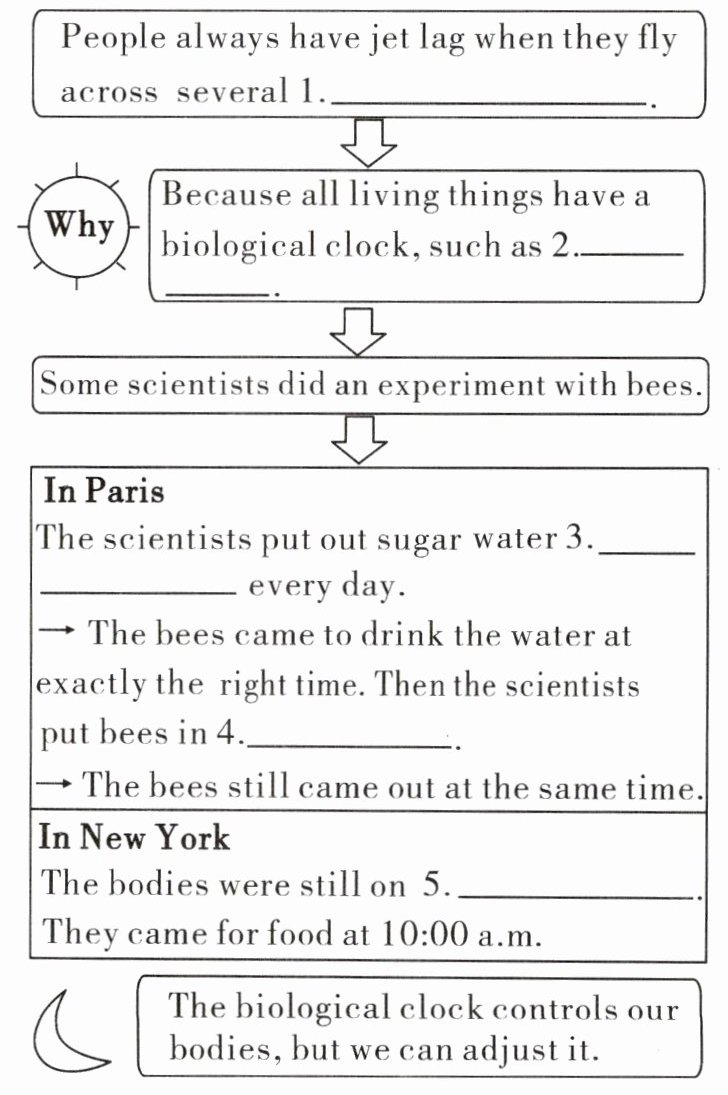 every day.
→ The bees came to drink the water at exactly the right time. Then the scientists put bees in 4. .
→ The bees still came out at the same time.
In New York
The bodies were still on 5. .
They came for food at 10:00 a.m.
↓
126 975 → The biological clock controls our bodies, but we can adjust it.
If you fly across several time zones, you may have jet lag(时差反应). You ar- rive in a new time zone, but your body is still living on the time in the old time zone. You may be ready for dinner at midnight, and you may want to sleep all day.
People have jet lag because all living things have a biological clock(生物钟). For example, plants begin to work at sunrise. When winter comes, birds fly to warm places. Some insects like bees also seem to set their alarm clocks to look for food.
Some scientists did an experiment(实验) with bees in Paris. They put out sugar water at 4:00 p.m. every day, and the bees came to drink the water at ex- actly(准确地) the right time. Then the scientists put bees in a dark room. The bees still came out at the same time. Lat- er the scientists took the bees to New York. The bees came for the food at the right time again, when it was only 10:00. a.m. in New York. Their bodies were still on Paris time.
Humans have a biological clock too. It tells us when to sleep and eat. Our bodies are controlled by a biological clock, but we can learn to adjust(调整) it to different time.
任务一:根据短文内容,选择正确的答案。
()1. How many examples of the bio- logical clock does the writer show in Paragraph 2?
A. Two. B. Three.
C. Four. D. Five.
()2. When did bees come out for food in New York?
A. At 10:00 a.m. (Paris time).
B. At 4:00 p.m. (Paris time).
C. At 4:00 a.m. (New York time).
D. At 10:00 p.m. (New York time).
()3. What is the purpose of showing the experiment with bees?
A. To explain how bees set their alarm clocks.
B. To tell us that bees look for sugar water to live.
C. To prove that living things have a biological clock.
D. To show that living things can reset their biological clock.
()4. What can we learn from the passage?
A. Humans can adjust their biological clock.
B. The biological clock isn't useful at all.
C. Bees couldn't tell the time in the dark room.
D. Some people have jet lag because they are weak.
任务二:根据短文内容补充结构图。
People always have jet lag when they fly across several 1. .
↓
↓
Some scientists did an experiment with bees.
↓
In Paris
The scientists put out sugar water
every day.→ The bees came to drink the water at exactly the right time. Then the scientists put bees in 4. .
→ The bees still came out at the same time.
In New York
The bodies were still on 5. .
They came for food at 10:00 a.m.
↓
答案
任务一:
1. B 【解析】根据"For example, plants begin to work at sunrise. When winter comes, birds fly to warm places. Some insects like bees also seem to set their alarm clocks to look for food."可知,作者举了三个生物钟的例子,分别是植物、鸟类和昆虫。故选 B。
2. B 【解析】根据"Later the scientists took the bees to New York. The bees came for the food at the right time again, when it was only 10:00. a.m. in New York. Their bodies were still on Paris time."可知,当纽约时间是上午10点时,蜜蜂出来觅食,而它们的身体还在巴黎时间,根据巴黎下午4点放糖水可知,此时巴黎时间是下午4点。故选 B。
3. C 【解析】根据"People have jet lag because all living things have a biological clock(生物钟)."以及"Some scientists did an experiment(实验) with bees in Paris."可知,科学家用蜜蜂做实验是为了证明所有生物都有生物钟。故选 C。
4. A 【解析】根据"Our bodies are controlled by a biological clock, but we can learn to adjust(调整) it to different time."可知,我们可以学会调整生物钟以适应不同的时间。故选 A。
任务二:1. time zones 2. plants, birds and bees 3. at 4:00 p.m. 4. a dark room 5. Paris time
1. B 【解析】根据"For example, plants begin to work at sunrise. When winter comes, birds fly to warm places. Some insects like bees also seem to set their alarm clocks to look for food."可知,作者举了三个生物钟的例子,分别是植物、鸟类和昆虫。故选 B。
2. B 【解析】根据"Later the scientists took the bees to New York. The bees came for the food at the right time again, when it was only 10:00. a.m. in New York. Their bodies were still on Paris time."可知,当纽约时间是上午10点时,蜜蜂出来觅食,而它们的身体还在巴黎时间,根据巴黎下午4点放糖水可知,此时巴黎时间是下午4点。故选 B。
3. C 【解析】根据"People have jet lag because all living things have a biological clock(生物钟)."以及"Some scientists did an experiment(实验) with bees in Paris."可知,科学家用蜜蜂做实验是为了证明所有生物都有生物钟。故选 C。
4. A 【解析】根据"Our bodies are controlled by a biological clock, but we can learn to adjust(调整) it to different time."可知,我们可以学会调整生物钟以适应不同的时间。故选 A。
任务二:1. time zones 2. plants, birds and bees 3. at 4:00 p.m. 4. a dark room 5. Paris time
解析
【分析】本题分为任务一(选择题)和任务二(补全结构图),均为英语阅读理解的细节类题目。解题思路是:先通读全文明确各段落大意,再针对每个题目回到原文定位关键信息,匹配对应内容后得出答案。任务一的选择题需定位到对应段落的具体句子,任务二的填空需匹配原文描述的实验过程、时差相关内容,确保答案与原文一致。
【解析】任务一:1. 定位第二段“For example, plants begin to work at sunrise. When winter comes, birds fly to warm places. Some insects like bees also seem to set their alarm clocks to look for food.”,可知作者举了3个生物钟的例子,故选B。2. 定位第三段“Later the scientists took the bees to New York. The bees came for the food at the right time again, when it was only 10:00 a.m. in New York. Their bodies were still on Paris time.”,结合巴黎时间下午4点放糖水,可知蜜蜂在纽约时对应巴黎时间下午4点觅食,故选B。3. 结合第一段“People have jet lag because all living things have a biological clock”及蜜蜂实验,可知实验目的是证明所有生物都有生物钟,故选C。4. 定位最后一段“Our bodies are controlled by a biological clock, but we can learn to adjust it to different time”,可知人类可调整生物钟适应不同时间,故选A。任务二:1. 对应原文第一句“If you fly across several time zones, you may have jet lag”,填time zones;2. 对应第二段的三个例子,填plants, birds and bees;3. 对应第三段“They put out sugar water at 4:00 p.m. every day”,填at 4:00 p.m.;4. 对应第三段“Then the scientists put bees in a dark room”,填a dark room;5. 对应第三段“Their bodies were still on Paris time”,填Paris time。
【答案】任务一:1.B 2.B 3.C 4.A;任务二:1.time zones 2.plants, birds and bees 3.at 4:00 p.m. 4.a dark room 5.Paris time
【知识点】英语阅读理解、细节理解题、名词短语运用
【点评】本题是常规英语阅读理解题,侧重考查学生快速定位原文信息的能力,难度适中,仔细阅读原文即可完成解答。
【难度系数】0.6
【解析】任务一:1. 定位第二段“For example, plants begin to work at sunrise. When winter comes, birds fly to warm places. Some insects like bees also seem to set their alarm clocks to look for food.”,可知作者举了3个生物钟的例子,故选B。2. 定位第三段“Later the scientists took the bees to New York. The bees came for the food at the right time again, when it was only 10:00 a.m. in New York. Their bodies were still on Paris time.”,结合巴黎时间下午4点放糖水,可知蜜蜂在纽约时对应巴黎时间下午4点觅食,故选B。3. 结合第一段“People have jet lag because all living things have a biological clock”及蜜蜂实验,可知实验目的是证明所有生物都有生物钟,故选C。4. 定位最后一段“Our bodies are controlled by a biological clock, but we can learn to adjust it to different time”,可知人类可调整生物钟适应不同时间,故选A。任务二:1. 对应原文第一句“If you fly across several time zones, you may have jet lag”,填time zones;2. 对应第二段的三个例子,填plants, birds and bees;3. 对应第三段“They put out sugar water at 4:00 p.m. every day”,填at 4:00 p.m.;4. 对应第三段“Then the scientists put bees in a dark room”,填a dark room;5. 对应第三段“Their bodies were still on Paris time”,填Paris time。
【答案】任务一:1.B 2.B 3.C 4.A;任务二:1.time zones 2.plants, birds and bees 3.at 4:00 p.m. 4.a dark room 5.Paris time
【知识点】英语阅读理解、细节理解题、名词短语运用
【点评】本题是常规英语阅读理解题,侧重考查学生快速定位原文信息的能力,难度适中,仔细阅读原文即可完成解答。
【难度系数】0.6
