

 登录
阅读下面短文,从短文后的选项中选出能填入空白处的最佳选项。 选项中有一项为多余选项。
 s winter comes, hands can easily get cold. Thick gloves might be a good choice, but sometimes wearing them is inconvenient. 1.
There is one folk story about its invention. Emperor Yang from the Sui Dynasty visited Jiangsu in winter. Because of the cold, a local official asked craftsmen(工匠) to make a small warmer for the emperor that could be held in his hands. 2.
By the Song Dynasty, the warmers had become popular among the common people. 3.
In the early days, copper(铜) was generally used in the production process. 4.
5.
A. So, the hand warmer was created.
B. Ancient hand warmers had different designs.
C. It was more suitable than silver, iron and porcelain.
D. The process of making the hand warmer was not easy.
E. However, this was not a problem for ancient Chinese people.
F. Skills for producing the tool were widely used in the Ming and Qing dynasties.

s winter comes, hands can easily get cold. Thick gloves might be a good choice, but sometimes wearing them is inconvenient. 1.E
They had a fine tool to warm their hands: hand warmers.There is one folk story about its invention. Emperor Yang from the Sui Dynasty visited Jiangsu in winter. Because of the cold, a local official asked craftsmen(工匠) to make a small warmer for the emperor that could be held in his hands. 2.
A
By the Song Dynasty, the warmers had become popular among the common people. 3.
F
Many poets from this period kept a record of people using hand warmers.In the early days, copper(铜) was generally used in the production process. 4.
C
It could transfer(传导) heat better, while reducing the risk of breakage or corrosion(腐蚀). Inside a hand warmer, there were coals, some of which were mixed with flowers, giving off a nice smell when burned.5.
B
Round, square and octagonal shapes were typical, and there were also some fancy shapes which looked like pumpkins, flowers and turtle shells. The patterns on the warmers would usually be animals or symbols with good meanings, such as deer, flowers or the Chinese characters for long life.A. So, the hand warmer was created.
B. Ancient hand warmers had different designs.
C. It was more suitable than silver, iron and porcelain.
D. The process of making the hand warmer was not easy.
E. However, this was not a problem for ancient Chinese people.
F. Skills for producing the tool were widely used in the Ming and Qing dynasties.
答案
[Tuesday 阅读还原]
篇章导读
本文主要介绍了古代的一种发明——手炉。
篇章图解
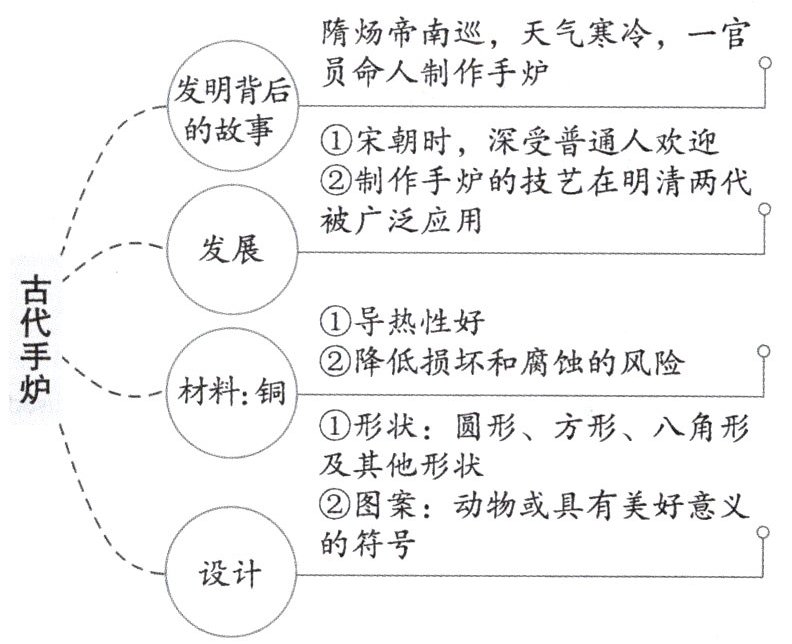
答案解析
1. E 由下一句“They had a fine tool to warm their hands: hand warmers.”可知,E项(然而,这对古代中国人来说不是问题)承上启下,符合语境。
2. A 通读本段可知,本段主要介绍了手炉的发明,故A项(因此,手炉就被制造出来了)与上文紧密衔接。
3. F 由下一句中的Many poets from this period可知,此处应该提到一个时期。结合选项可知,F项(制作这种器具的技艺在明代和清代被广泛应用)符合此处语境。
4. C 下一句解释了用铜做材料的优势,故C项(它比银、铁和瓷器更合适)符合此处语境。
5. B 由下文可知,本段主要介绍了古代手炉不同的设计,故B项(古代的手炉有不同的设计)符合此处语境。
全文翻译
冬天到了,手很容易变冷。厚厚的手套也许是个不错的选择,但有时戴手套并不方便。然而,这对古代中国人来说不是问题。他们有一个很好的暖手工具:手炉。
关于它的发明,有一个民间故事。隋炀帝冬天到江苏巡视。由于天气寒冷,当地一位官员要求工匠为皇帝制作一个可以拿在手上的小暖炉。因此,手炉就被制造出来了。
到了宋代,手炉开始在普通民众中流行起来。制作这种器具的技艺在明代和清代被广泛应用。这一时期的许多诗人都记录了人们使用手炉的情况。
早期,手炉在制作时通常选用铜材。它比银、铁和瓷器更合适。它能更好地导热,同时降低破损或腐蚀的风险。手炉内装有炭火,有些炭火中还混有花瓣,燃烧时散发出怡人的香气。
古代的手炉有不同的设计。圆形、方形和八角形是典型的形状,还有一些看起来像南瓜、花朵和龟壳的别致款式。手炉上的图案通常是寓意美好的动物或符号,如鹿、花或代表长寿的汉字。
