

 登录
Ⅰ. Complete the sentences with the correct forms of the words in the box.
forever brave whole collect science radio
1. A true scientist’s influence lasts
2. Zhong Yang spent his
3. It was hard for the research team
4. The museum’s art
5. Einstein’s
6. In the late 19th century, Guglielmo Marconi invented the
forever brave whole collect science radio
1. A true scientist’s influence lasts
forever
.2. Zhong Yang spent his
whole
life collecting seeds for China.3. It was hard for the research team
to brave
the terrible weather in this area.4. The museum’s art
collection
includes works from many famous painters.5. Einstein’s
scientific
research led to the development of nuclear energy.6. In the late 19th century, Guglielmo Marconi invented the
radio
and changed the way people communicate.答案
1. forever 2. whole 3. to brave 4. collection 5. scientific 6. radio
解析
【分析】本题要求用方框内单词的正确形式完成句子,解题思路为:先理解每个句子的句意,再结合方框内单词的词义、词性,根据句子结构(如修饰关系、固定句型、非谓语形式等)选择合适的单词形式。具体需关注:动词的修饰需用副词,名词前需用形容词,固定句型“it's + adj + for sb to do sth”需用动词不定式,名词作主语/宾语需用名词形式等。
【解析】1. 句意:真正科学家的影响永远存在。动词last需副词修饰,方框中forever为副词,故填forever。2. 句意:钟扬花了他的一生为中国收集种子。固定搭配“whole life”(一生),需形容词修饰名词life,故填whole。3. 固定句型“It is + adj + for sb to do sth”,此处需用动词不定式,方框中brave的动词形式为brave,故填to brave。4. 句意:博物馆的艺术收藏包括很多著名画家的作品。collect的名词形式为collection(收藏),作主语,故填collection。5. 句意:爱因斯坦的科学研究导致了核能的发展。science的形容词形式为scientific(科学的),修饰名词research,故填scientific。6. 句意:19世纪末,马可尼发明了收音机,改变了人们的交流方式。invented后需名词作宾语,radio为名词,故填radio。
【答案】1. forever 2. whole 3. to brave 4. collection 5. scientific 6. radio
【知识点】词汇的词性转换、固定搭配
【点评】本题考查基础词汇的适当形式运用,侧重词性变化和固定搭配,难度适中,适合学生巩固词汇基础。
【难度系数】0.7
Ⅱ. Read and complete the tasks.
Perhaps no other scientist has had a greater influence on China’s aerospace science than Qian Xuesen. As a gifted rocket scientist, Qian was patriotic(爱国的)and served his homeland with devotion.
Qian was born in Shanghai in 1911. He entered Shanghai Jiao Tong University to study Railway Engineering. But after the January 28 Incident broke out in 1932, he changed his major(专业)to aircraft manufacturing(制造)because he realized that China needed its own powerful air force to defend itself.
Qian went to the US in 1935 for graduate studies. During the 1930s and 1940s, he became a pioneer in jet and rocket technology, helping build the Jet Propulsion Laboratory, which is now one of NASA’s leading space centres.
In 1955, it was difficult for Qian to return to China, but he braved all difficulties and finally made his way back. He received a hero’s welcome and was put in charge of developing China’s rocket, space and missile(导弹)programmes. At that time, China had no rocket science experts, but Qian did not let that discourage him. When asked, “Can we Chinese possibly make missiles?”, his answer was a determined “Why not? We Chinese can make the same things other people make.”
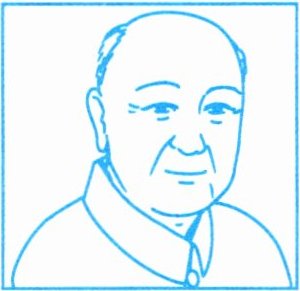
Under Qian’s leadership, China developed the Dongfeng missiles and the first Long March rocket. In 1970, China launched its first man-made satellite, Dong Fang Hong I, using a Long March rocket. Because much of the technology behind the Shenzhou spacecraft comes from Qian’s research, he is called “the father of China’s aerospace”.
Uninterested in fortune and fame, Qian devoted his life to rebuilding the nation. “As a Chinese technician, my life’s purpose is to serve the people,” he once said. Qian was also widely read and deeply interested in music and painting, which often gave him inspiration for his scientific research.
Qian passed away on 31 October 2009, but his influence will last for generations.
A. Complete the table.
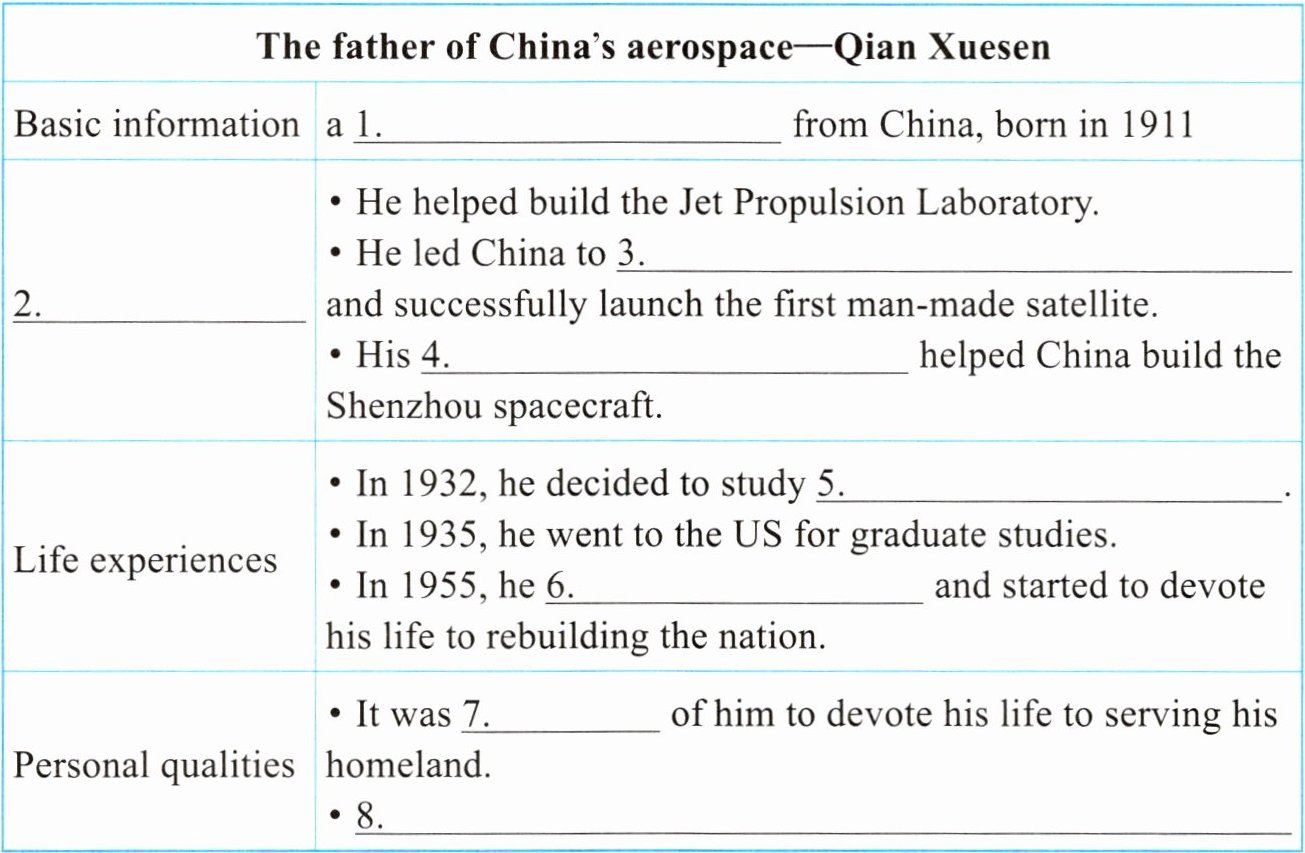
The father of China’s aerospace—Qian Xuesen
Basic information | a 1.
2.
• He led China to 3.
• His 4.
Life experiences | • In 1932, he decided to study 5.
• In 1935, he went to the US for graduate studies.
• In 1955, he 6.
Personal qualities | • It was 7.
• 8.
B. Answer the questions.
1. What does the underlined word “defend” in Paragraph 2 mean?
2. What does Paragraph 4 mainly talk about?
3. What made Qian Xuesen admirable? What can we learn from him?
Perhaps no other scientist has had a greater influence on China’s aerospace science than Qian Xuesen. As a gifted rocket scientist, Qian was patriotic(爱国的)and served his homeland with devotion.
Qian was born in Shanghai in 1911. He entered Shanghai Jiao Tong University to study Railway Engineering. But after the January 28 Incident broke out in 1932, he changed his major(专业)to aircraft manufacturing(制造)because he realized that China needed its own powerful air force to defend itself.
Qian went to the US in 1935 for graduate studies. During the 1930s and 1940s, he became a pioneer in jet and rocket technology, helping build the Jet Propulsion Laboratory, which is now one of NASA’s leading space centres.
In 1955, it was difficult for Qian to return to China, but he braved all difficulties and finally made his way back. He received a hero’s welcome and was put in charge of developing China’s rocket, space and missile(导弹)programmes. At that time, China had no rocket science experts, but Qian did not let that discourage him. When asked, “Can we Chinese possibly make missiles?”, his answer was a determined “Why not? We Chinese can make the same things other people make.”
Under Qian’s leadership, China developed the Dongfeng missiles and the first Long March rocket. In 1970, China launched its first man-made satellite, Dong Fang Hong I, using a Long March rocket. Because much of the technology behind the Shenzhou spacecraft comes from Qian’s research, he is called “the father of China’s aerospace”.
Uninterested in fortune and fame, Qian devoted his life to rebuilding the nation. “As a Chinese technician, my life’s purpose is to serve the people,” he once said. Qian was also widely read and deeply interested in music and painting, which often gave him inspiration for his scientific research.
Qian passed away on 31 October 2009, but his influence will last for generations.
A. Complete the table.
The father of China’s aerospace—Qian Xuesen
Basic information | a 1.
rocket scientist
from China, born in 19112.
Achievements
| • He helped build the Jet Propulsion Laboratory.• He led China to 3.
develop the Dongfeng missiles and the first Long March rocket
and successfully launch the first man-made satellite.• His 4.
scientific research
helped China build the Shenzhou spacecraft.Life experiences | • In 1932, he decided to study 5.
aircraft manufacturing
.• In 1935, he went to the US for graduate studies.
• In 1955, he 6.
returned to China
and started to devote his life to rebuilding the nation.Personal qualities | • It was 7.
patriotic
of him to devote his life to serving his homeland.• 8.
One possible version: It was confident of him to say "Why not?" when others doubted about China's ability of making its own missiles.
B. Answer the questions.
1. What does the underlined word “defend” in Paragraph 2 mean?
Protect.
2. What does Paragraph 4 mainly talk about?
The difficulties Qian Xuesen met and his determination of developing China's rocket science.
3. What made Qian Xuesen admirable? What can we learn from him?
One possible version: Qian Xuesen is admirable because he overcame so many difficulties to return to China and devoted his life to China's aerospace industry. From him, we can learn the power of patriotism and the importance of using scientific knowledge to serve one's homeland selflessly.
答案
A. 1. rocket scientist 2. Achievements
3. develop the Dongfeng missiles and the first Long March rocket
4. scientific research 5. aircraft manufacturing 6. returned to China
7. patriotic 8. One possible version: It was confident of him to say "Why not?" when others doubted about China's ability of making its own missiles.
B. 1. Protect. 2. The difficulties Qian Xuesen met and his determination of developing China's rocket science. 3. One possible version: Qian Xuesen is admirable because he overcame so many difficulties to return to China and devoted his life to China's aerospace industry. From him, we can learn the power of patriotism and the importance of using scientific knowledge to serve one's homeland selflessly.
解析
【分析】这是一篇介绍钱学森的英语阅读理解题,分为表格填空(A部分)和问答(B部分)。解题时需先通读全文把握主旨,A部分需根据表格类别定位原文对应内容,提取原词或同义表达;B部分词义猜测结合上下文语境,段落大意概括核心内容,开放性问题结合原文人物品质合理作答。
【解析】A部分:1. 定位第一段“Perhaps no other scientist has had a greater influence... As a gifted rocket scientist”,可知钱学森是火箭科学家,故填rocket scientist;2. 表格中列举的是钱学森的贡献成果,对应“成就”类,故填Achievements;3. 定位第六段“Under Qian’s leadership, China developed the Dongfeng missiles and the first Long March rocket”,提取原句;4. 定位第六段“Because much of the technology behind the Shenzhou spacecraft comes from Qian’s research”,故填scientific research;5. 定位第二段“he changed his major to aircraft manufacturing”,故填aircraft manufacturing;6. 定位第四段“In 1955, it was difficult for Qian to return to China, but he braved all difficulties and finally made his way back”,故填returned to China;7. 定位第一段“Qian was patriotic and served his homeland with devotion”,故填patriotic;8. 结合原文钱学森面对质疑时的决心,给出符合要求的表达。B部分:1. 第二段“China needed its own powerful air force to defend itself”,空军的作用是保卫,故defend意为Protect;2. 第四段主要讲述钱学森回国的困难及他发展中国火箭事业的决心;3. 结合原文钱学森克服困难回国、奉献航天事业的事迹及爱国精神,合理作答。
【答案】A. 1. rocket scientist 2. Achievements
3. develop the Dongfeng missiles and the first Long March rocket
4. scientific research 5. aircraft manufacturing 6. returned to China
7. patriotic 8. One possible version: It was confident of him to say "Why not?" when others doubted about China's ability of making its own missiles.
B. 1. Protect. 2. The difficulties Qian Xuesen met and his determination of developing China's rocket science. 3. One possible version: Qian Xuesen is admirable because he overcame so many difficulties to return to China and devoted his life to China's aerospace industry. From him, we can learn the power of patriotism and the importance of using scientific knowledge to serve one's homeland selflessly.
【知识点】英语阅读理解、词义猜测、细节理解
【点评】本题围绕钱学森的事迹展开,考查学生英语阅读综合能力,涵盖细节提取、词义推断、主旨概括与开放性表达,既需准确把握原文内容,也要求提炼人物品质,是兼顾基础与能力的阅读题。
【难度系数】0.6
