

 登录
四、连词成句。根据所给单词,连成完整的句子,注意大小写和标点符号。
1. the, in, soil, put, I, a, seed (.)
2. leaves, has, the, no, tree (.)
3. chick, out, a, baby, comes (.)
4. the, I, see, roots, can’t (.)
1. the, in, soil, put, I, a, seed (.)
I put a seed in the soil.
2. leaves, has, the, no, tree (.)
The tree has no leaves.
3. chick, out, a, baby, comes (.)
A baby chick comes out.
4. the, I, see, roots, can’t (.)
I can’t see the roots.
答案
1. I put a seed in the soil.
2. The tree has no leaves.
3. A baby chick comes out.
4. I can’t see the roots.
解析
【分析】
做英语连词成句题时,需先确定句子的主语(代词或名词),再找到对应的谓语动词,搭配宾语、状语等成分,最后注意单词顺序、句首大写和句末标点。
1. 先找主语I,谓语put,宾语a seed,地点状语in the soil放句末;
2. 主语是the tree,谓语has,宾语no leaves;
3. 主语a baby chick,谓语comes,状语out放句末;
4. 主语I,情态动词can’t加动词原形see,宾语the roots。
【解析】
1. 确定主语I,谓语put,宾语a seed,地点状语in the soil,按顺序排列,句末用句号,得到句子:I put a seed in the soil.
2. 主语为the tree,谓语has,宾语no leaves,排列后句末加句号,得到句子:The tree has no leaves.
3. 主语a baby chick,谓语comes,状语out,排列后句末加句号,得到句子:A baby chick comes out.
4. 主语I,情态动词can’t加动词原形see,宾语the roots,排列后句末加句号,得到句子:I can’t see the roots.
【答案】
1. I put a seed in the soil.
2. The tree has no leaves.
3. A baby chick comes out.
4. I can’t see the roots.
【知识点】
英语连词成句,英语基本句子结构
【点评】
本题考查英语基础简单句的结构运用,要求学生掌握代词、名词作主语,动词作谓语的基本搭配,同时注意句首大写和标点,是英语学习的基础题型,难度适中。
【难度系数】
0.7
五、根据例子,描述图片。
I like strawberries.
I put a strawberry seed in the soil.
It grows. Look. It has green l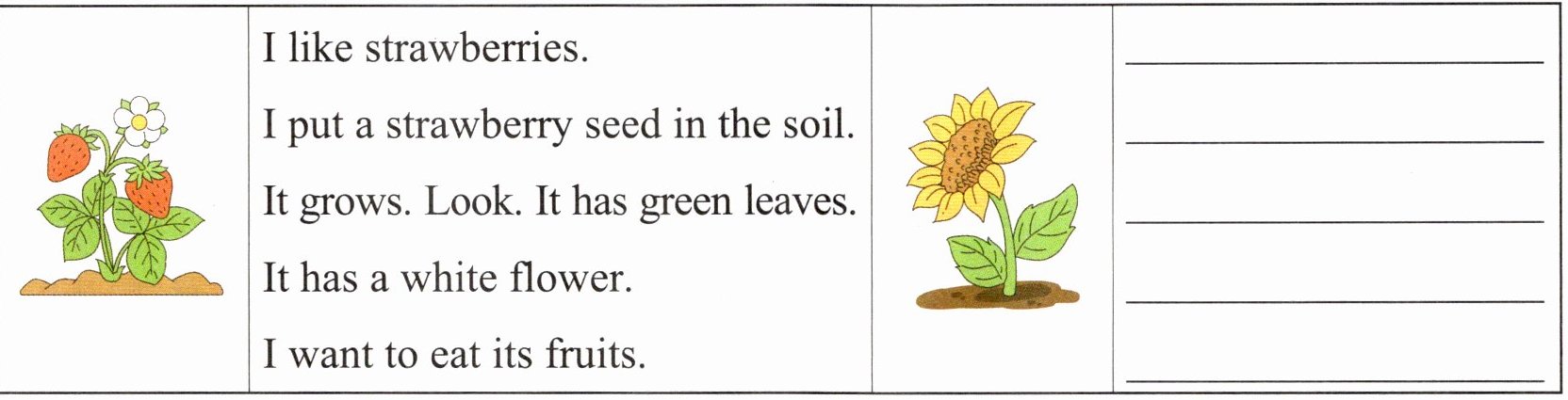 aves.
It has a white flower.
I want to eat its fruits.
I like strawberries.
I put a strawberry seed in the soil.
It grows. Look. It has green l
aves.It has a white flower.
I want to eat its fruits.
I like sunflowers.
I put a sunflower seed in the soil.
It grows. Look. It has green leaves.
It has a yellow flower.
I want to eat its seeds.
答案
I like sunflowers.
I put a sunflower seed in the soil.
It grows. Look. It has green leaves.
It has a yellow flower.
I want to eat its seeds.
解析
【分析】首先观察例子的句子结构,共5句,分别是:①表达对该植物的喜爱;②描述种下该植物的种子;③说明植物生长并长出绿叶;④描述植物的花的颜色;⑤表达想吃该植物的产物。然后对应右边的向日葵,替换相应词汇:将“strawberries”换成“sunflowers”,“strawberry seed”换成“sunflower seed”,“white flower”换成向日葵的花“yellow flower”,“fruits”换成向日葵的产物“seeds”,其余句式保持不变,即可完成仿写。
【解析】按照例子的5句结构,结合向日葵的特征,依次替换对应词汇:第一句表达喜欢向日葵;第二句写种下向日葵种子;第三句写生长并长出绿叶;第四句描述向日葵的花为黄色;第五句表达想吃向日葵的种子。
【答案】I like sunflowers.
I put a sunflower seed in the soil.
It grows. Look. It has green leaves.
It has a yellow flower.
I want to eat its seeds.
【知识点】英语句子仿写;植物词汇
【点评】本题为仿写类题目,考查学生对句子结构的掌握,同时结合不同植物的特征进行描述,难度适中,适合小学阶段学生练习。
【难度系数】0.3
A
(体裁:说明文 话题:不可或缺的植物 难易度:☆☆☆☆)
Plants are very important. This is because plants can make food from air, water and sunlight. Animals and people can not make food from air, water and sunlight. Animals can get their food by eating plants and animals. People get their food by eating plants and animals, too. So animals and people need plants in order to live. This is why there are so many plants around us. There are two kinds of plants: flowering plants and non-flowering plants. You can know some trees from their flowers and fruits. Non-flowering plants do not grow flowers. You can not see many non-flowering plants around you. If you look carefully at the plants around us, you will find that there are many kinds of plants. Some plants are large and some are small. Most of them are green.
读短文,选择最佳答案。
(
A. Man. B. Animals. C. Air, water and sunlight.
(
A. plants are green B. plants grow easily
C. we need plants in order to live
(
A. green B. black C. yellow
(
A. 不结果的 B. 不开花的 C. 不发芽的
(
A. Plants around us B. Food from plants C. Plants and animals
(体裁:说明文 话题:不可或缺的植物 难易度:☆☆☆☆)
Plants are very important. This is because plants can make food from air, water and sunlight. Animals and people can not make food from air, water and sunlight. Animals can get their food by eating plants and animals. People get their food by eating plants and animals, too. So animals and people need plants in order to live. This is why there are so many plants around us. There are two kinds of plants: flowering plants and non-flowering plants. You can know some trees from their flowers and fruits. Non-flowering plants do not grow flowers. You can not see many non-flowering plants around you. If you look carefully at the plants around us, you will find that there are many kinds of plants. Some plants are large and some are small. Most of them are green.
读短文,选择最佳答案。
(
C
) 1. What is the most important(最重要的) for the plants?A. Man. B. Animals. C. Air, water and sunlight.
(
C
) 2. We need many plants around us because .A. plants are green B. plants grow easily
C. we need plants in order to live
(
A
) 3. Most of the plants are .A. green B. black C. yellow
(
B
) 4. The underlined word “non-flowering” means in Chinese.A. 不结果的 B. 不开花的 C. 不发芽的
(
A
) 5. [新趋势·思维探究]The best title is “”.A. Plants around us B. Food from plants C. Plants and animals
答案
1.C 2.C 3.A 4.B 5.A
解析
【分析】本题为英语说明文阅读理解题,解题思路如下:1. 先通读短文,把握文章核心内容(围绕植物的重要性、种类及特征展开);2. 针对各小题,逐一回到原文定位关键信息:细节题直接找对应句子,词义猜测题结合构词法或上下文,主旨大意题总结全文主题;3. 对比选项选出最佳答案。
【解析】1. 细节题:原文第一段第二句明确指出“plants can make food from air, water and sunlight”,可知植物制造食物的来源是空气、水和阳光,故选C;2. 细节题:原文第一段“So animals and people need plants in order to live”,说明我们需要植物来生存,故选C;3. 细节题:原文最后一句“Most of them are green”,可知大多数植物是绿色的,故选A;4. 词义猜测题:“flowering”意为“开花的”,前缀“non-”表否定,故“non-flowering”意为“不开花的”,选B;5. 主旨大意题:全文围绕“我们周围的植物”展开,A选项贴合主题,B仅涉及食物,C仅涉及动植物关系,故选A。
【答案】1.C 2.C 3.A 4.B 5.A
【知识点】英语阅读理解、词义猜测、主旨大意
【点评】本题考查基础英语说明文阅读能力,涵盖细节定位、词义猜测和主旨归纳,题目设置贴合文本,难度适中,适合初中低年级学生练习。
【难度系数】0.6
