

 登录
登录
Ⅴ. 对话还原。
1. A: I like the film. The special effects(特技效果) are amazing!
B: Me too.
A: They make the action scenes so exciting.
2. A: The paintings in this art exhibition are wonderful.
B: I know!
A: Each painting seems to tell a story.
3. A: I think this is the best pizza.
B: Oh, I agree.
A: I will eat it again.
4. A: The concert last night was so amazing. The singer's voice was so powerful.
B: Absolutely!
5. A: That basketball game was exciting! The final shot was amazing.
B: Exactly.
A: I was always nervous until the end.
1. A: I like the film. The special effects(特技效果) are amazing!
B: Me too.
B
A: They make the action scenes so exciting.
2. A: The paintings in this art exhibition are wonderful.
B: I know!
A
A: Each painting seems to tell a story.
3. A: I think this is the best pizza.
B: Oh, I agree.
C
A: I will eat it again.
4. A: The concert last night was so amazing. The singer's voice was so powerful.
B: Absolutely!
D
5. A: That basketball game was exciting! The final shot was amazing.
B: Exactly.
E
A: I was always nervous until the end.
答案
1.B 2.A 3.C 4.D 5.E
解析
【分析】
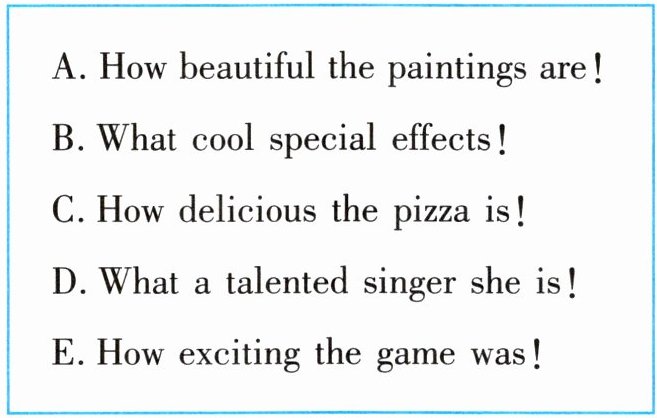
要完成对话还原,需抓住每道题上下文中的核心关键词,匹配对应选项的感叹句内容:第1题A提到“special effects(特技效果)”,需选对应特技效果的感叹句;第2题A提到“paintings(画)”,匹配关于画的感叹句;第3题A提到“pizza(披萨)”,匹配关于披萨的感叹句;第4题A提到“singer(歌手)”,匹配关于歌手的感叹句;第5题A提到“game(比赛)”,匹配关于比赛的感叹句。
【解析】
1. 第1题:A提及电影的特技效果很棒,选项B是“What cool special effects!”,对应“特技效果”,故选B。
2. 第2题:A提到画展的画很棒,选项A是“How beautiful the paintings are!”,对应“画”,故选A。
3. 第3题:A表示这是最好的披萨,选项C是“How delicious the pizza is!”,对应“披萨”,故选C。
4. 第4题:A说演唱会的歌手很棒,选项D是“What a talented singer she is!”,对应“歌手”,故选D。
5. 第5题:A提到篮球赛很刺激,选项E是“How exciting the game was!”,对应“比赛”,故选E。
【答案】
1.B 2.A 3.C 4.D 5.E
【知识点】
英语感叹句、情景对话匹配
【点评】
本题通过对话上下文的核心关键词匹配感叹句,考查学生对感叹句的理解及情景对话的逻辑衔接能力,难度适中。
【难度系数】
0.5
要完成对话还原,需抓住每道题上下文中的核心关键词,匹配对应选项的感叹句内容:第1题A提到“special effects(特技效果)”,需选对应特技效果的感叹句;第2题A提到“paintings(画)”,匹配关于画的感叹句;第3题A提到“pizza(披萨)”,匹配关于披萨的感叹句;第4题A提到“singer(歌手)”,匹配关于歌手的感叹句;第5题A提到“game(比赛)”,匹配关于比赛的感叹句。
【解析】
1. 第1题:A提及电影的特技效果很棒,选项B是“What cool special effects!”,对应“特技效果”,故选B。
2. 第2题:A提到画展的画很棒,选项A是“How beautiful the paintings are!”,对应“画”,故选A。
3. 第3题:A表示这是最好的披萨,选项C是“How delicious the pizza is!”,对应“披萨”,故选C。
4. 第4题:A说演唱会的歌手很棒,选项D是“What a talented singer she is!”,对应“歌手”,故选D。
5. 第5题:A提到篮球赛很刺激,选项E是“How exciting the game was!”,对应“比赛”,故选E。
【答案】
1.B 2.A 3.C 4.D 5.E
【知识点】
英语感叹句、情景对话匹配
【点评】
本题通过对话上下文的核心关键词匹配感叹句,考查学生对感叹句的理解及情景对话的逻辑衔接能力,难度适中。
【难度系数】
0.5
Ⅵ. 阅读理解。
Xinjiang is a beautiful place with sweet fruit as well as kind people. They can sing and dance beautifully. And the food in Xinjiang is also delicious. Let's have a look!
Xinjiang Naan
As the saying goes, "One can go without eating meat for three days, but can't live one day without Xinjiang Naan." Xinjiang Naan is a traditional food with a history of over 2,000 years in Xinjiang. People usually cook it in a clay oven(泥炉). The shape of the food is round. People think it can bring good luck to them. They like to share the food with others because they want to share good luck.
Xinjiang Big Plate Chicken
It's a famous dish and you can find it everywhere. Many people think a cook called Li Shilin created dapanji in the 1980s. At that time, people enjoyed the taste of the dish, but they thought a small plate wasn't enough. This is why Li decided to cook a whole chicken one day, and put it in a big plate for his guests. The dish tastes really good.
Xinjiang Hand-pulled Noodles
Xinjiang Hand-pulled Noodles, also known as latiaozi, are a kind of popular Xinjiang food. People introduced the cooking way of noodles to Xinjiang from other parts of northwest China. The locals add mutton and all kinds of vegetables to the dish. The cooking of the noodles attracts lots of people's interest and they all like to watch it, especially pulling noodles.
(
A. Xinjiang Naan is more delicious than meat.
B. Xinjiang Naan is very important in local people's daily life.
C. People in Xinjiang don't like meat.
D. Xinjiang Naan is easier to make than meat.
(
A. It was first made for a special festival.
B. It was created by accident.
C. It was created to satisfy customers' need for more food.
D. It was only popular in Xinjiang at first.
(
A. Other parts of Xinjiang.
B. Southwest China.
C. Other parts of northwest China.
D. Central China.
Xinjiang is a beautiful place with sweet fruit as well as kind people. They can sing and dance beautifully. And the food in Xinjiang is also delicious. Let's have a look!
Xinjiang Naan
As the saying goes, "One can go without eating meat for three days, but can't live one day without Xinjiang Naan." Xinjiang Naan is a traditional food with a history of over 2,000 years in Xinjiang. People usually cook it in a clay oven(泥炉). The shape of the food is round. People think it can bring good luck to them. They like to share the food with others because they want to share good luck.
Xinjiang Big Plate Chicken
It's a famous dish and you can find it everywhere. Many people think a cook called Li Shilin created dapanji in the 1980s. At that time, people enjoyed the taste of the dish, but they thought a small plate wasn't enough. This is why Li decided to cook a whole chicken one day, and put it in a big plate for his guests. The dish tastes really good.
Xinjiang Hand-pulled Noodles
Xinjiang Hand-pulled Noodles, also known as latiaozi, are a kind of popular Xinjiang food. People introduced the cooking way of noodles to Xinjiang from other parts of northwest China. The locals add mutton and all kinds of vegetables to the dish. The cooking of the noodles attracts lots of people's interest and they all like to watch it, especially pulling noodles.
(
B
)1. What does the saying "One can go without eating meat for three days, but can't live one day without Xinjiang Naan" show?A. Xinjiang Naan is more delicious than meat.
B. Xinjiang Naan is very important in local people's daily life.
C. People in Xinjiang don't like meat.
D. Xinjiang Naan is easier to make than meat.
(
C
)2. Which of the following is TRUE about Xinjiang Big Plate Chicken according to the passage?A. It was first made for a special festival.
B. It was created by accident.
C. It was created to satisfy customers' need for more food.
D. It was only popular in Xinjiang at first.
(
C
)3. Where did the cooking method of Xinjiang Hand-pulled Noodles originally come from?A. Other parts of Xinjiang.
B. Southwest China.
C. Other parts of northwest China.
D. Central China.
答案
1.B 2.C 3.C
解析
【分析】
1. 第1题:定位到文章中新疆馕的谚语部分,谚语强调馕在当地人生活中的不可或缺性,据此分析选项。
2. 第2题:定位到新疆大盘鸡的段落,查找关于其创作原因的描述,对应选项内容。
3. 第3题:定位到新疆手擀面的段落,找到关于其烹饪方法来源的语句,据此选出答案。
【解析】
1. 第1题:根据文章中“One can go without eating meat for three days, but can't live one day without Xinjiang Naan”,该谚语突出新疆馕在当地日常生活中的重要性,A、C、D选项均不符合原文含义,故选B。
2. 第2题:根据新疆大盘鸡段落内容,当时人们认为小盘装的食物不够,厨师为满足客人对更多食物的需求,将整只鸡放在大盘中制作,A、B、D选项均未提及,故选C。
3. 第3题:根据新疆手擀面段落中“People introduced the cooking way of noodles to Xinjiang from other parts of northwest China”,可知其烹饪方法来自中国西北其他地区,故选C。
【答案】
1.B 2.C 3.C
【知识点】
英语阅读理解、细节信息定位
【点评】
本题为介绍新疆特色美食的英语阅读理解题,主要考查学生对文章细节信息的查找与理解能力,题目均为细节题,难度适中,准确对应原文即可选出答案。
【难度系数】
0.7
1. 第1题:定位到文章中新疆馕的谚语部分,谚语强调馕在当地人生活中的不可或缺性,据此分析选项。
2. 第2题:定位到新疆大盘鸡的段落,查找关于其创作原因的描述,对应选项内容。
3. 第3题:定位到新疆手擀面的段落,找到关于其烹饪方法来源的语句,据此选出答案。
【解析】
1. 第1题:根据文章中“One can go without eating meat for three days, but can't live one day without Xinjiang Naan”,该谚语突出新疆馕在当地日常生活中的重要性,A、C、D选项均不符合原文含义,故选B。
2. 第2题:根据新疆大盘鸡段落内容,当时人们认为小盘装的食物不够,厨师为满足客人对更多食物的需求,将整只鸡放在大盘中制作,A、B、D选项均未提及,故选C。
3. 第3题:根据新疆手擀面段落中“People introduced the cooking way of noodles to Xinjiang from other parts of northwest China”,可知其烹饪方法来自中国西北其他地区,故选C。
【答案】
1.B 2.C 3.C
【知识点】
英语阅读理解、细节信息定位
【点评】
本题为介绍新疆特色美食的英语阅读理解题,主要考查学生对文章细节信息的查找与理解能力,题目均为细节题,难度适中,准确对应原文即可选出答案。
【难度系数】
0.7
