

 登录
登录
二、阅读理解 用笑声温暖人心
素养:语言能力 难度:中 用时:8分钟
[2025 广元中考改编] Victor Hugo once said, “Laughter is the sun that drives winter from the human face.” Up to now, nobody has been able to create laughter like Charlie Chaplin. He brightened the lives of millions through the hard years.
Not that Chaplin’s own life was easy. He was born into a poor family. Chaplin learnt to sing and dance as soon as he could speak and walk. Every member of the family performed to help make money. By his teens, Chaplin had, through his humour, become one of the most popular child actors in England.
Later, Chaplin began making silent films, where the story was told only through body language and movements. Usually, Chaplin appeared in these films as the Little Tramp, a poor man with a moustache (上唇的胡子), large trousers, worn-out shoes and a round hat. He walked around stiffly (僵硬地) with a walking stick. Even though the Little Tramp was considered a failure in life, he always tried to turn his sadness into joy like Chaplin.
In the film The Kid, the Little Tramp brings up an abandoned (被遗弃的) child as his own. While the film has many funny moments, it also has times of great sadness. As Chaplin said, it was “a picture with a smile, and perhaps a tear”. Similarly, in The Gold Rush, with nothing to eat, the Little Tramp treats one boot (靴子) as something delicious and makes you believe that this is one of the best meals he has ever tasted.
Chaplin once said, “My pain may be the reason for somebody’s laugh. But my laugh must never be the reason for somebody’s pain.” He is loved and remembered as a great actor who encouraged people during dark times.
1. Why are Hugo’s words mentioned in the first paragraph?
A. To explain the “humour”.
B. To introduce the topic.
C. To make readers think deeply.
D. To show the influence of laughter.
2. What made Chaplin learn to perform at such an early age?
A. He was popular enough.
B. He was talented in performing.
C. He had to make money for his family.
D. It was common for everyone at that time.
3. What do we know about the Little Tramp?
A. He was a poor man in real life.
B. He had similar experiences with Chaplin.
C. He always told jokes to make people laugh.
D. He showed his humour through his body language.
4. What do The Kid and The Gold Rush have in common?
A. They are rich in funny conversations.
B. Their main characters have nothing to wear.
C. They show a picture with a smile and a tear.
D. Their main characters have a happy childhood.
5. What did Chaplin want to express in the last paragraph?
A. He was in pain.
B. People laughed at him.
C. People encouraged him.
D. He just brought joy to people.
素养:语言能力 难度:中 用时:8分钟
[2025 广元中考改编] Victor Hugo once said, “Laughter is the sun that drives winter from the human face.” Up to now, nobody has been able to create laughter like Charlie Chaplin. He brightened the lives of millions through the hard years.
Not that Chaplin’s own life was easy. He was born into a poor family. Chaplin learnt to sing and dance as soon as he could speak and walk. Every member of the family performed to help make money. By his teens, Chaplin had, through his humour, become one of the most popular child actors in England.
Later, Chaplin began making silent films, where the story was told only through body language and movements. Usually, Chaplin appeared in these films as the Little Tramp, a poor man with a moustache (上唇的胡子), large trousers, worn-out shoes and a round hat. He walked around stiffly (僵硬地) with a walking stick. Even though the Little Tramp was considered a failure in life, he always tried to turn his sadness into joy like Chaplin.
In the film The Kid, the Little Tramp brings up an abandoned (被遗弃的) child as his own. While the film has many funny moments, it also has times of great sadness. As Chaplin said, it was “a picture with a smile, and perhaps a tear”. Similarly, in The Gold Rush, with nothing to eat, the Little Tramp treats one boot (靴子) as something delicious and makes you believe that this is one of the best meals he has ever tasted.
Chaplin once said, “My pain may be the reason for somebody’s laugh. But my laugh must never be the reason for somebody’s pain.” He is loved and remembered as a great actor who encouraged people during dark times.
1. Why are Hugo’s words mentioned in the first paragraph?
A. To explain the “humour”.
B. To introduce the topic.
C. To make readers think deeply.
D. To show the influence of laughter.
2. What made Chaplin learn to perform at such an early age?
A. He was popular enough.
B. He was talented in performing.
C. He had to make money for his family.
D. It was common for everyone at that time.
3. What do we know about the Little Tramp?
A. He was a poor man in real life.
B. He had similar experiences with Chaplin.
C. He always told jokes to make people laugh.
D. He showed his humour through his body language.
4. What do The Kid and The Gold Rush have in common?
A. They are rich in funny conversations.
B. Their main characters have nothing to wear.
C. They show a picture with a smile and a tear.
D. Their main characters have a happy childhood.
5. What did Chaplin want to express in the last paragraph?
A. He was in pain.
B. People laughed at him.
C. People encouraged him.
D. He just brought joy to people.
答案
二、阅读理解
语篇研读
主题和内容
本文围绕喜剧大师卓别林展开,介绍了他坎坷的出身经历、早年演艺成长历程、经典银幕形象、代表影片作品以及他的喜剧创作理念与人生精神,展现了卓别林用欢笑治愈苦难、温暖他人的一生。
意义和价值
文章帮助我们了解卓别林的生平与艺术成就,明白喜剧背后蕴含的坚强与善良,懂得身处困境依然乐观向上、用美好治愈他人的人生态度,提升人文素养与情感感悟。
方式和方法
语篇类型:本文为人物传记类记叙文,介绍了喜剧大师卓别林的生平事迹与艺术成就,运用让步状语从句、定语从句等多种句式丰富文章内容,帮助学生学习人物介绍类语篇的写作与表达。
篇章结构:本文是“总—分—总”结构,第一段开篇引用名言引出主人公卓别林,点明其非凡的喜剧成就;第二至四段依次讲述他贫苦的童年出身、年少成名经历、默片电影生涯、经典角色形象以及经典影片情节;最后一段引用卓别林的名言总结其精神内核与后世影响。
亮点表达:本文引用名人名言开篇与结尾,提升文采;同时运用“Even though ...”等从句体现人物与情节的反差。此外用“Similarly”衔接不同影片事例,行文逻辑清晰,描写细腻生动,兼具叙事性与抒情性。
词汇积累
(1)not that 并不是说
(2)turn ... into ... 使……变成……
(3)bring up 抚养
1. B 写作意图题。根据第一段中的“Up to now, nobody has been able to create laughter like Charlie Chaplin”可知,文章先是引用了维克多·雨果关于笑声的话,然后提到查理·卓别林非常擅长创造笑声,故引用的目的是引出文章的话题。故选B。
2. C 细节理解题。根据第二段中的“He was born into a poor family. Chaplin learnt to sing and dance as soon as he could speak and walk. Every member of the family performed to help make money”可知,卓别林的家庭很穷,所以他早早地为家庭赚钱。
3. D 细节理解题。根据第三段中的“Later, Chaplin began making silent films, where the story was told only through body language and movements”可知,小流浪汉在无声电影中通过肢体语言展现了他的幽默。故选D。
4. C 推理判断题。根据第四段中的“As Chaplin said, it was 'a picture with a smile, and perhaps a tear'. Similarly, in The Gold Rush ...”可推知,这两部电影都有幽默和悲伤的元素。故选C。
5. D 推理判断题。根据最后一段中的“My pain may be the reason for somebody's laugh. But my laugh must never be the reason for somebody's pain”可推知,卓别林只想给人们带来快乐。故选D。
解题通法
找描述性词汇解观点态度题
观点态度题主要考查学生对作者或文章中某个人物的观点、态度或立场的理解。我们可以通过找描述性词汇来解此类题。其中,描述性词汇主要指能够描述人物特征、行为、情感或事物性质、状态、功能等的词汇。这些词汇通常包括形容词、副词以及某些动词(特别是表达“行动、思考和言语”的动词)和名词。
语篇研读
主题和内容
本文围绕喜剧大师卓别林展开,介绍了他坎坷的出身经历、早年演艺成长历程、经典银幕形象、代表影片作品以及他的喜剧创作理念与人生精神,展现了卓别林用欢笑治愈苦难、温暖他人的一生。
意义和价值
文章帮助我们了解卓别林的生平与艺术成就,明白喜剧背后蕴含的坚强与善良,懂得身处困境依然乐观向上、用美好治愈他人的人生态度,提升人文素养与情感感悟。
方式和方法
语篇类型:本文为人物传记类记叙文,介绍了喜剧大师卓别林的生平事迹与艺术成就,运用让步状语从句、定语从句等多种句式丰富文章内容,帮助学生学习人物介绍类语篇的写作与表达。
篇章结构:本文是“总—分—总”结构,第一段开篇引用名言引出主人公卓别林,点明其非凡的喜剧成就;第二至四段依次讲述他贫苦的童年出身、年少成名经历、默片电影生涯、经典角色形象以及经典影片情节;最后一段引用卓别林的名言总结其精神内核与后世影响。
亮点表达:本文引用名人名言开篇与结尾,提升文采;同时运用“Even though ...”等从句体现人物与情节的反差。此外用“Similarly”衔接不同影片事例,行文逻辑清晰,描写细腻生动,兼具叙事性与抒情性。
词汇积累
(1)not that 并不是说
(2)turn ... into ... 使……变成……
(3)bring up 抚养
1. B 写作意图题。根据第一段中的“Up to now, nobody has been able to create laughter like Charlie Chaplin”可知,文章先是引用了维克多·雨果关于笑声的话,然后提到查理·卓别林非常擅长创造笑声,故引用的目的是引出文章的话题。故选B。
2. C 细节理解题。根据第二段中的“He was born into a poor family. Chaplin learnt to sing and dance as soon as he could speak and walk. Every member of the family performed to help make money”可知,卓别林的家庭很穷,所以他早早地为家庭赚钱。
3. D 细节理解题。根据第三段中的“Later, Chaplin began making silent films, where the story was told only through body language and movements”可知,小流浪汉在无声电影中通过肢体语言展现了他的幽默。故选D。
4. C 推理判断题。根据第四段中的“As Chaplin said, it was 'a picture with a smile, and perhaps a tear'. Similarly, in The Gold Rush ...”可推知,这两部电影都有幽默和悲伤的元素。故选C。
5. D 推理判断题。根据最后一段中的“My pain may be the reason for somebody's laugh. But my laugh must never be the reason for somebody's pain”可推知,卓别林只想给人们带来快乐。故选D。
解题通法
找描述性词汇解观点态度题
观点态度题主要考查学生对作者或文章中某个人物的观点、态度或立场的理解。我们可以通过找描述性词汇来解此类题。其中,描述性词汇主要指能够描述人物特征、行为、情感或事物性质、状态、功能等的词汇。这些词汇通常包括形容词、副词以及某些动词(特别是表达“行动、思考和言语”的动词)和名词。
解析
【分析】
这是一篇中考改编的人物传记类阅读理解,围绕喜剧大师卓别林的生平与艺术成就展开。解题时需先通读全文把握主旨,再针对每道题的题型(写作意图题、细节理解题、推理判断题),回到原文定位关键信息,对比选项得出答案:第1题考查引用名言的写作意图,需结合第一段前后内容判断;第2、3题是细节理解题,需精准定位原文对应语句;第4、5题是推理判断题,需结合原文相关内容合理推断,避免主观臆断。
【解析】
1. 写作意图题:第一段引用雨果关于笑声的名言后,紧接着提到“nobody has been able to create laughter like Charlie Chaplin”,说明引用雨果的话是为了引出本文关于卓别林的话题,故选B。
2. 细节理解题:根据第二段“He was born into a poor family... Every member of the family performed to help make money”可知,卓别林早年表演是为了帮家里赚钱,故选C。
3. 细节理解题:根据第三段“Chaplin began making silent films, where the story was told only through body language and movements”可知,小流浪汉通过肢体语言展现幽默,故选D。
4. 推理判断题:根据第四段“As Chaplin said, it was 'a picture with a smile, and perhaps a tear'. Similarly, in The Gold Rush...”可知,两部电影都兼具欢笑与悲伤,故选C。
5. 推理判断题:根据最后一段“My pain may be the reason for somebody's laugh. But my laugh must never be the reason for somebody's pain”可知,卓别林想表达自己只为他人带来快乐,故选D。
【答案】
1.B 2.C 3.D 4.C 5.D
【知识点】
人物传记类阅读理解、细节理解题、推理判断题
【点评】
本题为中考改编的人物传记类阅读理解,考查学生对文章主旨、细节、写作意图及人物观点的理解,需学生具备快速定位原文信息、合理推断的能力,贴合中考英语阅读理解的考查方向,难度中等。
【难度系数】
0.5
这是一篇中考改编的人物传记类阅读理解,围绕喜剧大师卓别林的生平与艺术成就展开。解题时需先通读全文把握主旨,再针对每道题的题型(写作意图题、细节理解题、推理判断题),回到原文定位关键信息,对比选项得出答案:第1题考查引用名言的写作意图,需结合第一段前后内容判断;第2、3题是细节理解题,需精准定位原文对应语句;第4、5题是推理判断题,需结合原文相关内容合理推断,避免主观臆断。
【解析】
1. 写作意图题:第一段引用雨果关于笑声的名言后,紧接着提到“nobody has been able to create laughter like Charlie Chaplin”,说明引用雨果的话是为了引出本文关于卓别林的话题,故选B。
2. 细节理解题:根据第二段“He was born into a poor family... Every member of the family performed to help make money”可知,卓别林早年表演是为了帮家里赚钱,故选C。
3. 细节理解题:根据第三段“Chaplin began making silent films, where the story was told only through body language and movements”可知,小流浪汉通过肢体语言展现幽默,故选D。
4. 推理判断题:根据第四段“As Chaplin said, it was 'a picture with a smile, and perhaps a tear'. Similarly, in The Gold Rush...”可知,两部电影都兼具欢笑与悲伤,故选C。
5. 推理判断题:根据最后一段“My pain may be the reason for somebody's laugh. But my laugh must never be the reason for somebody's pain”可知,卓别林想表达自己只为他人带来快乐,故选D。
【答案】
1.B 2.C 3.D 4.C 5.D
【知识点】
人物传记类阅读理解、细节理解题、推理判断题
【点评】
本题为中考改编的人物传记类阅读理解,考查学生对文章主旨、细节、写作意图及人物观点的理解,需学生具备快速定位原文信息、合理推断的能力,贴合中考英语阅读理解的考查方向,难度中等。
【难度系数】
0.5
【语篇解构】 阅读文章,补充下面的结构图(每空一词)
Charlie Chaplin
Background
Chaplin was born into a poor family, so he learnt to 1.
Films
◎In his 3.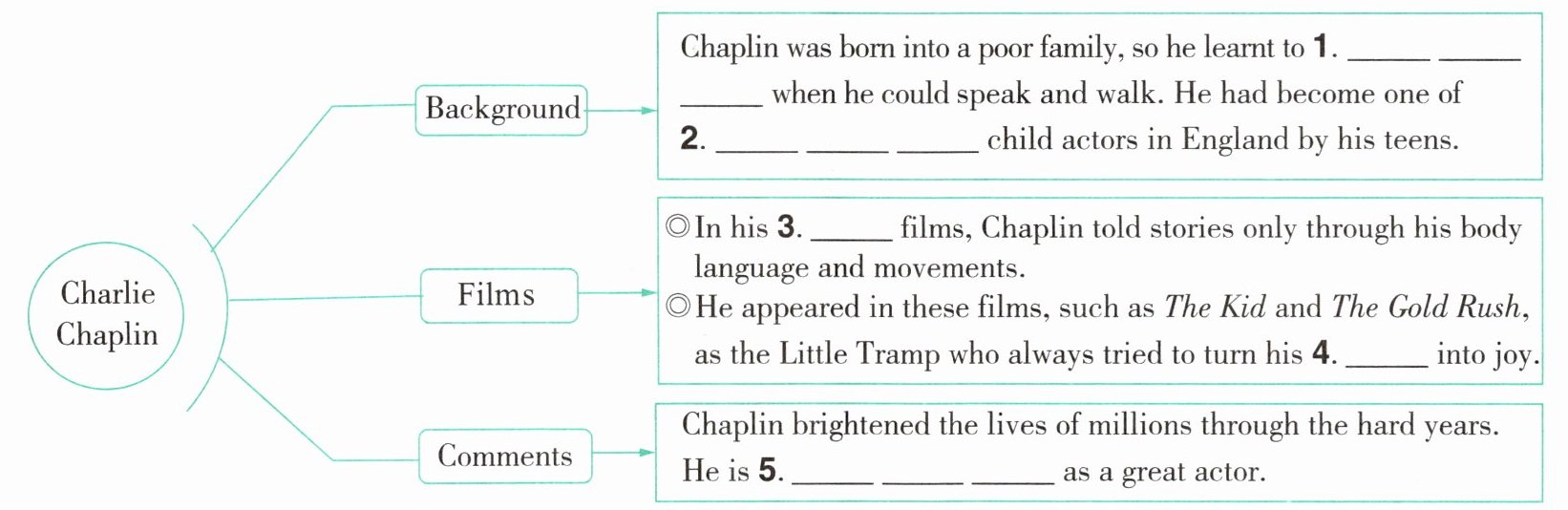 and movements.
◎He appeared in these films, such as The Kid and The Gold Rush, as the Little Tramp who always tried to turn his 4.
Comments
Chaplin brightened the lives of millions through the hard years.
He is 5.
注:人物介绍类语篇研读见答案 P36
Charlie Chaplin
Background
Chaplin was born into a poor family, so he learnt to 1.
sing
and
dance
when he could speak and walk. He had become one of 2. the
most
popular
child actors in England by his teens.Films
◎In his 3.
silent
films, Chaplin told stories only through his body and movements.◎He appeared in these films, such as The Kid and The Gold Rush, as the Little Tramp who always tried to turn his 4.
sadness
into joy.Comments
Chaplin brightened the lives of millions through the hard years.
He is 5.
loved
and
remembered
as a great actor.注:人物介绍类语篇研读见答案 P36
答案
【语篇解构】
1. sing and dance
2. the most popular
3. silent
4. sadness
5. loved and remembered
1. sing and dance
2. the most popular
3. silent
4. sadness
5. loved and remembered
解析
【分析】本题是人物介绍类的语篇解构题,需结合查理·卓别林的生平经历、电影特点及评价补全结构图。解题时,先分析每个空所在句子的语境,再结合人物相关常识和英语语法结构确定答案:1. 背景部分,卓别林出身贫寒,早年需学谋生技能,对应他会唱跳的经历;2. 背景中“one of + 形容词最高级”的固定结构,结合他童星时期的知名度;3. 电影部分,他的早期电影是无声电影,靠肢体语言叙事;4. 角色设定里小流浪汉将负面情绪转为快乐;5. 评价部分,他作为伟大演员被后人铭记热爱。
【解析】1. 卓别林出身贫困,在会说话和走路时就学习唱跳,故填sing and dance;2. “one of + the + 形容词最高级 + 可数名词复数”是固定结构,结合他童星时期的受欢迎程度,填the most popular;3. 卓别林的早期电影为无声电影,仅通过肢体语言和动作讲故事,填silent;4. 他饰演的小流浪汉角色总是努力把悲伤转化为快乐,填sadness;5. 他被热爱和铭记为伟大演员,用被动语态loved and remembered,符合语境。
【答案】1. sing and dance;2. the most popular;3. silent;4. sadness;5. loved and remembered
【知识点】人物介绍、形容词最高级、被动语态
【点评】本题考查对人物相关常识的掌握及语篇语境的理解,需结合卓别林的生平、电影特点完成填空,难度适中。
【难度系数】0.5
【解析】1. 卓别林出身贫困,在会说话和走路时就学习唱跳,故填sing and dance;2. “one of + the + 形容词最高级 + 可数名词复数”是固定结构,结合他童星时期的受欢迎程度,填the most popular;3. 卓别林的早期电影为无声电影,仅通过肢体语言和动作讲故事,填silent;4. 他饰演的小流浪汉角色总是努力把悲伤转化为快乐,填sadness;5. 他被热爱和铭记为伟大演员,用被动语态loved and remembered,符合语境。
【答案】1. sing and dance;2. the most popular;3. silent;4. sadness;5. loved and remembered
【知识点】人物介绍、形容词最高级、被动语态
【点评】本题考查对人物相关常识的掌握及语篇语境的理解,需结合卓别林的生平、电影特点完成填空,难度适中。
【难度系数】0.5
