

 登录
登录
C
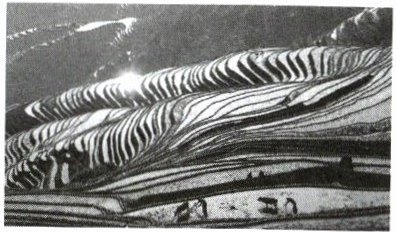
In spring, they are like silver rivers, shining brightly in the sun. Summer sees the mountains turn bright green with growing rice. During autumn, the mountains are gold. And in winter, white snow covers them, making them look very beautiful. These changing colours are what the Longji Rice Terraces(龙脊梯田) look like all year round.
The Longji Rice Terraces were built by the Zhuang and Yao people hundreds of years ago. You might wonder why the Zhuang and Yao people worked so hard to make these terraces. Well, here are the reasons. First, in this area, there were few big, flat(平的) pieces of land. By building these terraces, they could get more places to grow things. Second, the flat terraces can catch the rainwater on rainy days. This helps stop the soil(土壤) from being washed away.
So how do the terraces work? There are hundreds of connected waterways. During the rainy season, rainwater runs down the mountains through these waterways and into the terraces. Then, the sun heats(加热) the water, and it turns into vapor. This vapor forms clouds, and later it rains again onto the terraces.
Even though modern technology can help grow more crops, these terraces still mean a lot to the local people and they pass down the knowledge of taking care of the terraces. So, people today still use the old ways to keep the terraces in good condition. Today, people come from far away to see this great wonder which shows how people work together with nature.
(
A. By listing numbers.
B. By giving famous sayings.
C. By asking questions.
D. By describing the sights.
(
A. Because they helped reduce rainwater.
B. Because they helped wash away the soil.
C. Because they provided flat pieces of land.
D. Because they made the mountains beautiful.
(

A. ①
B. ②
C. ③
D. ④
(
A. They are useless in modern life.
B. They are only for travelling purpose.
C. They are still important and helpful.
D. They are worse than modern technology.
D
In spring, they are like silver rivers, shining brightly in the sun. Summer sees the mountains turn bright green with growing rice. During autumn, the mountains are gold. And in winter, white snow covers them, making them look very beautiful. These changing colours are what the Longji Rice Terraces(龙脊梯田) look like all year round.
The Longji Rice Terraces were built by the Zhuang and Yao people hundreds of years ago. You might wonder why the Zhuang and Yao people worked so hard to make these terraces. Well, here are the reasons. First, in this area, there were few big, flat(平的) pieces of land. By building these terraces, they could get more places to grow things. Second, the flat terraces can catch the rainwater on rainy days. This helps stop the soil(土壤) from being washed away.
So how do the terraces work? There are hundreds of connected waterways. During the rainy season, rainwater runs down the mountains through these waterways and into the terraces. Then, the sun heats(加热) the water, and it turns into vapor. This vapor forms clouds, and later it rains again onto the terraces.
Even though modern technology can help grow more crops, these terraces still mean a lot to the local people and they pass down the knowledge of taking care of the terraces. So, people today still use the old ways to keep the terraces in good condition. Today, people come from far away to see this great wonder which shows how people work together with nature.
(
D
)23. How does the writer introduce Longji Rice Terraces in Paragraph 1?A. By listing numbers.
B. By giving famous sayings.
C. By asking questions.
D. By describing the sights.
(
C
)24. Why did people build Longji Rice Terraces?A. Because they helped reduce rainwater.
B. Because they helped wash away the soil.
C. Because they provided flat pieces of land.
D. Because they made the mountains beautiful.
(
B
)25. Which number shows the underlined word "vapor" in Paragraph 3?A. ①
B. ②
C. ③
D. ④
(
C
)26. What do local people think of Longji Rice Terraces now?A. They are useless in modern life.
B. They are only for travelling purpose.
C. They are still important and helpful.
D. They are worse than modern technology.
D
答案
23.D 24.C 25.B 26.C
解析
【分析】
本题为关于龙脊梯田的英语阅读理解选择题,需结合原文段落内容,逐一分析每道题的考查点并定位对应信息:23题考查作者介绍梯田的方式,需判断第一段的写作手法;24题考查建梯田的原因,需定位第二段的相关表述;25题考查词义猜测,需结合第三段的逻辑推断“vapor”的含义;26题考查当地人对梯田的看法,需定位第四段的关键描述。
【解析】
23题:定位原文第一段,作者分别描述了龙脊梯田春、夏、秋、冬四季的不同景色,是通过描述景色的方式介绍梯田,对应选项D。
24题:定位原文第二段,明确提到“in this area, there were few big, flat pieces of land. By building these terraces, they could get more places to grow things”,说明建梯田是为了提供平坦的种植地,对应选项C。
25题:定位原文第三段,“the sun heats the water, and it turns into vapor”表明vapor是水加热后形成的水汽,结合词义逻辑,对应选项B。
26题:定位原文第四段,“these terraces still mean a lot to the local people and they pass down the knowledge of taking care of the terraces”说明梯田对当地人仍重要且有帮助,对应选项C。
【答案】
23.D 24.C 25.B 26.C
【知识点】
英语阅读理解,细节理解题,词义猜测题
【点评】
本题围绕龙脊梯田展开,侧重考查学生对原文细节信息的定位与理解,以及词义猜测、写作手法判断的能力,整体难度适中,需学生仔细梳理原文对应内容。
【难度系数】
0.7
本题为关于龙脊梯田的英语阅读理解选择题,需结合原文段落内容,逐一分析每道题的考查点并定位对应信息:23题考查作者介绍梯田的方式,需判断第一段的写作手法;24题考查建梯田的原因,需定位第二段的相关表述;25题考查词义猜测,需结合第三段的逻辑推断“vapor”的含义;26题考查当地人对梯田的看法,需定位第四段的关键描述。
【解析】
23题:定位原文第一段,作者分别描述了龙脊梯田春、夏、秋、冬四季的不同景色,是通过描述景色的方式介绍梯田,对应选项D。
24题:定位原文第二段,明确提到“in this area, there were few big, flat pieces of land. By building these terraces, they could get more places to grow things”,说明建梯田是为了提供平坦的种植地,对应选项C。
25题:定位原文第三段,“the sun heats the water, and it turns into vapor”表明vapor是水加热后形成的水汽,结合词义逻辑,对应选项B。
26题:定位原文第四段,“these terraces still mean a lot to the local people and they pass down the knowledge of taking care of the terraces”说明梯田对当地人仍重要且有帮助,对应选项C。
【答案】
23.D 24.C 25.B 26.C
【知识点】
英语阅读理解,细节理解题,词义猜测题
【点评】
本题围绕龙脊梯田展开,侧重考查学生对原文细节信息的定位与理解,以及词义猜测、写作手法判断的能力,整体难度适中,需学生仔细梳理原文对应内容。
【难度系数】
0.7
