

 登录
登录
When someone's heart suddenly stops, we can use an AED to save him or her. It can be found in public places and it is easy to use. Turn it on and follow the voice instructions. Here are some key steps.

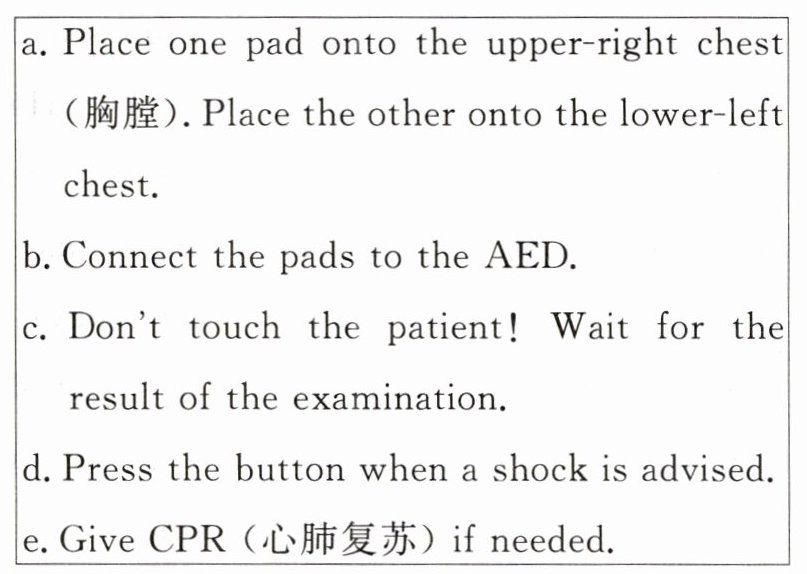
Remember: It's best to treat the patient within the "Golden 4 Minutes"! Time matters! If an AED is not around, send someone to get one and give CPR while waiting. Don't forget to call 120.
1. When is an AED used?
A. When someone's heart suddenly stops.
B. When someone has a headache.
C. When someone's back suddenly hurts.
D. When someone has a toothache.
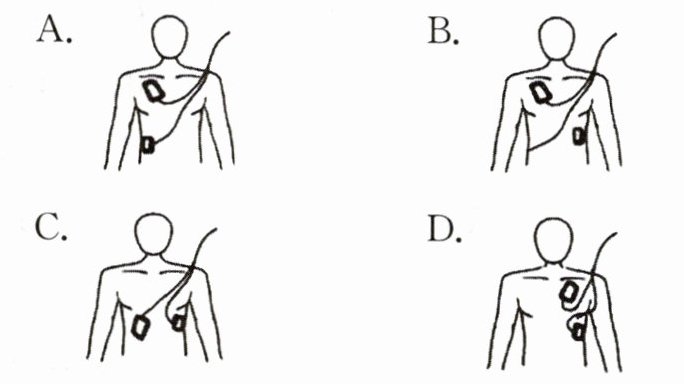
2. Where should the pads be placed on the patient?
3. What's the golden time to use an AED?
A. The first 4 minutes.
B. The first 5 minutes.
C. The first 6 minutes.
D. The first 7 minutes.
Remember: It's best to treat the patient within the "Golden 4 Minutes"! Time matters! If an AED is not around, send someone to get one and give CPR while waiting. Don't forget to call 120.
1. When is an AED used?
A. When someone's heart suddenly stops.
B. When someone has a headache.
C. When someone's back suddenly hurts.
D. When someone has a toothache.
2. Where should the pads be placed on the patient?
3. What's the golden time to use an AED?
A. The first 4 minutes.
B. The first 5 minutes.
C. The first 6 minutes.
D. The first 7 minutes.
答案
Passage 11
1—3 ABA
1—3 ABA
解析
【解析】
1. 根据原文第一句“When someone's heart suddenly stops, we can use an AED to save him or her.”可知,当有人心脏骤停时使用AED,故选A。
2. 根据文章对应的插图提示,电极片的正确放置位置对应选项B。
3. 根据原文“It's best to treat the patient within the 'Golden 4 Minutes'!”可知,黄金救援时间是最初的4分钟,故选A。
【答案】
1—3 ABA
【知识点】
细节信息查找、急救知识阅读
【点评】
本文是关于AED使用的实用类阅读,题目均为细节理解题,考查学生从文中提取关键信息的能力,需精准定位原文内容作答。
【难度系数】
0.8
1. 根据原文第一句“When someone's heart suddenly stops, we can use an AED to save him or her.”可知,当有人心脏骤停时使用AED,故选A。
2. 根据文章对应的插图提示,电极片的正确放置位置对应选项B。
3. 根据原文“It's best to treat the patient within the 'Golden 4 Minutes'!”可知,黄金救援时间是最初的4分钟,故选A。
【答案】
1—3 ABA
【知识点】
细节信息查找、急救知识阅读
【点评】
本文是关于AED使用的实用类阅读,题目均为细节理解题,考查学生从文中提取关键信息的能力,需精准定位原文内容作答。
【难度系数】
0.8
As we often use eyes to touch nature, most of us "lose" the ability to listen to the world.
Peter writes music. He likes sounds and uses natural sounds as part of his music. He often went out to the wild with his microphone and recorded interesting sounds to put in movies or to use in his own songs. Instead of trying to capture just the sound of one animal, he recorded the sound of everything all together—the animals, the trees, the wind and the earth. He called these recordings "soundscapes"—the sound of a certain place. Every soundscape Peter recorded had a lot of information.
Back in his workshop, Peter used a computer to make a picture of all the sounds going on in a place. Each animal, bird and insect had its own place on the picture—its own notes in the music. The busier the picture, the richer the life in that place. "While a picture may be worth 1,000 words, a soundscape is worth 1,000 pictures," Peter said. "Our ears tell us the sound of every leaf and animal and speak to the natural sources(来源)of our lives, which may hold the secrets of love for all things, especially our own humanity."
But not everything is satisfying. When Peter began recording over forty years ago, he could record for ten hours and get one hour of usable material good enough for a movie. Now, because of human activities, it can take up to 1,000 hours or more to get the same thing. Some of the places he has recorded over the years have slowly fallen silent. His sound pictures show that although nature might look the same to humans, it has lost part of its orchestra(管弦乐队).
So next time you are in the forests, try another way to look—shut your eyes, and listen.
1. Why did Peter record natural sounds?
A. To write songs for a music group.
B. To discover rich lives in the forest.
C. To use some of them in his music.
D. To make music about birds singing.
2. What does the underlined word "capture" in Paragraph 2 mean?
A. Shut.
B. Catch.
C. Touch.
D. Check.
3. What is a sound picture in the passage?
A. The sound of every leaf and animal in nature.
B. The sound recorded in the natural environment.
C. A picture of music with sounds of 1,000 animals.
D. A picture of music with natural sounds in a place.
4. What can we learn from Paragraph 4?
A. Recording sounds needs less material.
B. Sound pictures are the same as before.
C. Some beautiful sounds in nature are lost.
D. Human activities improve recording results.
5. What does the writer mainly want to tell us?
A. Nature is the source of our future.
B. Nature has wonders to be heard.
C. Making music enriches our lives.
D. Making music needs information.
Peter writes music. He likes sounds and uses natural sounds as part of his music. He often went out to the wild with his microphone and recorded interesting sounds to put in movies or to use in his own songs. Instead of trying to capture just the sound of one animal, he recorded the sound of everything all together—the animals, the trees, the wind and the earth. He called these recordings "soundscapes"—the sound of a certain place. Every soundscape Peter recorded had a lot of information.
Back in his workshop, Peter used a computer to make a picture of all the sounds going on in a place. Each animal, bird and insect had its own place on the picture—its own notes in the music. The busier the picture, the richer the life in that place. "While a picture may be worth 1,000 words, a soundscape is worth 1,000 pictures," Peter said. "Our ears tell us the sound of every leaf and animal and speak to the natural sources(来源)of our lives, which may hold the secrets of love for all things, especially our own humanity."
But not everything is satisfying. When Peter began recording over forty years ago, he could record for ten hours and get one hour of usable material good enough for a movie. Now, because of human activities, it can take up to 1,000 hours or more to get the same thing. Some of the places he has recorded over the years have slowly fallen silent. His sound pictures show that although nature might look the same to humans, it has lost part of its orchestra(管弦乐队).
So next time you are in the forests, try another way to look—shut your eyes, and listen.
1. Why did Peter record natural sounds?
A. To write songs for a music group.
B. To discover rich lives in the forest.
C. To use some of them in his music.
D. To make music about birds singing.
2. What does the underlined word "capture" in Paragraph 2 mean?
A. Shut.
B. Catch.
C. Touch.
D. Check.
3. What is a sound picture in the passage?
A. The sound of every leaf and animal in nature.
B. The sound recorded in the natural environment.
C. A picture of music with sounds of 1,000 animals.
D. A picture of music with natural sounds in a place.
4. What can we learn from Paragraph 4?
A. Recording sounds needs less material.
B. Sound pictures are the same as before.
C. Some beautiful sounds in nature are lost.
D. Human activities improve recording results.
5. What does the writer mainly want to tell us?
A. Nature is the source of our future.
B. Nature has wonders to be heard.
C. Making music enriches our lives.
D. Making music needs information.
答案
Passage 12
1. C 根据第二段中的“He…recorded interesting sounds to put in movies or to use in his own songs.”可知,Peter录制自然声音的目的是用于音乐创作,故选C。
2. B 根据后文中的“recorded the sound of everything”可推测“capture”在此意为“捕捉(声音)”,与“Catch”语意一致,故选B。
3. D 根据第三段中的“Peter used a computer to make a picture of all the sounds going on in a place”“Each animal,bird and insect had its own place on the picture”可知,sound picture是指包含自然声音的音乐图片,故选D。
4. C 第四段指出因人类活动,过去10小时可得的素材现在需1,000小时才能获得,且部分录制地逐渐变得安静,再结合“although nature might look the same to humans,it has lost part of its orchestra(管弦乐队)”可知,自然中某些美妙声音已消失,故选C。
5. B 根据文章结尾处的“shut your eyes,and listen”及全文对自然声音价值的强调可知,文章的核心主旨是“大自然中有可被听见的奇迹”,故选B。
1. C 根据第二段中的“He…recorded interesting sounds to put in movies or to use in his own songs.”可知,Peter录制自然声音的目的是用于音乐创作,故选C。
2. B 根据后文中的“recorded the sound of everything”可推测“capture”在此意为“捕捉(声音)”,与“Catch”语意一致,故选B。
3. D 根据第三段中的“Peter used a computer to make a picture of all the sounds going on in a place”“Each animal,bird and insect had its own place on the picture”可知,sound picture是指包含自然声音的音乐图片,故选D。
4. C 第四段指出因人类活动,过去10小时可得的素材现在需1,000小时才能获得,且部分录制地逐渐变得安静,再结合“although nature might look the same to humans,it has lost part of its orchestra(管弦乐队)”可知,自然中某些美妙声音已消失,故选C。
5. B 根据文章结尾处的“shut your eyes,and listen”及全文对自然声音价值的强调可知,文章的核心主旨是“大自然中有可被听见的奇迹”,故选B。
解析
【解析】
1. 根据第二段中的“He…recorded interesting sounds to put in movies or to use in his own songs.”可知,Peter录制自然声音的目的是用于音乐创作,故选C。
2. 根据后文中的“recorded the sound of everything”可推测“capture”在此意为“捕捉(声音)”,与“Catch”语意一致,故选B。
3. 根据第三段中的“Peter used a computer to make a picture of all the sounds going on in a place”“Each animal,bird and insect had its own place on the picture”可知,sound picture是指包含一个地方自然声音的音乐图片,故选D。
4. 第四段指出因人类活动,过去10小时可得的素材现在需1000小时才能获得,且部分录制地逐渐变得安静,再结合“although nature might look the same to humans,it has lost part of its orchestra(管弦乐队)”可知,自然中某些美妙声音已消失,故选C。
5. 根据文章结尾处的“shut your eyes,and listen”及全文对自然声音价值的强调可知,文章的核心主旨是“大自然中有可被听见的奇迹”,故选B。
【答案】
1. C
2. B
3. D
4. C
5. B
【知识点】
词义猜测题、细节理解题、主旨大意题
【点评】
本文通过介绍音乐人Peter录制自然声音创作音乐的故事,强调了自然声音的价值,呼吁人们聆听自然。题目考查多种阅读理解技能,有助于提升学生捕捉细节、猜测词义及归纳主旨的能力。
【难度系数】
0.6
1. 根据第二段中的“He…recorded interesting sounds to put in movies or to use in his own songs.”可知,Peter录制自然声音的目的是用于音乐创作,故选C。
2. 根据后文中的“recorded the sound of everything”可推测“capture”在此意为“捕捉(声音)”,与“Catch”语意一致,故选B。
3. 根据第三段中的“Peter used a computer to make a picture of all the sounds going on in a place”“Each animal,bird and insect had its own place on the picture”可知,sound picture是指包含一个地方自然声音的音乐图片,故选D。
4. 第四段指出因人类活动,过去10小时可得的素材现在需1000小时才能获得,且部分录制地逐渐变得安静,再结合“although nature might look the same to humans,it has lost part of its orchestra(管弦乐队)”可知,自然中某些美妙声音已消失,故选C。
5. 根据文章结尾处的“shut your eyes,and listen”及全文对自然声音价值的强调可知,文章的核心主旨是“大自然中有可被听见的奇迹”,故选B。
【答案】
1. C
2. B
3. D
4. C
5. B
【知识点】
词义猜测题、细节理解题、主旨大意题
【点评】
本文通过介绍音乐人Peter录制自然声音创作音乐的故事,强调了自然声音的价值,呼吁人们聆听自然。题目考查多种阅读理解技能,有助于提升学生捕捉细节、猜测词义及归纳主旨的能力。
【难度系数】
0.6
