

 登录
登录
一、根据句意及汉语提示填写单词
1. The
2. Mr Liu has a
3. I ate too much just now. Now my
4. I think that a good doctor should be kind and
5. You should wash your hands to keep the
1. The
dentist
( 牙 医 ) told me to brush my teeth twice a day.2. Mr Liu has a
fever
( 发烧 ) so he should stop working to have a rest.3. I ate too much just now. Now my
stomach
( 胃部 ) aches.4. I think that a good doctor should be kind and
patient
( 有耐心的 ).5. You should wash your hands to keep the
virus
( 病毒 ) away.答案
1. dentist 2. fever 3. stomach 4. patient 5. virus
二、在空白处填入适当的词或用括号中所给单词的适当形式填空
1. He suffered
2. —What's the matter with you?
—I have a
3. The teacher said that my answer was wrong because I was
4. The
5. Tom
6. He needs
7. The
8. The doctor
9. Her
10. Please take
1. He suffered
from
a bad cold last week but he feels much better now.2. —What's the matter with you?
—I have a
runny
( run ) nose.3. The teacher said that my answer was wrong because I was
careless
( care ).4. The
injury
( injure ) to his back made him stay in bed for a week.5. Tom
coughed
( cough ) a lot so he went to the hospital at once.6. He needs
to avoid
( avoid ) junk food to keep healthy.7. The
description
( describe ) on the website matches the product perfectly.8. The doctor
tested
( test ) my eyesight carefully and gave me some advice.9. Her
illness
( ill ) is not serious, and she will get well soon.10. Please take
a
seat. I'll be right back with your coffee.答案
1. from 2. runny 3. careless 4. injury 5. coughed 6. to avoid 7. description 8. tested 9. illness 10. a
三、句子翻译
1. 我流鼻血了,我现在该怎么办?
2. 让我量一下你的体温吧。
3. 护士让 Jeff 按住鼻子等几分钟。
4. 医生告诉 Helen 吃些药并多喝水。
5. 这种药可以防止你感冒。
1. 我流鼻血了,我现在该怎么办?
I have a nosebleed. What should I do for now?
2. 让我量一下你的体温吧。
Let me take your temperature.
3. 护士让 Jeff 按住鼻子等几分钟。
The nurse asked Jeff to press down on his nose and wait for a few minutes.
4. 医生告诉 Helen 吃些药并多喝水。
The doctor asked Helen to take some medicine and drink more water.
5. 这种药可以防止你感冒。
This medicine can stop you from getting a cold.
答案
1. I have a nosebleed. What should I do for now? 2. Let me take your temperature. 3. The nurse asked Jeff to press down on his nose and wait for a few minutes. 4. The doctor asked Helen to take some medicine and drink more water. 5. This medicine can stop you from getting a cold.
一、阅读短文,选择正确答案
Have you ever talked to someone who had no teeth? They cannot speak very clearly. You need teeth to help you talk right. A person who has no teeth has another problem too. The face of that person is not as pretty as the face of someone with pretty teeth. Also teeth chew ( 咀嚼 ) your food for you. If you had no teeth, you would only be able to eat soft food rather than beef, apples, biscuits or hamburgers.
Tooth care begins with eating the right kinds of food. Eat green vegetables, and drink three or more glasses of milk a day. Try not to eat sweets. Fruits are better for you.
Remember to brush your teeth after eating. Always brush your teeth the way they grow—up on the lower teeth and down on the upper teeth. Do not use your teeth as a tool to bite into hard things, such as opening a bottle with your teeth. Or you may hurt your teeth badly. Another suggestion for you is to visit your dentist twice a year. He can tell if anything bad has happened to your teeth. Moreover, if your gums ( 牙 龈 ) bleed while brushing, it might be an indication of unhealthy teeth. Tell your parents or dentist about it early.
Healthy teeth not only let you enjoy delicious food but also give you confidence to smile brightly. Start caring for your teeth now, and they will stay strong for your whole life!
1. Paragraph 1 mainly tells us
A. the importance of teeth
B. we should try to speak clearly
C. a person without teeth is ugly
D. teeth can chew food for us
2. According to the text, which of the following shows the right directions while brushing teeth? (
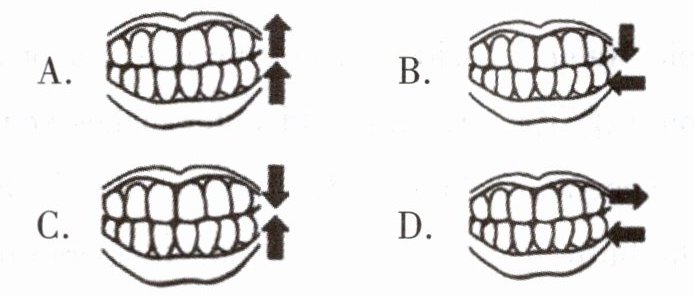
3. The underlined word “indication” in Paragraph 3 means “
A. prize
B. service
C. rule
D. sign
4. In which section of a magazine can we read the text? (
A. History.
B. Health.
C. Business.
D. Art.
Have you ever talked to someone who had no teeth? They cannot speak very clearly. You need teeth to help you talk right. A person who has no teeth has another problem too. The face of that person is not as pretty as the face of someone with pretty teeth. Also teeth chew ( 咀嚼 ) your food for you. If you had no teeth, you would only be able to eat soft food rather than beef, apples, biscuits or hamburgers.
Tooth care begins with eating the right kinds of food. Eat green vegetables, and drink three or more glasses of milk a day. Try not to eat sweets. Fruits are better for you.
Remember to brush your teeth after eating. Always brush your teeth the way they grow—up on the lower teeth and down on the upper teeth. Do not use your teeth as a tool to bite into hard things, such as opening a bottle with your teeth. Or you may hurt your teeth badly. Another suggestion for you is to visit your dentist twice a year. He can tell if anything bad has happened to your teeth. Moreover, if your gums ( 牙 龈 ) bleed while brushing, it might be an indication of unhealthy teeth. Tell your parents or dentist about it early.
Healthy teeth not only let you enjoy delicious food but also give you confidence to smile brightly. Start caring for your teeth now, and they will stay strong for your whole life!
1. Paragraph 1 mainly tells us
A
. (A
)A. the importance of teeth
B. we should try to speak clearly
C. a person without teeth is ugly
D. teeth can chew food for us
2. According to the text, which of the following shows the right directions while brushing teeth? (
C
)3. The underlined word “indication” in Paragraph 3 means “
D
”. (D
)A. prize
B. service
C. rule
D. sign
4. In which section of a magazine can we read the text? (
B
)A. History.
B. Health.
C. Business.
D. Art.
答案
1—4 ACDB
