

 登录
登录
一、根据句意及汉语提示填写单词
1. He was so thankful for the help that he
2. Little Nancy
3. After their big argument, they finally
4. She was so excited that she raised her
5. It's impolite to
1. He was so thankful for the help that he
bowed
(鞠躬)to his friend again and again.2. Little Nancy
kissed
(亲吻)her favourite doll and put it to sleep in the toy bed.3. After their big argument, they finally
hugged
(拥抱)and said sorry to each other.4. She was so excited that she raised her
fist
(拳头)in the air and shouted for joy.5. It's impolite to
bump
(碰;撞)into others in a crowded place.答案
一、1. bowed 2. kissed 3. hugged 4. fist 5. bump
二、在空白处填入适当的词或用括号中所给单词的适当形式填空
1. The dog
2. He felt
3. When meeting important guests, we should speak and behave
4. The little boy
5. She looked
6. Lily finds it hard to communicate
1. The dog
shook
(shake)its wet fur after the bath, and water went everywhere.2. He felt
embarrassed
(embarrass)when he made a mistake in front of the class.3. When meeting important guests, we should speak and behave
formally
(formal)to show respect.4. The little boy
rubbed
(rub)his eyes because he was sleepy.5. She looked
confused
(confuse)when she heard the difficult question.6. Lily finds it hard to communicate
with
new people.答案
二、1. shook 2. embarrassed 3. formally 4. rubbed 5. confused 6. with
三、句子翻译
1. 我们从不碰拳头,因为那不够正式。
2. 在日本,人们见面时通常鞠躬。
3. 他们第一次见面时握了手。
4. 在法国,人们经常亲吻脸颊来互相问候。
5. 他因为在全班面前犯了错误而感到尴尬。
1. 我们从不碰拳头,因为那不够正式。
We never bump fists because it's not formal enough.
2. 在日本,人们见面时通常鞠躬。
In Japan, people usually bow when they meet.
3. 他们第一次见面时握了手。
They shook hands when they met for the first time.
4. 在法国,人们经常亲吻脸颊来互相问候。
In France, people often kiss cheeks to greet each other.
5. 他因为在全班面前犯了错误而感到尴尬。
He felt embarrassed when he made a mistake in front of the class.
答案
三、1. We never bump fists because it's not formal enough. 2. In Japan, people usually bow when they meet. 3. They shook hands when they met for the first time. 4. In France, people often kiss cheeks to greet each other. 5. He felt embarrassed when he made a mistake in front of the class.
一、阅读短文,从方框内所给选项中选出可以填入空白处的最佳选项,其中有一个多余的选项
All societies have customs about how to eat politely. In English, we call these customs "table manners". Based on culture and location, table manners can be quite different from place to place. It's very interesting! 1.
In some cultures, it's polite to serve food to guests, while in other cultures, people don't do this because it makes the guests feel like they are being forced to eat. In most East Asian countries, people use chopsticks at the table. 2.
4.
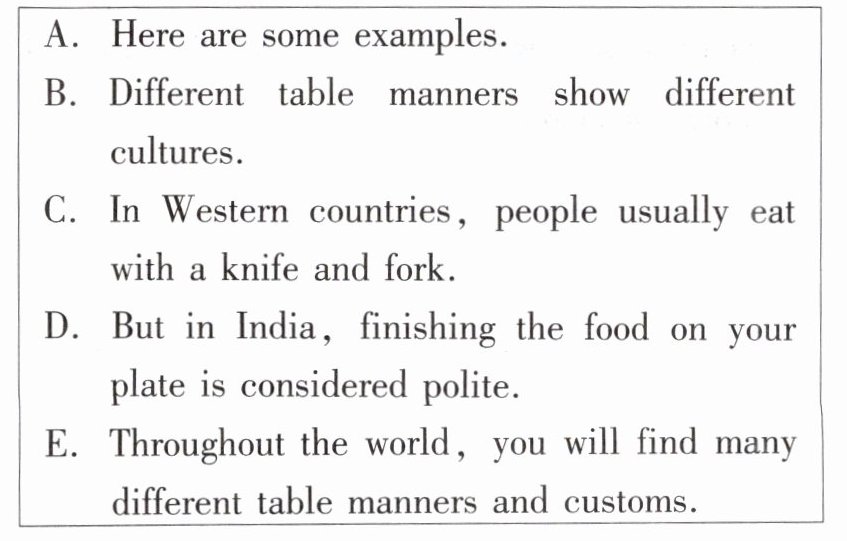
All societies have customs about how to eat politely. In English, we call these customs "table manners". Based on culture and location, table manners can be quite different from place to place. It's very interesting! 1.
A
In some cultures, it's polite to serve food to guests, while in other cultures, people don't do this because it makes the guests feel like they are being forced to eat. In most East Asian countries, people use chopsticks at the table. 2.
C
Do you know that in some places people simply use their hands to eat? And in some places, only their right hand? In Russia, it's polite to leave a bit of food on your plate to show the host that there was plenty to eat. 3. D
It means you enjoyed the food.4.
E
So when you visit another place or another country, take the time to learn the local customs and manners. Remember, "When in Rome, do as the Romans do."答案
一、1—4 ACDE
