

 登录
登录
3Ⅰ. Put the following words in the correct space and write their past forms.
play cook meet go do visit lose try give take learn talk see feel get leave look ask answer realize spend stop walk work
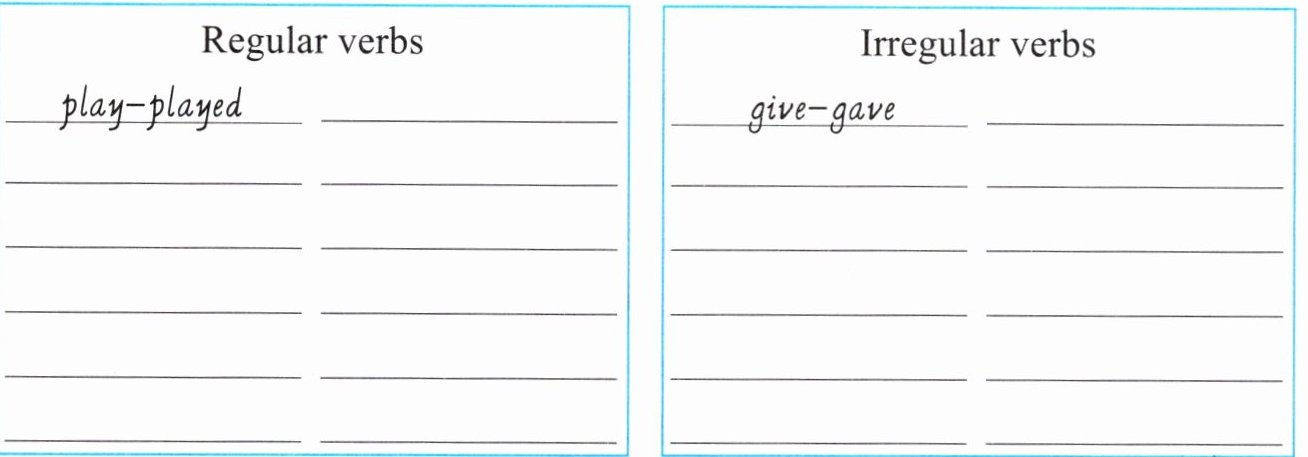
play cook meet go do visit lose try give take learn talk see feel get leave look ask answer realize spend stop walk work
答案
Ⅰ.
Regular verbs
play—played cook—cooked
visit—visited try—tried
talk—talked look—looked
ask—asked answer—answered
realize—realized stop—stopped
walk—walked work—worked
Irregular verbs
give—gave meet—met
go—went do—did
lose—lost take—took
learn—learnt / learned see—saw
feel—felt get—got
leave—left spend—spent
Regular verbs
play—played cook—cooked
visit—visited try—tried
talk—talked look—looked
ask—asked answer—answered
realize—realized stop—stopped
walk—walked work—worked
Irregular verbs
give—gave meet—met
go—went do—did
lose—lost take—took
learn—learnt / learned see—saw
feel—felt get—got
leave—left spend—spent
解析
【解析】
首先区分规则动词和不规则动词:规则动词过去式通常遵循一般变化规则(直接加-ed、以不发音e结尾加-d、辅音字母+y结尾变y为i加-ed、重读闭音节结尾双写末尾辅音字母加-ed);不规则动词过去式无统一变化规则,需特殊记忆。再将给出的动词分别归入对应类别并写出过去式。
【答案】
Regular verbs
play—played cook—cooked
visit—visited try—tried
talk—talked look—looked
ask—asked answer—answered
realize—realized stop—stopped
walk—walked work—worked
Irregular verbs
give—gave meet—met
go—went do—did
lose—lost take—took
learn—learnt / learned see—saw
feel—felt get—got
leave—left spend—spent
【知识点】
规则动词过去式,不规则动词过去式,动词分类
【点评】
本题考查规则与不规则动词过去式的掌握,需牢记不同动词过去式的变化规则与特殊变形,能帮助强化一般过去时的动词运用能力。
【难度系数】
0.6
首先区分规则动词和不规则动词:规则动词过去式通常遵循一般变化规则(直接加-ed、以不发音e结尾加-d、辅音字母+y结尾变y为i加-ed、重读闭音节结尾双写末尾辅音字母加-ed);不规则动词过去式无统一变化规则,需特殊记忆。再将给出的动词分别归入对应类别并写出过去式。
【答案】
Regular verbs
play—played cook—cooked
visit—visited try—tried
talk—talked look—looked
ask—asked answer—answered
realize—realized stop—stopped
walk—walked work—worked
Irregular verbs
give—gave meet—met
go—went do—did
lose—lost take—took
learn—learnt / learned see—saw
feel—felt get—got
leave—left spend—spent
【知识点】
规则动词过去式,不规则动词过去式,动词分类
【点评】
本题考查规则与不规则动词过去式的掌握,需牢记不同动词过去式的变化规则与特殊变形,能帮助强化一般过去时的动词运用能力。
【难度系数】
0.6
Ⅱ. Complete the sentences with the proper forms of the words in Exercise Ⅰ.
1. Tom failed the maths exam. He
2. I got on the wrong bus. What’s worse, I
3. The car
4. Although it was difficult, she
5. She
1. Tom failed the maths exam. He
felt
really bad about it.2. I got on the wrong bus. What’s worse, I
left
my bag on the bus too.3. The car
stopped
when the traffic light turned red.4. Although it was difficult, she
tried
her best to solve the problem.5. She
gave
her ticket to the woman at the check-in desk.答案
Ⅱ. 1. felt 2. left 3. stopped 4. tried 5. gave
解析
【解析】
1. 前半句中failed为过去式,说明句子是一般过去时,feel的过去式felt符合“感到糟糕”的语境。
2. 前半句got是过去式,句子为一般过去时,leave的过去式left表示“落下”,契合“把包落在车上”的语境。
3. 后半句turned是过去式,句子为一般过去时,stop的过去式stopped表示“停下”,符合“红灯时车辆停下”的语境。
4. 前半句was是过去式,句子为一般过去时,try one's best是固定短语,try的过去式tried符合“尽力解决问题”的语境。
5. 句子描述过去的动作,用一般过去时,give的过去式gave表示“递、给”,符合“在值机柜台递票”的语境。
【答案】
1. felt 2. left 3. stopped 4. tried 5. gave
【知识点】
一般过去时用法、动词过去式变形、常用动词短语
【点评】
本题考查一般过去时的实际运用,需结合句子语境和已有过去式提示选择合适动词的过去式填空,重点考查不规则动词过去式的掌握,属于基础类时态运用题。
【难度系数】
0.8
1. 前半句中failed为过去式,说明句子是一般过去时,feel的过去式felt符合“感到糟糕”的语境。
2. 前半句got是过去式,句子为一般过去时,leave的过去式left表示“落下”,契合“把包落在车上”的语境。
3. 后半句turned是过去式,句子为一般过去时,stop的过去式stopped表示“停下”,符合“红灯时车辆停下”的语境。
4. 前半句was是过去式,句子为一般过去时,try one's best是固定短语,try的过去式tried符合“尽力解决问题”的语境。
5. 句子描述过去的动作,用一般过去时,give的过去式gave表示“递、给”,符合“在值机柜台递票”的语境。
【答案】
1. felt 2. left 3. stopped 4. tried 5. gave
【知识点】
一般过去时用法、动词过去式变形、常用动词短语
【点评】
本题考查一般过去时的实际运用,需结合句子语境和已有过去式提示选择合适动词的过去式填空,重点考查不规则动词过去式的掌握,属于基础类时态运用题。
【难度系数】
0.8
Ⅲ. Rewrite the sentences with the words given after the model.
Model: I go to the cinema on Saturday evening. (last Saturday evening) → I went to the cinema last Saturday evening.
1. Linda takes the subway to school every day. (the day before yesterday) →
2. The boy goes to the theatre to watch a show every weekend. (a week ago) →
3. There are too many people in the supermarket today. (last night) →
4. Do you visit the Natural History Museum every year? (last weekend) →
5. Does Tony study for the science test? (yesterday) →
Model: I go to the cinema on Saturday evening. (last Saturday evening) → I went to the cinema last Saturday evening.
1. Linda takes the subway to school every day. (the day before yesterday) →
Linda took the subway to school the day before yesterday.
2. The boy goes to the theatre to watch a show every weekend. (a week ago) →
The boy went to the theatre to watch a show a week ago.
3. There are too many people in the supermarket today. (last night) →
There were too many people in the supermarket last night.
4. Do you visit the Natural History Museum every year? (last weekend) →
Did you visit the Natural History Museum last weekend?
5. Does Tony study for the science test? (yesterday) →
Did Tony study for the science test yesterday?
答案
Ⅲ. 1. Linda took the subway to school the day before yesterday. 2. The boy went to the theatre to watch a show a week ago. 3. There were too many people in the supermarket last night. 4. Did you visit the Natural History Museum last weekend? 5. Did Tony study for the science test yesterday?
解析
【解析】
本题要求根据给定的过去时间状语,将一般现在时的句子改写为一般过去时,改写规则如下:
1. 主谓宾结构且谓语为实义动词时,将一般现在时的动词形式改为过去式;
2. there be句型中,把are改为were;
3. 一般疑问句中,将助动词do/does改为did,实义动词还原为原形。
按照上述规则结合每个句子的时间状语进行改写即可。
【答案】
Ⅲ. 1. Linda took the subway to school the day before yesterday. 2. The boy went to the theatre to watch a show a week ago. 3. There were too many people in the supermarket last night. 4. Did you visit the Natural History Museum last weekend? 5. Did Tony study for the science test yesterday?
【知识点】
一般过去时改写、实义动词过去式、there be句型时态转换
【点评】
本题通过时间状语的变化,考查学生对一般现在时与一般过去时转换规则的掌握,重点突出谓语动词和助动词的形式变化,帮助学生强化不同时态的运用能力。
【难度系数】
0.8
本题要求根据给定的过去时间状语,将一般现在时的句子改写为一般过去时,改写规则如下:
1. 主谓宾结构且谓语为实义动词时,将一般现在时的动词形式改为过去式;
2. there be句型中,把are改为were;
3. 一般疑问句中,将助动词do/does改为did,实义动词还原为原形。
按照上述规则结合每个句子的时间状语进行改写即可。
【答案】
Ⅲ. 1. Linda took the subway to school the day before yesterday. 2. The boy went to the theatre to watch a show a week ago. 3. There were too many people in the supermarket last night. 4. Did you visit the Natural History Museum last weekend? 5. Did Tony study for the science test yesterday?
【知识点】
一般过去时改写、实义动词过去式、there be句型时态转换
【点评】
本题通过时间状语的变化,考查学生对一般现在时与一般过去时转换规则的掌握,重点突出谓语动词和助动词的形式变化,帮助学生强化不同时态的运用能力。
【难度系数】
0.8
