

 登录
登录
Ⅰ. Complete the passage with the proper form of the words and expressions in the box.
survive midsummer underground ancient
well water shortage thanks to amazing
Turpan, located in Xinjiang, is one of the hottest and driest places in China. In 1.
The karez system in Turpan includes more than 1,000 connected 5.
8.
survive midsummer underground ancient
well water shortage thanks to amazing
Turpan, located in Xinjiang, is one of the hottest and driest places in China. In 1.
midsummer
, the desert sand can be as hot as 80°C! It has a serious 2.water shortage
, with only about 16 mm of rainfall each year. So how do people 3.survive
in such a dry place? The secret lies in the karez system, a(n) 4.ancient
watering system built over 2,000 years ago.The karez system in Turpan includes more than 1,000 connected 5.
wells
, some as deep as 100 metres. They appear every 20 - 30 metres. Under these wells, there are over 5,000 km of 6.underground
canals. Water from the mountains falls into the wells and then runs underground in the canals. This keeps water cool and safe from the desert heat. 7.Amazingly
, it was all built by hand.8.
Thanks to
the karez system, local people can grow grapes and other fruit in the desert. Today, the system still plays an important role. More young people are protecting it. The centuries - old water system will surely be carried into the future.答案
Ⅰ. 1. midsummer 2. water shortage 3. survive 4. ancient 5. wells 6. underground 7. Amazingly 8. Thanks to
解析
【解析】
1. 根据前文提到吐鲁番炎热干旱的特点,此处表示“在盛夏”时沙漠沙子温度可达80℃,故填midsummer。
2. 由后文“年降雨量仅约16毫米”可知,当地存在严重的水资源短缺问题,故填water shortage。
3. 前文描述了当地极端干旱的环境,此处询问人们如何在这样的环境中生存,故填survive。
4. 由“建于2000多年前”可知,坎儿井是古老的灌溉系统,故填ancient。
5. 坎儿井系统包含1000多个相连的井,well为可数名词,此处需用复数形式wells。
6. 根据后文“水在运河里地下流动”的描述,可知这些是地下运河,故填underground。
7. 此处需要副词修饰整个句子,表达“令人惊讶的是,它全是手工建造的”这一含义,故填Amazingly。
8. 结合语境,坎儿井系统让当地人能在沙漠种植作物,此处表示“多亏了”,故填Thanks to。
【答案】
1. midsummer 2. water shortage 3. survive 4. ancient 5. wells 6. underground 7. Amazingly 8. Thanks to
【知识点】
词汇语境运用、副词用法、固定短语
【点评】
本题结合吐鲁番坎儿井的文化背景,考查学生对词汇形式转换及语境运用的能力,要求学生能根据上下文准确选择并变换词汇形式,同时了解相关地域文化常识。
【难度系数】
0.6
1. 根据前文提到吐鲁番炎热干旱的特点,此处表示“在盛夏”时沙漠沙子温度可达80℃,故填midsummer。
2. 由后文“年降雨量仅约16毫米”可知,当地存在严重的水资源短缺问题,故填water shortage。
3. 前文描述了当地极端干旱的环境,此处询问人们如何在这样的环境中生存,故填survive。
4. 由“建于2000多年前”可知,坎儿井是古老的灌溉系统,故填ancient。
5. 坎儿井系统包含1000多个相连的井,well为可数名词,此处需用复数形式wells。
6. 根据后文“水在运河里地下流动”的描述,可知这些是地下运河,故填underground。
7. 此处需要副词修饰整个句子,表达“令人惊讶的是,它全是手工建造的”这一含义,故填Amazingly。
8. 结合语境,坎儿井系统让当地人能在沙漠种植作物,此处表示“多亏了”,故填Thanks to。
【答案】
1. midsummer 2. water shortage 3. survive 4. ancient 5. wells 6. underground 7. Amazingly 8. Thanks to
【知识点】
词汇语境运用、副词用法、固定短语
【点评】
本题结合吐鲁番坎儿井的文化背景,考查学生对词汇形式转换及语境运用的能力,要求学生能根据上下文准确选择并变换词汇形式,同时了解相关地域文化常识。
【难度系数】
0.6
Ⅱ. Read and complete the tasks.
For a long time, people have been changing nature in amazing ways. One wonderful example is the Longji Rice Terraces (梯田) in Guangxi, China. These beautiful terraces were built by the local Zhuang and Yao people. The work began during the Yuan Dynasty and took hundreds of years to complete, finally finished in the early Qing Dynasty.
▲ First, there aren't many large and flat lands in this area. By making terraces on the mountains, they could have more places to grow rice. Second, although there's lots of rain here, the mountains are steep and the soil is not deep. The flat terraces can hold rainwater and stop the soil from being washed away.
What's really special is how people have worked with nature here. The terraces are connected by many waterways. In the rainy season, rainwater flows down the mountains through these waterways into the terraces. The sun warms the water and turns it into vapour (水蒸气), which forms clouds and then rains back onto the terraces. Also, the terraces are a good home for birds and fish. Some of these animals eat insects that can harm the rice plants.
Today, modern farming technology could help grow more crops, but the Longji Rice Terraces are still very important to the local people because they value traditions. The knowledge of building and caring for the terraces is passed down through families, so younger generations still use the old farming methods. Now, thousands of visitors come each year to see this amazing place where people and nature work together in harmony.
A. Complete the table. No more than four words for each blank.
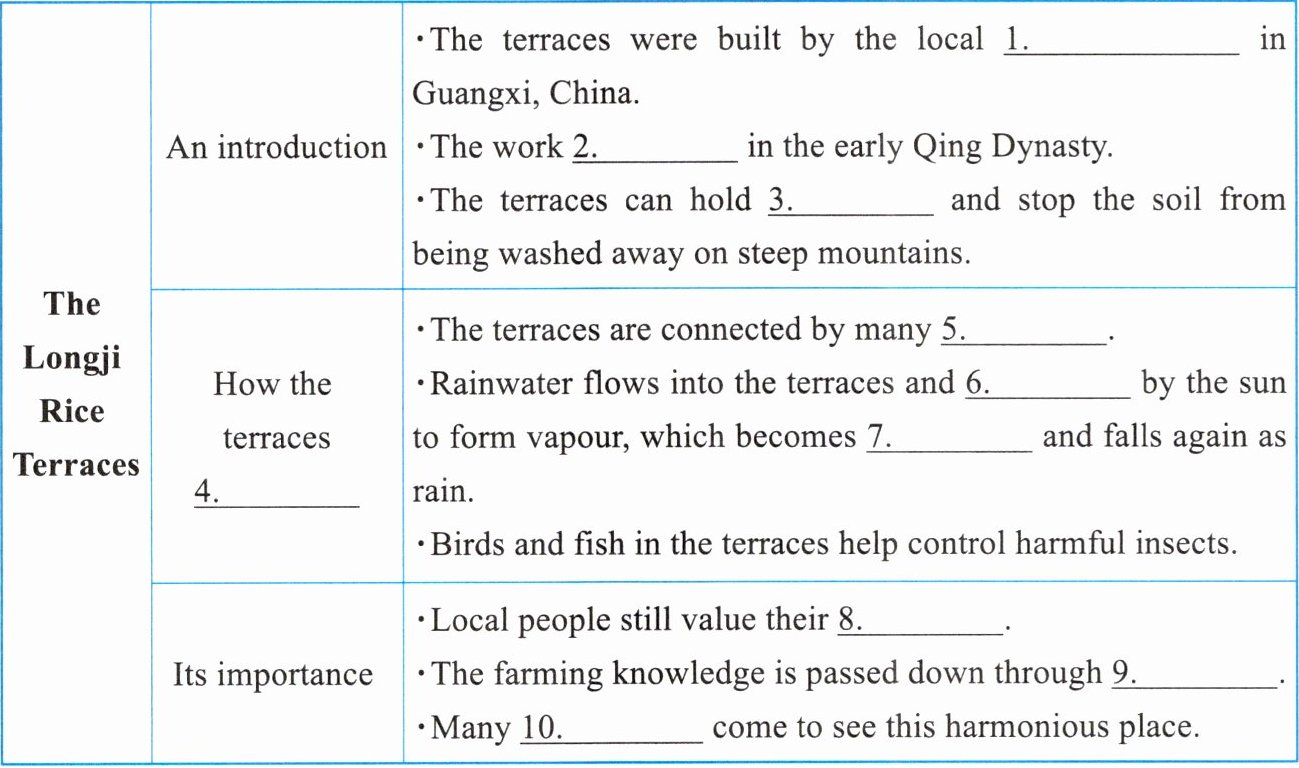
B. Answer the questions.
(
A. Who came to visit the terraces?
B. Why did people build these terraces?
C. When did people start to build the terraces?
D. How long did it take to build the terraces?
(
A. Longji Rice Terraces help grow more crops.
B. Many visitors come to see the beautiful Longji Rice Terraces.
C. Longji Rice Terraces were built to stop soil from washing away.
D. Longji Rice Terraces show harmony between people and nature.
C. Put the following in the correct order to show how water moves in the terraces during the rainy season.
rain →
A. turn into vapour
B. form clouds
C. flow into the terraces
D. run through the waterways
For a long time, people have been changing nature in amazing ways. One wonderful example is the Longji Rice Terraces (梯田) in Guangxi, China. These beautiful terraces were built by the local Zhuang and Yao people. The work began during the Yuan Dynasty and took hundreds of years to complete, finally finished in the early Qing Dynasty.
▲ First, there aren't many large and flat lands in this area. By making terraces on the mountains, they could have more places to grow rice. Second, although there's lots of rain here, the mountains are steep and the soil is not deep. The flat terraces can hold rainwater and stop the soil from being washed away.
What's really special is how people have worked with nature here. The terraces are connected by many waterways. In the rainy season, rainwater flows down the mountains through these waterways into the terraces. The sun warms the water and turns it into vapour (水蒸气), which forms clouds and then rains back onto the terraces. Also, the terraces are a good home for birds and fish. Some of these animals eat insects that can harm the rice plants.
Today, modern farming technology could help grow more crops, but the Longji Rice Terraces are still very important to the local people because they value traditions. The knowledge of building and caring for the terraces is passed down through families, so younger generations still use the old farming methods. Now, thousands of visitors come each year to see this amazing place where people and nature work together in harmony.
A. Complete the table. No more than four words for each blank.
B. Answer the questions.
(
B
)1. Which of the following is the best to fill in "▲"?A. Who came to visit the terraces?
B. Why did people build these terraces?
C. When did people start to build the terraces?
D. How long did it take to build the terraces?
(
D
)2. What is the main idea of the passage?A. Longji Rice Terraces help grow more crops.
B. Many visitors come to see the beautiful Longji Rice Terraces.
C. Longji Rice Terraces were built to stop soil from washing away.
D. Longji Rice Terraces show harmony between people and nature.
C. Put the following in the correct order to show how water moves in the terraces during the rainy season.
rain →
D
→ C
→ A
→ B
A. turn into vapour
B. form clouds
C. flow into the terraces
D. run through the waterways
答案
Ⅱ. A. 1. Zhuang and Yao people 2. was finished 3. rainwater 4. work 5. waterways 6. is warmed 7. clouds 8. traditions 9. families 10. visitors B. 1. B 2. D C. D→C→A→B
解析
【解析】
A. 完成表格:
1. 从原文“These beautiful terraces were built by the local Zhuang and Yao people.”提取对应答案;
2. 根据原文“finally finished in the early Qing Dynasty.”,此处需用被动语态,故填was finished;
3. 由原文“The flat terraces can hold rainwater”得出答案;
4. 该板块介绍梯田的运作模式,对应原文“What's really special is how people have worked with nature here.”,故填work;
5. 从原文“The terraces are connected by many waterways.”提取答案;
6. 根据原文“The sun warms the water and turns it into vapour”,此处需用被动语态,故填is warmed;
7. 由原文“which forms clouds and then rains back onto the terraces.”得出答案;
8. 从原文“because they value traditions.”提取答案;
9. 根据原文“The knowledge of building and caring for the terraces is passed down through families”提取答案;
10. 由原文“Now, thousands of visitors come each year”提取答案。
B. 选择题:
1. 后文内容围绕建造梯田的原因展开,因此选B;
2. 文章核心主旨是龙脊梯田体现了人与自然的和谐共生,对应选项D。
C. 排序题:
根据原文“In the rainy season, rainwater flows down the mountains through these waterways into the terraces. The sun warms the water and turns it into vapour (水蒸气), which forms clouds and then rains back onto the terraces.”梳理雨水循环路径,得出顺序为D→C→A→B。
【答案】
A. 1. Zhuang and Yao people
2. was finished
3. rainwater
4. work
5. waterways
6. is warmed
7. clouds
8. traditions
9. families
10. visitors
B. 1. B
2. D
C. D→C→A→B
【知识点】
细节信息查找、主旨大意归纳、逻辑顺序梳理
【点评】
本题以龙脊梯田为主题,综合考查学生对文本细节的提取能力、主旨的归纳能力以及逻辑的梳理能力,要求学生精准定位原文内容,理解文本内在逻辑与核心主旨。
【难度系数】
0.6
A. 完成表格:
1. 从原文“These beautiful terraces were built by the local Zhuang and Yao people.”提取对应答案;
2. 根据原文“finally finished in the early Qing Dynasty.”,此处需用被动语态,故填was finished;
3. 由原文“The flat terraces can hold rainwater”得出答案;
4. 该板块介绍梯田的运作模式,对应原文“What's really special is how people have worked with nature here.”,故填work;
5. 从原文“The terraces are connected by many waterways.”提取答案;
6. 根据原文“The sun warms the water and turns it into vapour”,此处需用被动语态,故填is warmed;
7. 由原文“which forms clouds and then rains back onto the terraces.”得出答案;
8. 从原文“because they value traditions.”提取答案;
9. 根据原文“The knowledge of building and caring for the terraces is passed down through families”提取答案;
10. 由原文“Now, thousands of visitors come each year”提取答案。
B. 选择题:
1. 后文内容围绕建造梯田的原因展开,因此选B;
2. 文章核心主旨是龙脊梯田体现了人与自然的和谐共生,对应选项D。
C. 排序题:
根据原文“In the rainy season, rainwater flows down the mountains through these waterways into the terraces. The sun warms the water and turns it into vapour (水蒸气), which forms clouds and then rains back onto the terraces.”梳理雨水循环路径,得出顺序为D→C→A→B。
【答案】
A. 1. Zhuang and Yao people
2. was finished
3. rainwater
4. work
5. waterways
6. is warmed
7. clouds
8. traditions
9. families
10. visitors
B. 1. B
2. D
C. D→C→A→B
【知识点】
细节信息查找、主旨大意归纳、逻辑顺序梳理
【点评】
本题以龙脊梯田为主题,综合考查学生对文本细节的提取能力、主旨的归纳能力以及逻辑的梳理能力,要求学生精准定位原文内容,理解文本内在逻辑与核心主旨。
【难度系数】
0.6
