

 登录
登录
一、阅读理解 中式英语席卷外网
素养:文化意识 难度:难 用时:8分钟
"You pretty, he ugly. You swan(天鹅), he frog!" Foreign people just love these funny English sentences going around the internet.
It all started when a foreign girl named Kris posted a sad photo online. It looked like she broke up with(和……分手) her boyfriend. Some nice Chinese people tried to cheer her up. They asked her to find someone better. Some made funny Chinglish to make her feel happy, such as "You swan, he frog!"
This became a hit among foreigners. Many found it cool. They shared it a lot online and made funny pictures with it. "I need Chinese netizens(网民) in my life who call the people that have hurt me frogs," said a foreign internet user, showing her love for the expression. Some of them wanted to know why Chinese people used "swan" and "frog" to describe this couple. After looking into it, they learned that it came from the famous old Chinese story of the beautiful swan and the ugly toad(癞蛤蟆), and got interested in the Chinese stories behind Chinglish.
In the past, people often corrected those who spoke Chinglish because it was full of grammar errors(错误). However, with globalization(全球化), people from different countries can now share their ideas more often. Different styles of speaking English are becoming common and even accepted. English with local touches can also be popular. For example, the well-known "add oil" has now appeared in the Oxford Dictionary and people use it widely. The phrase shows Chinese culture.
"Once I understood the full meaning, it
became much funnier," said Cody, a young man from New Zealand, when asked about "You swan, he frog!" "It's great that more Chinese culture is being shared with the rest of the world," he told China Daily.
1. Why did the sentence "You swan, he frog!" become popular among foreigners?
A. They found it funny and cool.
B. They found it easy to remember.
C. It showed that Chinese people are friendly.
D. It was part of a famous English poem.
2. What did some foreigners want to know about the sentence "You swan, he frog!"?
A. The grammar rules behind it.
B. The reasons why Chinese people love it.
C. The different expressions for it.
D. The story behind it.
3. How has globalization changed the way we use English?
A. It has made English grammar stricter.
B. It has allowed more ways to speak English.
C. It has cut the number of English expressions.
D. We have made fewer grammar errors.
4. What does the underlined word "touches" in Paragraph 4 probably mean?
A. Animals.
B. Examples.
C. Features.
D. People.
5. What does the passage mainly tell us?
A. Foreigners love Chinglish expressions about animals.
B. Chinglish expressions are becoming popular among foreigners.
C. Chinese people are getting better at speaking English.
D. Foreigners find it hard to understand Chinese culture.
【语篇解构】 阅读文章,补充下面的结构图(每空一词)
A Chinglish sentence became a hit on the internent.
What happened
Kris posted 1.
Chinese people comforted her with Chinglish.
How it spread
Foreigners shared and made 2.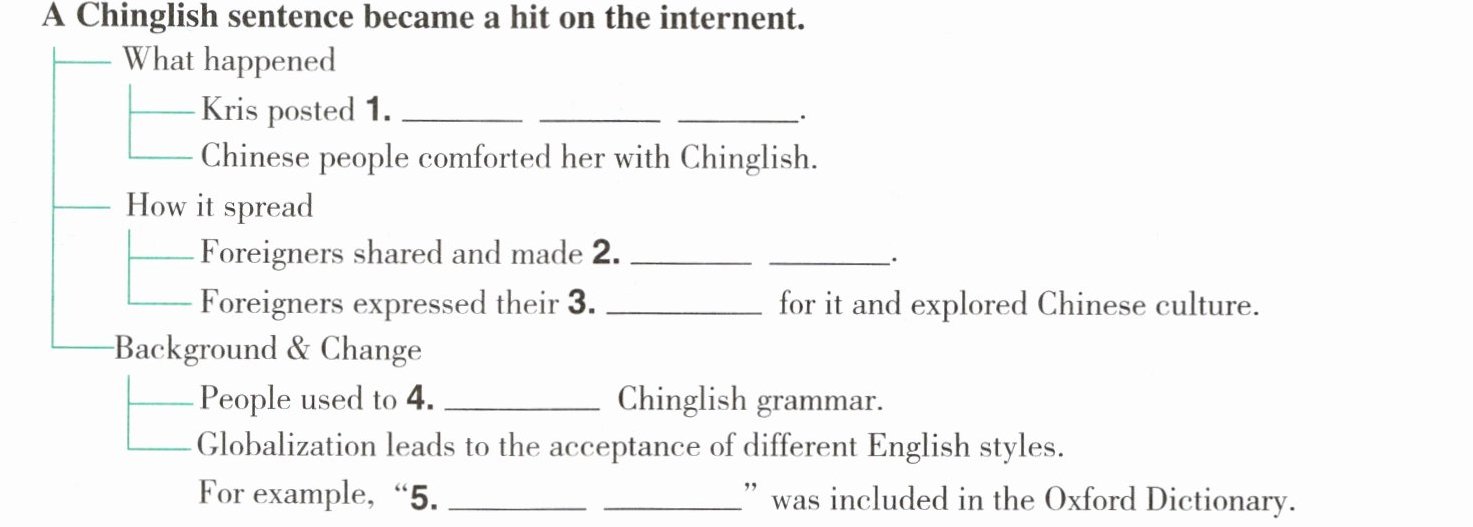
Foreigners expressed their 3.
Background & Change
People used to 4.
Globalization leads to the acceptance of different English styles.
For example, "5.
注:介绍现象类说明文语篇研读见答案 P12
素养:文化意识 难度:难 用时:8分钟
"You pretty, he ugly. You swan(天鹅), he frog!" Foreign people just love these funny English sentences going around the internet.
It all started when a foreign girl named Kris posted a sad photo online. It looked like she broke up with(和……分手) her boyfriend. Some nice Chinese people tried to cheer her up. They asked her to find someone better. Some made funny Chinglish to make her feel happy, such as "You swan, he frog!"
This became a hit among foreigners. Many found it cool. They shared it a lot online and made funny pictures with it. "I need Chinese netizens(网民) in my life who call the people that have hurt me frogs," said a foreign internet user, showing her love for the expression. Some of them wanted to know why Chinese people used "swan" and "frog" to describe this couple. After looking into it, they learned that it came from the famous old Chinese story of the beautiful swan and the ugly toad(癞蛤蟆), and got interested in the Chinese stories behind Chinglish.
In the past, people often corrected those who spoke Chinglish because it was full of grammar errors(错误). However, with globalization(全球化), people from different countries can now share their ideas more often. Different styles of speaking English are becoming common and even accepted. English with local touches can also be popular. For example, the well-known "add oil" has now appeared in the Oxford Dictionary and people use it widely. The phrase shows Chinese culture.
"Once I understood the full meaning, it
became much funnier," said Cody, a young man from New Zealand, when asked about "You swan, he frog!" "It's great that more Chinese culture is being shared with the rest of the world," he told China Daily.
1. Why did the sentence "You swan, he frog!" become popular among foreigners?
A. They found it funny and cool.
B. They found it easy to remember.
C. It showed that Chinese people are friendly.
D. It was part of a famous English poem.
2. What did some foreigners want to know about the sentence "You swan, he frog!"?
A. The grammar rules behind it.
B. The reasons why Chinese people love it.
C. The different expressions for it.
D. The story behind it.
3. How has globalization changed the way we use English?
A. It has made English grammar stricter.
B. It has allowed more ways to speak English.
C. It has cut the number of English expressions.
D. We have made fewer grammar errors.
4. What does the underlined word "touches" in Paragraph 4 probably mean?
A. Animals.
B. Examples.
C. Features.
D. People.
5. What does the passage mainly tell us?
A. Foreigners love Chinglish expressions about animals.
B. Chinglish expressions are becoming popular among foreigners.
C. Chinese people are getting better at speaking English.
D. Foreigners find it hard to understand Chinese culture.
【语篇解构】 阅读文章,补充下面的结构图(每空一词)
A Chinglish sentence became a hit on the internent.
What happened
Kris posted 1.
a
sad
photo
.Chinese people comforted her with Chinglish.
How it spread
Foreigners shared and made 2.
funny
pictures
.Foreigners expressed their 3.
love
for it and explored Chinese culture.Background & Change
People used to 4.
correct
Chinglish grammar.Globalization leads to the acceptance of different English styles.
For example, "5.
add
oil
" was included in the Oxford Dictionary.注:介绍现象类说明文语篇研读见答案 P12
答案
语篇研读
主题和内容 本文以"You swan, he frog!"为引,介绍了中式英语如何逐渐被外国人认可、接受并喜爱的。
意义和价值 引导学生理解语言与文化的紧密联系,认识到全球化背景下语言的多样性,培养跨文化交际意识和文化自信。
方式和方法 体裁:本文为说明文,围绕中式英语席卷外网这一现象展开介绍。
篇章发展脉络:第一至三段先是引出网络热句"You swan, he frog!",然后依次介绍其走红过程以及外国网友的关注;第四、五段从网络热句延伸到人们对中式英语态度的变化以及外国网友的评价。
呈现方式:使用"以小见大"的写作手法,从网络流行语"You swan, he frog!"入手,揭示语言作为交流工具的本质及语言与文化的密切连接。
长难句解读
(" I 主语 need 谓语 Chinese netizens 宾语 in my life who call the people that have hurt me frogs,") 定语从句 said 主句谓语 a foreign Internet user, 主句主语 showing her love for the expression. 现在分词短语作状语 一位外国网民表明了她对这个表达的喜爱,她说:"我生活中需要称那些伤害我的人为青蛙的中国网民。"
1 A 细节理解题。根据第三段中的"This became a hit among foreigners. Many found it cool. They shared it a lot online and made funny pictures with it"可知,外国网民喜欢"You swan, he frog!"这句话是因为他们觉得它很有趣,很酷。
2 D 细节理解题。根据第三段中的"Some of them wanted to know why Chinese people used 'swan' and 'frog' to describe this couple. After looking into it, they learned that it came from the famous old Chinese story of the beautiful swan and the ugly toad(癞蛤蟆)"可知,一些外国网民想知道"You swan, he frog!"这句话背后的故事,后来他们了解到它来源于中国一个古老的著名故事。
3 B 细节理解题。根据第四段中的"However, with globalization(全球化), people from different countries can now share their ideas more often. Different styles of speaking English are becoming common and even accepted"可知,随着全球化的进程,现在不同国家的人们可以更频繁地交流思想,不同风格的英语表达变得常见,甚至被接受。故选B。
4 C 词义猜测题。根据画线词所在句"English with local touches can also be popular"以及下文的例子可知,"touches"在这里的意思是"特征",表示带有地方特色的英语也很受欢迎。
5 B 主旨大意题。通读全文可知,文章主要讲述了中式英语"You swan, he frog!"如何受到外国网民的喜爱,并引发他们对中国文化的兴趣,说明中式英语表达在外国人中变得很流行。故选B。
【语篇解构】 1 a sad photo 2 funny pictures 3 love 4 correct 5 add oil
主题和内容 本文以"You swan, he frog!"为引,介绍了中式英语如何逐渐被外国人认可、接受并喜爱的。
意义和价值 引导学生理解语言与文化的紧密联系,认识到全球化背景下语言的多样性,培养跨文化交际意识和文化自信。
方式和方法 体裁:本文为说明文,围绕中式英语席卷外网这一现象展开介绍。
篇章发展脉络:第一至三段先是引出网络热句"You swan, he frog!",然后依次介绍其走红过程以及外国网友的关注;第四、五段从网络热句延伸到人们对中式英语态度的变化以及外国网友的评价。
呈现方式:使用"以小见大"的写作手法,从网络流行语"You swan, he frog!"入手,揭示语言作为交流工具的本质及语言与文化的密切连接。
长难句解读
(" I 主语 need 谓语 Chinese netizens 宾语 in my life who call the people that have hurt me frogs,") 定语从句 said 主句谓语 a foreign Internet user, 主句主语 showing her love for the expression. 现在分词短语作状语 一位外国网民表明了她对这个表达的喜爱,她说:"我生活中需要称那些伤害我的人为青蛙的中国网民。"
1 A 细节理解题。根据第三段中的"This became a hit among foreigners. Many found it cool. They shared it a lot online and made funny pictures with it"可知,外国网民喜欢"You swan, he frog!"这句话是因为他们觉得它很有趣,很酷。
2 D 细节理解题。根据第三段中的"Some of them wanted to know why Chinese people used 'swan' and 'frog' to describe this couple. After looking into it, they learned that it came from the famous old Chinese story of the beautiful swan and the ugly toad(癞蛤蟆)"可知,一些外国网民想知道"You swan, he frog!"这句话背后的故事,后来他们了解到它来源于中国一个古老的著名故事。
3 B 细节理解题。根据第四段中的"However, with globalization(全球化), people from different countries can now share their ideas more often. Different styles of speaking English are becoming common and even accepted"可知,随着全球化的进程,现在不同国家的人们可以更频繁地交流思想,不同风格的英语表达变得常见,甚至被接受。故选B。
4 C 词义猜测题。根据画线词所在句"English with local touches can also be popular"以及下文的例子可知,"touches"在这里的意思是"特征",表示带有地方特色的英语也很受欢迎。
5 B 主旨大意题。通读全文可知,文章主要讲述了中式英语"You swan, he frog!"如何受到外国网民的喜爱,并引发他们对中国文化的兴趣,说明中式英语表达在外国人中变得很流行。故选B。
【语篇解构】 1 a sad photo 2 funny pictures 3 love 4 correct 5 add oil
