

 登录
登录
丝绸之路:连接东西方的纽带
外刊精读 口语朗读
语篇类型: 说明文
难度星级: ★★★★★
建议用时: /10 min
参考答案: P16
The Silk Road is the name of a group of trade routes, not only on land but also by sea.
The maritime(海运的) Silk Road began during the Qin Dynasty and reached its peak during the Ming Dynasty. It linked Chinese ports with Korea, Japan, South Asia, and even East Africa. Zheng He, the famous explorer in the Ming Dynasty led large ships to many different countries.
Over two thousand years ago, Zhang Qian's visit to the Western Regions(西域) marked the beginning of the Ancient Silk Road. He brought back many new foods and other things, as well as information about Central Asian lands. Then, Ban Chao helped expand(扩展) the Silk Road and Gan Ying tried to find “Da Qin”, the Chinese name for the Roman Empire at that time.
Chinese silk, tea, and porcelain(瓷器) were very popular along the Silk Road. People in Central Asia, the Middle East, and Europe loved these goods and traded them with gold, spices, and glass. The four great inventions of ancient China—paper making, printing, compass, and gunpowder—also reached European countries through the Silk Road. What's more, the Silk Road inspired famous explorers like Marco Polo, whose travels sparked the first wave of “China fever” in Europe.
The Silk Road was a path of cultural exchanges between the East and the West. Many people over the centuries travelled the Silk Road in search of friendship between different parts of the world. Today, China’s “Belt and Road Initiative” revives this old spirit, helping countries trade, share cultures, and become more successful together.
根据短文内容完成表格,每空1~2词。
| | The maritime Silk Road (by sea) | The Ancient Silk Road (on 1.
| --- | --- | --- |
| Began During | 2.
| Famous People | Zheng He | 3.
| Destinations | Korea, Japan,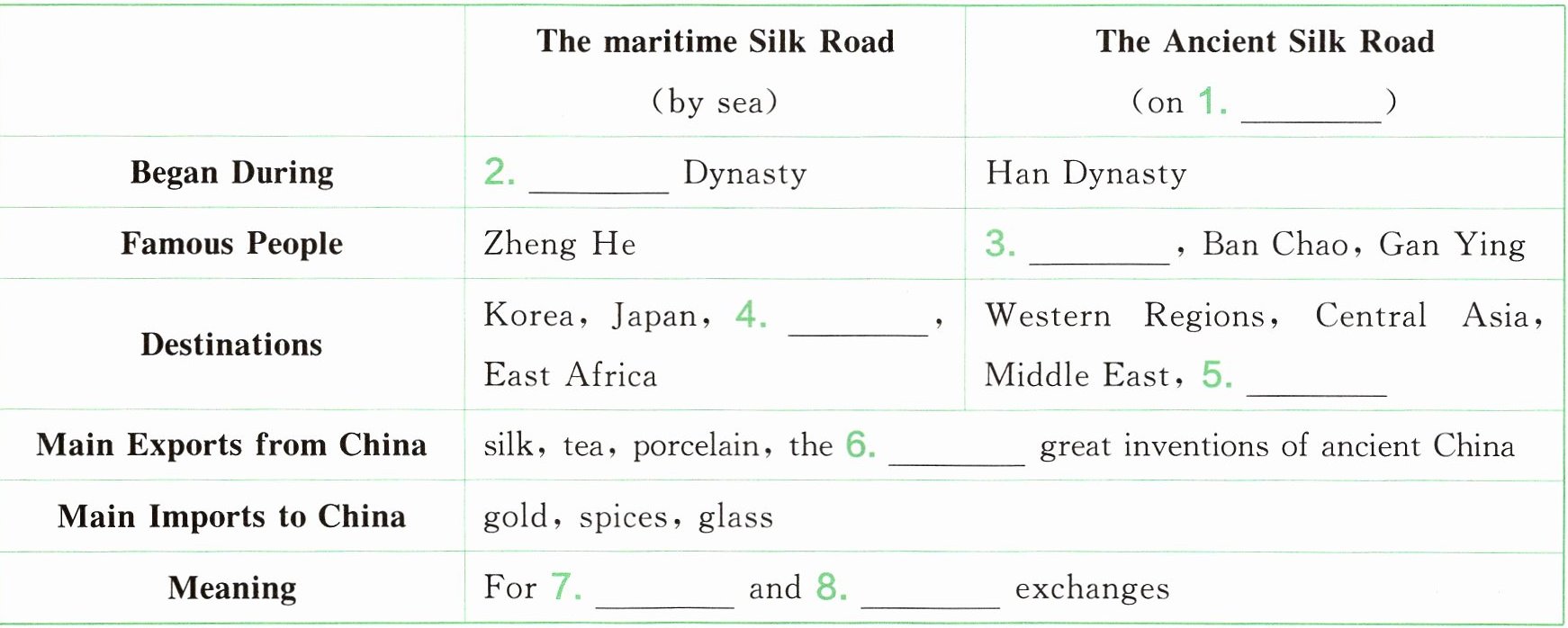 , East Africa | Western Regions, Central Asia, Middle East, 5.
| Main Exports from China | silk, tea, porcelain, the 6.
| Main Imports to China | gold, spices, glass |
| Meaning | For 7.
词汇积累
trade /treɪd/ n. 贸易
peak /piːk/ n. 高峰
dynasty /ˈdɪnəsti/ n. 朝代
wave /weɪv/ n. 浪潮
语法充电
“ only ... but also ...”意为“不仅……而且……”,连接两个并列的成分——两个成分在语法结构上一致。
Week 5 交通出行 039
外刊精读 口语朗读
语篇类型: 说明文
难度星级: ★★★★★
建议用时: /10 min
参考答案: P16
The Silk Road is the name of a group of trade routes, not only on land but also by sea.
The maritime(海运的) Silk Road began during the Qin Dynasty and reached its peak during the Ming Dynasty. It linked Chinese ports with Korea, Japan, South Asia, and even East Africa. Zheng He, the famous explorer in the Ming Dynasty led large ships to many different countries.
Over two thousand years ago, Zhang Qian's visit to the Western Regions(西域) marked the beginning of the Ancient Silk Road. He brought back many new foods and other things, as well as information about Central Asian lands. Then, Ban Chao helped expand(扩展) the Silk Road and Gan Ying tried to find “Da Qin”, the Chinese name for the Roman Empire at that time.
Chinese silk, tea, and porcelain(瓷器) were very popular along the Silk Road. People in Central Asia, the Middle East, and Europe loved these goods and traded them with gold, spices, and glass. The four great inventions of ancient China—paper making, printing, compass, and gunpowder—also reached European countries through the Silk Road. What's more, the Silk Road inspired famous explorers like Marco Polo, whose travels sparked the first wave of “China fever” in Europe.
The Silk Road was a path of cultural exchanges between the East and the West. Many people over the centuries travelled the Silk Road in search of friendship between different parts of the world. Today, China’s “Belt and Road Initiative” revives this old spirit, helping countries trade, share cultures, and become more successful together.
根据短文内容完成表格,每空1~2词。
| | The maritime Silk Road (by sea) | The Ancient Silk Road (on 1.
land
) || --- | --- | --- |
| Began During | 2.
Qin
Dynasty | Han Dynasty || Famous People | Zheng He | 3.
Zhang Qian
, Ban Chao, Gan Ying || Destinations | Korea, Japan,
, East Africa | Western Regions, Central Asia, Middle East, 5. Europe
|| Main Exports from China | silk, tea, porcelain, the 6.
four
great inventions of ancient China || Main Imports to China | gold, spices, glass |
| Meaning | For 7.
trade
and 8. cultural
exchanges |词汇积累
trade /treɪd/ n. 贸易
peak /piːk/ n. 高峰
dynasty /ˈdɪnəsti/ n. 朝代
wave /weɪv/ n. 浪潮
语法充电
“
only ... but also ...”意为“不仅……而且……”,连接两个并列的成分——两个成分在语法结构上一致。Week 5 交通出行 039
答案
1. land 根据开头“The Silk Road is the name of a group of trade routes, not only on land but also by sea.”可知,丝绸之路包含陆上的和海上的,the maritime Silk Road 是海上的,根据第三段描述可知古代丝绸之路是陆上的,因此填 land。
2. Qin 根据第二段“The maritime Silk Road began during the Qin Dynasty”可知,海上丝绸之路始于秦朝,因此填 Qin。
3. Zhang Qian 根据第三段“Over two thousand years ago, Zhang Qian's visit to the Western Regions marked the beginning of the Ancient Silk Road.”可知,张骞是古代丝绸之路的著名人物之一,因此填 Zhang Qian。
4. South Asia 根据第二段“It linked Chinese ports with Korea, Japan, South Asia, and even East Africa.”可知,海上丝绸之路的目的地还包括南亚,因此填 South Asia。
5. Europe 根据第四段“People in Central Asia, the Middle East, and Europe loved these goods”可知,古代丝绸之路的目的地包括欧洲,因此填 Europe。
6. four 根据第四段“The four great inventions of ancient China ... also reached European countries ...”可知,中国古代的四大发明通过丝绸之路传播,因此填 four。
7. trade 根据最后一段“The Silk Road was a path of cultural exchanges between the East and the West.”以及“helping countries trade, share cultures”,还有前文描述古代通过丝绸之路进行贸易可知,丝绸之路的意义包括贸易和文化交流,因此填 trade。
8. cultural 根据短文最后一段“The Silk Road was a path of cultural exchanges between the East and the West.”可知,丝绸之路的意义包括文化交流,因此填 cultural。
⚠知识拓展 “一带一路”倡议
“一带一路”是“丝绸之路经济带”(the Silk Road Economic Belt)和“21 世纪海上丝绸之路”(the 21st-Century Maritime Silk Road)的简称。丝绸之路经济带,是在古丝绸之路概念基础上形成的一个新的经济发展区域。包括西北五省区陕西、甘肃、青海、宁夏、新疆,西南四省区市重庆、四川、云南、广西。
“21 世纪海上丝绸之路”是古代海上丝绸之路的传承和延续,它从福建省泉州市开始,经过泰国、印尼等东盟国家,再穿过马六甲海峡进入孟加拉湾,途经斯里兰卡、印度以及巴基斯坦等南亚三国,然后分成三条线路,北线穿过霍尔木兹海峡来到波斯湾,西线经红海到达非洲东海岸的内罗毕和欧洲的鹿特丹,南线沿印度洋向南至澳大利亚,中间辐射东盟和中东等人口、资源密集的地区,是连通欧洲、亚洲、非洲和澳大利亚海上贸易的航路。
2. Qin 根据第二段“The maritime Silk Road began during the Qin Dynasty”可知,海上丝绸之路始于秦朝,因此填 Qin。
3. Zhang Qian 根据第三段“Over two thousand years ago, Zhang Qian's visit to the Western Regions marked the beginning of the Ancient Silk Road.”可知,张骞是古代丝绸之路的著名人物之一,因此填 Zhang Qian。
4. South Asia 根据第二段“It linked Chinese ports with Korea, Japan, South Asia, and even East Africa.”可知,海上丝绸之路的目的地还包括南亚,因此填 South Asia。
5. Europe 根据第四段“People in Central Asia, the Middle East, and Europe loved these goods”可知,古代丝绸之路的目的地包括欧洲,因此填 Europe。
6. four 根据第四段“The four great inventions of ancient China ... also reached European countries ...”可知,中国古代的四大发明通过丝绸之路传播,因此填 four。
7. trade 根据最后一段“The Silk Road was a path of cultural exchanges between the East and the West.”以及“helping countries trade, share cultures”,还有前文描述古代通过丝绸之路进行贸易可知,丝绸之路的意义包括贸易和文化交流,因此填 trade。
8. cultural 根据短文最后一段“The Silk Road was a path of cultural exchanges between the East and the West.”可知,丝绸之路的意义包括文化交流,因此填 cultural。
⚠知识拓展 “一带一路”倡议
“一带一路”是“丝绸之路经济带”(the Silk Road Economic Belt)和“21 世纪海上丝绸之路”(the 21st-Century Maritime Silk Road)的简称。丝绸之路经济带,是在古丝绸之路概念基础上形成的一个新的经济发展区域。包括西北五省区陕西、甘肃、青海、宁夏、新疆,西南四省区市重庆、四川、云南、广西。
“21 世纪海上丝绸之路”是古代海上丝绸之路的传承和延续,它从福建省泉州市开始,经过泰国、印尼等东盟国家,再穿过马六甲海峡进入孟加拉湾,途经斯里兰卡、印度以及巴基斯坦等南亚三国,然后分成三条线路,北线穿过霍尔木兹海峡来到波斯湾,西线经红海到达非洲东海岸的内罗毕和欧洲的鹿特丹,南线沿印度洋向南至澳大利亚,中间辐射东盟和中东等人口、资源密集的地区,是连通欧洲、亚洲、非洲和澳大利亚海上贸易的航路。
