

 登录
登录
三、阅读短文,从方框中选出最佳选项填入对应空白处,使短文通顺、连贯。(选项中有一项多余)
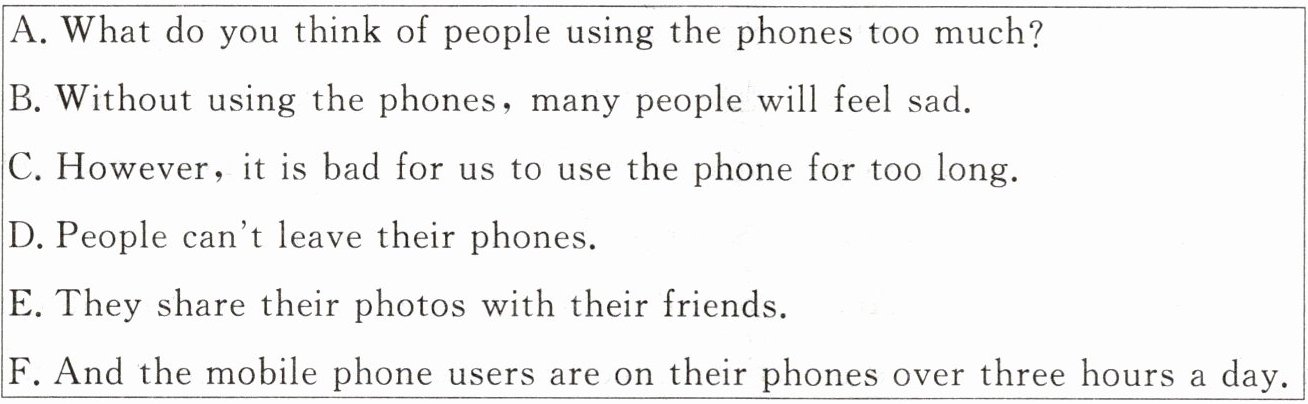
We use our mobile phones to do many things every day. Many of us can't live without them. 1
A study says that many people start to use their mobile phones early in the morning. They check emails and so on. And before they get out of bed, many people often check the weather, read the news and send messages(发信息)to friends. After getting up, they often take photos of food themselves and even whatever they can see with their phones. 2 The study finds that users pick up their phones more than 1,500 times to do different things in a week. 3 That is to say, people use their phones for almost one full day each week.
Using phones will take up a lot of time and it's also bad for our health. Many people stay up late to play on their phones, and mobile phones will influence(影响)our sleep. 4 Many people also find themselves using their phones without realizing(意识到)they're doing so. 5
1.
2.
3.
4.
5.
We use our mobile phones to do many things every day. Many of us can't live without them. 1
A study says that many people start to use their mobile phones early in the morning. They check emails and so on. And before they get out of bed, many people often check the weather, read the news and send messages(发信息)to friends. After getting up, they often take photos of food themselves and even whatever they can see with their phones. 2 The study finds that users pick up their phones more than 1,500 times to do different things in a week. 3 That is to say, people use their phones for almost one full day each week.
Using phones will take up a lot of time and it's also bad for our health. Many people stay up late to play on their phones, and mobile phones will influence(影响)our sleep. 4 Many people also find themselves using their phones without realizing(意识到)they're doing so. 5
1.
2.
3.
4.
5.
答案
【解析】:我们可以根据上下文逻辑逐一确定答案:
1. 空前句提到很多人离开手机就无法生活,D选项“人们离不开手机”承接上文语义,自然引出下文对人们日常使用手机行为的介绍。
2. 空前句提到人们起床后经常用手机拍食物、自己以及能看到的任何事物,E选项“他们把这些照片分享给朋友”刚好承接“拍照”的动作,逻辑连贯。
3. 空前句提到研究发现用户一周内拿起手机做不同事情的次数超过1500次,空后句表示也就是说人们每周用手机的时间几乎有一整天,F选项“手机用户每天使用手机的时长超过3小时”,按一周7天计算总时长接近一整天,完美衔接前后内容。
4. 空前句提到很多人熬夜玩手机,手机会影响睡眠,体现人们对手机的依赖,B选项“不使用手机的话,很多人会感到难过”进一步说明人们对手机的依赖程度,和后文“很多人没意识到自己正在用手机”的依赖表现呼应。
5. 前文已经介绍了过度使用手机的种种表现和坏处,A选项“你怎么看待人们过度使用手机的现象?”以提问的方式收尾,符合行文逻辑。
本题有一个多余选项C,无需选用。
【答案】:1. D
2. E
3. F
4. B
5. A
1. 空前句提到很多人离开手机就无法生活,D选项“人们离不开手机”承接上文语义,自然引出下文对人们日常使用手机行为的介绍。
2. 空前句提到人们起床后经常用手机拍食物、自己以及能看到的任何事物,E选项“他们把这些照片分享给朋友”刚好承接“拍照”的动作,逻辑连贯。
3. 空前句提到研究发现用户一周内拿起手机做不同事情的次数超过1500次,空后句表示也就是说人们每周用手机的时间几乎有一整天,F选项“手机用户每天使用手机的时长超过3小时”,按一周7天计算总时长接近一整天,完美衔接前后内容。
4. 空前句提到很多人熬夜玩手机,手机会影响睡眠,体现人们对手机的依赖,B选项“不使用手机的话,很多人会感到难过”进一步说明人们对手机的依赖程度,和后文“很多人没意识到自己正在用手机”的依赖表现呼应。
5. 前文已经介绍了过度使用手机的种种表现和坏处,A选项“你怎么看待人们过度使用手机的现象?”以提问的方式收尾,符合行文逻辑。
本题有一个多余选项C,无需选用。
【答案】:1. D
2. E
3. F
4. B
5. A
四、短文填空。
make festival hold family hope where poster read if race
The Dragon Boat Festival falls on the fifth day of the fifth lunar(阴历的)month. It's an important traditional 1 in China. People usually celebrate it by eating zongzi and 2 dragon boat races.
It's 8:00 on the evening of the Dragon Boat Festival. My 3 are all at home. We are doing different things.
Look! My grandma is talking on the phone with my aunt. Now my aunt is in New York. She will come back next month. All of us are looking forward to her coming. My grandpa is 4 a book. He likes reading very much. 5 he has free time, he will go to the library near our house. He really enjoys spending time on books.
My brother is watching boat 6 on TV. He loves boat races and 7 to take part in them in the future.
Do you know 8 I am? I am in my room. I'm doing my homework. It is a(n) 9 for the Dragon Boat Festival. I will take the poster to school tomorrow.
What are my parents doing? They are 10 zongzi in the kitchen. Zongzi tastes delicious! Both dumplings and zongzi are my favourite food.
What a wonderful evening!
1. 2. 3. 4. 5.
6. 7. 8. 9. 10.
make festival hold family hope where poster read if race
The Dragon Boat Festival falls on the fifth day of the fifth lunar(阴历的)month. It's an important traditional 1 in China. People usually celebrate it by eating zongzi and 2 dragon boat races.
It's 8:00 on the evening of the Dragon Boat Festival. My 3 are all at home. We are doing different things.
Look! My grandma is talking on the phone with my aunt. Now my aunt is in New York. She will come back next month. All of us are looking forward to her coming. My grandpa is 4 a book. He likes reading very much. 5 he has free time, he will go to the library near our house. He really enjoys spending time on books.
My brother is watching boat 6 on TV. He loves boat races and 7 to take part in them in the future.
Do you know 8 I am? I am in my room. I'm doing my homework. It is a(n) 9 for the Dragon Boat Festival. I will take the poster to school tomorrow.
What are my parents doing? They are 10 zongzi in the kitchen. Zongzi tastes delicious! Both dumplings and zongzi are my favourite food.
What a wonderful evening!
1. 2. 3. 4. 5.
6. 7. 8. 9. 10.
答案
1. festival
2. holding
3. family
4. reading
5. If
6. races
7. hopes
8. where
9. poster
10. making
2. holding
3. family
4. reading
5. If
6. races
7. hopes
8. where
9. poster
10. making
解析
我们结合方框内词汇和上下文语境逐一分析:
1. 句意:它是中国一个重要的传统节日。端午节属于中国传统节日,填入名词festival符合语境。
2. 句意:人们通常通过吃粽子和举办赛龙舟来庆祝它。介词by后接动名词作方式状语,and并列两个动名词,hold的动名词形式为holding。
3. 句意:我的家人们都在家。集合名词family此处指代家庭成员,谓语搭配复数are,符合后文全家都在做不同事的语境。
4. 句意:我的爷爷正在看书。本句为现在进行时,结构是be+现在分词,read a book是固定搭配“读书”,read变为reading。
5. 句意:如果他有空,他就会去我家附近的图书馆。此处引导条件状语从句,表“如果”,句首首字母大写,填入If,符合主将从现的语法规则。
6. 句意:我的哥哥正在电视上看龙舟比赛。后文也出现了boat races的表述,此处用race的复数形式races,泛指多场龙舟赛事。
7. 句意:他喜爱龙舟比赛,希望未来能参加它们。主语he是第三人称单数,一般现在时谓语动词用第三人称单数形式,hope变为hopes,构成固定搭配hope to do sth“希望做某事”。
8. 句意:你知道我在哪里吗?根据答语“我在我的房间里”,可知此处提问地点,填入where。
9. 句意:这是一张端午节的海报。根据后文“我明天要把这张海报带去学校”的提示,填入poster。
10. 句意:他们正在厨房里包粽子。本句为现在进行时,结构是be+现在分词,make zongzi是固定表达“包粽子”,make变为making。
1. 句意:它是中国一个重要的传统节日。端午节属于中国传统节日,填入名词festival符合语境。
2. 句意:人们通常通过吃粽子和举办赛龙舟来庆祝它。介词by后接动名词作方式状语,and并列两个动名词,hold的动名词形式为holding。
3. 句意:我的家人们都在家。集合名词family此处指代家庭成员,谓语搭配复数are,符合后文全家都在做不同事的语境。
4. 句意:我的爷爷正在看书。本句为现在进行时,结构是be+现在分词,read a book是固定搭配“读书”,read变为reading。
5. 句意:如果他有空,他就会去我家附近的图书馆。此处引导条件状语从句,表“如果”,句首首字母大写,填入If,符合主将从现的语法规则。
6. 句意:我的哥哥正在电视上看龙舟比赛。后文也出现了boat races的表述,此处用race的复数形式races,泛指多场龙舟赛事。
7. 句意:他喜爱龙舟比赛,希望未来能参加它们。主语he是第三人称单数,一般现在时谓语动词用第三人称单数形式,hope变为hopes,构成固定搭配hope to do sth“希望做某事”。
8. 句意:你知道我在哪里吗?根据答语“我在我的房间里”,可知此处提问地点,填入where。
9. 句意:这是一张端午节的海报。根据后文“我明天要把这张海报带去学校”的提示,填入poster。
10. 句意:他们正在厨房里包粽子。本句为现在进行时,结构是be+现在分词,make zongzi是固定表达“包粽子”,make变为making。
