

 登录
登录
四、信息还原
People live in different kinds of houses in the world. Usually, each house has its own living room, bedroom, kitchen and bathroom. 1 What are they? Now, let's take a look.
A flat is usually in a building. There are usually many families living in the same flat building. 2
3 In a town house, the kitchen, the living room and the dining room are usually on the ground floor and the bedrooms are usually on the first floor.
A farmhouse is a house on a farm. There are many farmers living there. 4 There are also some "houses" for cows and hens near the farmhouse. The field is not far from the farmhouse, so farmers always go to the field on foot.
A dormitory(集体宿舍)is a large room in a school, and every 4 to 8 students share one dormitory. 5 But each student has his or her own bed. Students can learn how to get along well with(与……和睦相处)each other in a dormitory.
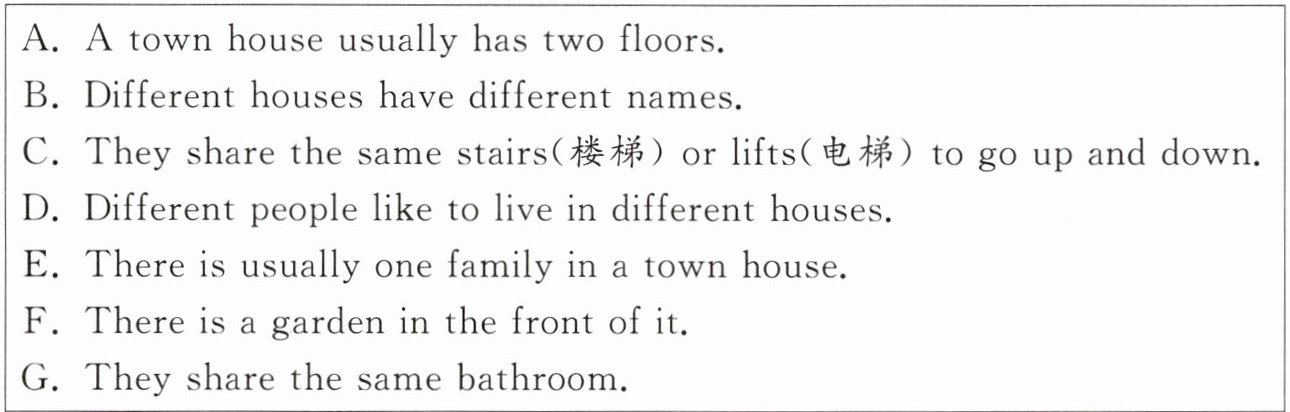
People live in different kinds of houses in the world. Usually, each house has its own living room, bedroom, kitchen and bathroom. 1 What are they? Now, let's take a look.
A flat is usually in a building. There are usually many families living in the same flat building. 2
3 In a town house, the kitchen, the living room and the dining room are usually on the ground floor and the bedrooms are usually on the first floor.
A farmhouse is a house on a farm. There are many farmers living there. 4 There are also some "houses" for cows and hens near the farmhouse. The field is not far from the farmhouse, so farmers always go to the field on foot.
A dormitory(集体宿舍)is a large room in a school, and every 4 to 8 students share one dormitory. 5 But each student has his or her own bed. Students can learn how to get along well with(与……和睦相处)each other in a dormitory.
答案
1—5 BCAFG
解析
【分析】
做信息还原题时,需先通读全文把握主旨,明确文章介绍不同类型房屋及其特点的核心,再结合每个空的上下文语境,匹配选项的逻辑关系。第1空需承接上文“不同房屋”并引出下文对各类房屋的介绍;第2空要对应公寓楼多家庭居住的特点;第3空需引出联排别墅的相关描述,衔接下文楼层布局内容;第4空要补充农舍的特征;第5空需说明集体宿舍的共享设施特点,结合上下文逻辑逐一匹配选项即可。
【解析】
1. 第1空:上文提到人们住不同类型的房子,下文问“What are they?”,选项B“Different houses have different names.”承接上文“不同房屋”,引出下文要介绍的各类房屋,符合逻辑,故选B。
2. 第2空:上文说明同一公寓楼里有很多家庭,选项C“They share the same stairs or lifts to go up and down.”描述公寓楼住户共享楼梯或电梯的特点,符合公寓的居住特征,故选C。
3. 第3空:下文介绍联排别墅(town house)的楼层布局,选项A“A town house usually has two floors.”引出联排别墅的基本结构特点,与下文内容衔接自然,故选A。
4. 第4空:上文介绍农舍(farmhouse),选项F“There is a garden in the front of it.”补充农舍的特征,符合农舍的描述,故选F。
5. 第5空:上文说明集体宿舍里学生的居住情况,选项G“They share the same bathroom.”说明宿舍的共享设施,与下文“each student has his or her own bed”并列,符合逻辑,故选G。
【答案】
1—5 BCAFG
【知识点】
阅读理解;信息还原;房屋类词汇
【点评】
本题考查英语阅读理解中的信息还原能力,要求学生理解不同类型房屋的特点,结合上下文逻辑匹配选项,需掌握常见房屋相关的英文表达,难度适中。
【难度系数】
0.5
做信息还原题时,需先通读全文把握主旨,明确文章介绍不同类型房屋及其特点的核心,再结合每个空的上下文语境,匹配选项的逻辑关系。第1空需承接上文“不同房屋”并引出下文对各类房屋的介绍;第2空要对应公寓楼多家庭居住的特点;第3空需引出联排别墅的相关描述,衔接下文楼层布局内容;第4空要补充农舍的特征;第5空需说明集体宿舍的共享设施特点,结合上下文逻辑逐一匹配选项即可。
【解析】
1. 第1空:上文提到人们住不同类型的房子,下文问“What are they?”,选项B“Different houses have different names.”承接上文“不同房屋”,引出下文要介绍的各类房屋,符合逻辑,故选B。
2. 第2空:上文说明同一公寓楼里有很多家庭,选项C“They share the same stairs or lifts to go up and down.”描述公寓楼住户共享楼梯或电梯的特点,符合公寓的居住特征,故选C。
3. 第3空:下文介绍联排别墅(town house)的楼层布局,选项A“A town house usually has two floors.”引出联排别墅的基本结构特点,与下文内容衔接自然,故选A。
4. 第4空:上文介绍农舍(farmhouse),选项F“There is a garden in the front of it.”补充农舍的特征,符合农舍的描述,故选F。
5. 第5空:上文说明集体宿舍里学生的居住情况,选项G“They share the same bathroom.”说明宿舍的共享设施,与下文“each student has his or her own bed”并列,符合逻辑,故选G。
【答案】
1—5 BCAFG
【知识点】
阅读理解;信息还原;房屋类词汇
【点评】
本题考查英语阅读理解中的信息还原能力,要求学生理解不同类型房屋的特点,结合上下文逻辑匹配选项,需掌握常见房屋相关的英文表达,难度适中。
【难度系数】
0.5
五、阅读表达
阅读下面的短文,用英语回答短文后的问题,并将答案写在横线上。
Two old men moved into a hospital room one after the other. The first one could sit up for an hour every day. His bed was next to the room's only window. The second one was lying on the bed all day and couldn't see clearly. They would talk about their homes, jobs, family and friends, and what they would do when they left the hospital.
Every afternoon, a nurse would help the first man sit up. He then would tell the second man about the things that happened outside the window. The second man could feel that it was a beautiful and lively world. It made him feel alive, even though he couldn't go out. He also wondered how he could thank the first man. It was that one hour that made him want to live.
As time went on, the nurse found the first man had passed away one morning. The second man was very sad to hear that. Since he became better, he asked to change to the bed by the window. However, when he got there, he saw nothing but a wall.
The old man got angry and asked the nurse why the first man lied. The nurse replied that the man was blind. "Though he couldn't see, he had a warm and big heart full of love," she added.
1. Why did the second old man want to change to the bed by the window?
2. What did the second old man see outside the window after he changed the bed?
3. Why did the first old man lie to the second old man?
阅读下面的短文,用英语回答短文后的问题,并将答案写在横线上。
Two old men moved into a hospital room one after the other. The first one could sit up for an hour every day. His bed was next to the room's only window. The second one was lying on the bed all day and couldn't see clearly. They would talk about their homes, jobs, family and friends, and what they would do when they left the hospital.
Every afternoon, a nurse would help the first man sit up. He then would tell the second man about the things that happened outside the window. The second man could feel that it was a beautiful and lively world. It made him feel alive, even though he couldn't go out. He also wondered how he could thank the first man. It was that one hour that made him want to live.
As time went on, the nurse found the first man had passed away one morning. The second man was very sad to hear that. Since he became better, he asked to change to the bed by the window. However, when he got there, he saw nothing but a wall.
The old man got angry and asked the nurse why the first man lied. The nurse replied that the man was blind. "Though he couldn't see, he had a warm and big heart full of love," she added.
1. Why did the second old man want to change to the bed by the window?
Because he wanted to see the world by himself.
2. What did the second old man see outside the window after he changed the bed?
Nothing but a wall.
3. Why did the first old man lie to the second old man?
Because he wanted to cheer up the second man.(言之有理即可)
答案
1. Because he wanted to see the world by himself.
2. Nothing but a wall.
3. Because he wanted to cheer up the second man.(言之有理即可)
2. Nothing but a wall.
3. Because he wanted to cheer up the second man.(言之有理即可)
解析
【分析】
本题为英语阅读理解的细节类问题,需先通读短文明确每个问题的核心,再定位到短文中对应问题的相关段落,提取关键信息,结合问题要求用规范英语作答。具体步骤:1. 针对第一个问题,定位第二个老人换床的原因,结合前文他听第一个老人讲述窗外美好世界的经历,明确其想亲眼看到的诉求;2. 针对第二个问题,定位换床后看到的事物,找到短文对应语句;3. 针对第三个问题,定位第一个老人撒谎的原因,结合短文最后一段护士的表述及前文第一个老人的善意,明确其初衷。
【解析】
1. 由短文第三段可知,第二个老人此前通过第一个老人的讲述感受到窗外的美好世界,他希望自己亲眼看到,因此想换至靠窗的床,故答案为Because he wanted to see the world by himself.
2. 由短文第三段最后一句可知,第二个老人换至靠窗的床后,只看到了一堵墙,故答案为Nothing but a wall.
3. 由短文最后一段可知,第一个老人是盲人,他撒谎是为了让第二个老人振作起来,故答案为Because he wanted to cheer up the second man.(符合言之有理即可的要求)
【答案】
1. Because he wanted to see the world by himself.
2. Nothing but a wall.
3. Because he wanted to cheer up the second man.
【知识点】
英语阅读理解(细节理解)、短文信息提取、英语问答
【点评】
本题考查学生对英语短文细节信息的定位与提取能力,难度适中,只要仔细阅读短文,找到对应问题的关键语句即可准确作答,符合初中英语阅读题的常见考查形式。
【难度系数】
0.6
本题为英语阅读理解的细节类问题,需先通读短文明确每个问题的核心,再定位到短文中对应问题的相关段落,提取关键信息,结合问题要求用规范英语作答。具体步骤:1. 针对第一个问题,定位第二个老人换床的原因,结合前文他听第一个老人讲述窗外美好世界的经历,明确其想亲眼看到的诉求;2. 针对第二个问题,定位换床后看到的事物,找到短文对应语句;3. 针对第三个问题,定位第一个老人撒谎的原因,结合短文最后一段护士的表述及前文第一个老人的善意,明确其初衷。
【解析】
1. 由短文第三段可知,第二个老人此前通过第一个老人的讲述感受到窗外的美好世界,他希望自己亲眼看到,因此想换至靠窗的床,故答案为Because he wanted to see the world by himself.
2. 由短文第三段最后一句可知,第二个老人换至靠窗的床后,只看到了一堵墙,故答案为Nothing but a wall.
3. 由短文最后一段可知,第一个老人是盲人,他撒谎是为了让第二个老人振作起来,故答案为Because he wanted to cheer up the second man.(符合言之有理即可的要求)
【答案】
1. Because he wanted to see the world by himself.
2. Nothing but a wall.
3. Because he wanted to cheer up the second man.
【知识点】
英语阅读理解(细节理解)、短文信息提取、英语问答
【点评】
本题考查学生对英语短文细节信息的定位与提取能力,难度适中,只要仔细阅读短文,找到对应问题的关键语句即可准确作答,符合初中英语阅读题的常见考查形式。
【难度系数】
0.6
