

 登录
一、用方框中所给单词的适当形式完成句子
$\boxed{yet, plan, treasure, hunt, lift}$
1. We have a long way to go
2. They went out to
3. Could you give me a
4. We are
5. The old man told us a story about a hidden
$\boxed{yet, plan, treasure, hunt, lift}$
1. We have a long way to go
yet
.2. They went out to
hunt
for some firewood in the forest.3. Could you give me a
lift
to the airport? My car is broken.4. We are
planning
to go on a trip to the mountains next weekend.5. The old man told us a story about a hidden
treasure
in the forest.答案
1. yet 2. hunt 3. lift 4. planning 5. treasure
解析
【分析】本题为用方框内所给单词的适当形式完成句子的词汇运用题,需结合句子语境、语法规则(如时态、固定搭配)选择并变形单词。逐个分析句子:1. 句需填副词,yet常用于句末表“还、仍然”,符合语境;2. 句需填动词原形,固定搭配hunt for表“寻找”,go out to do sth结构要求用原形;3. 句需填名词,固定短语give sb a lift表“捎某人一程”,符合搭车语境;4. 句表将来计划,用现在进行时表将来,需用动词现在分词;5. 句需填名词,treasure表“宝藏”,符合“隐藏的宝藏”的语境。
【解析】1. 句1:句意“我们还有很长的路要走”,yet作为副词置于句末,符合用法,故填yet;2. 句2:固定搭配hunt for意为“寻找”,go out to do sth中用动词原形,故填hunt;3. 句3:固定短语give sb a lift意为“捎某人一程”,契合“车坏需搭车”的语境,故填lift;4. 句4:由next weekend可知表将来计划,现在进行时表将来的结构为“be + 现在分词”,plan的现在分词是planning,故填planning;5. 句5:hidden为形容词,后接名词,treasure意为“宝藏”,符合句意,故填treasure。
【答案】1. yet 2. hunt 3. lift 4. planning 5. treasure
【知识点】单词适当形式填空,固定搭配,现在进行时
【点评】本题考查基础词汇的词义辨析、固定搭配及动词形式变化,是初中英语常见基础题型,需掌握常用词汇的用法和基本语法规则即可作答。
【难度系数】0.6
二、补全对话
根据对话内容,从文后的选项中选出能填入空白处的最佳选项。其中有两个为多余选项。
A: Ben, I want to make Russian soup for a party on Sunday. 1.
B: Sure. First, buy some beef, one cabbage, four carrots, three potatoes, five tomatoes and one onion. 2.
A: What's next?
B: Next, put the beef, carrots and potatoes into a pot and add some water. 3.
A: 4.
B: No, one more thing. 5.
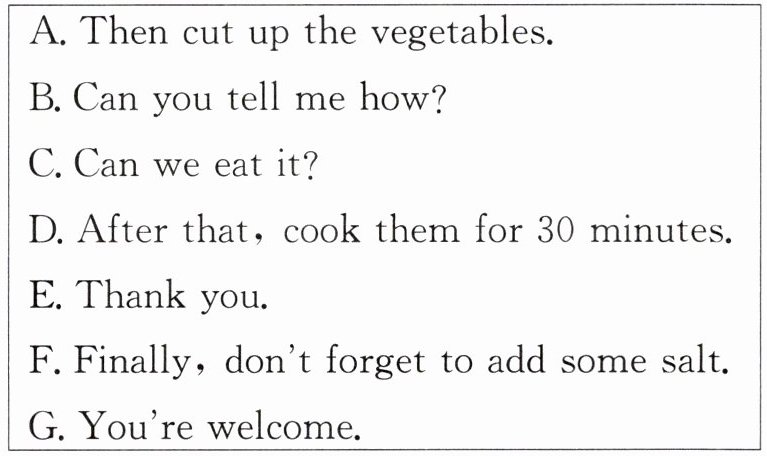
根据对话内容,从文后的选项中选出能填入空白处的最佳选项。其中有两个为多余选项。
A: Ben, I want to make Russian soup for a party on Sunday. 1.
B
B: Sure. First, buy some beef, one cabbage, four carrots, three potatoes, five tomatoes and one onion. 2.
A
A: What's next?
B: Next, put the beef, carrots and potatoes into a pot and add some water. 3.
D
Then, add the cabbage, tomatoes and onion and cook for another 10 minutes.A: 4.
C
B: No, one more thing. 5.
F
答案
1. B 2. A 3. D 4. C 5. F
解析
【分析】
补全对话需结合上下文的逻辑关系(如问答逻辑、动作顺序)选择合适选项。本题对话围绕制作罗宋汤的步骤展开,需根据每处空白前后的语句,判断所需内容:第一空是A询问制作方法,对应B选项;第二空是买完材料后的切菜步骤,对应A选项;第三空是放食材加水后的烹饪步骤,对应D选项;第四空是A询问能否食用,对应C选项;第五空是最后添加盐的步骤,对应F选项。
【解析】
1. 第一空:A表示想做罗宋汤,后文B以“Sure”回应并讲解制作步骤,说明A是询问制作方法,故填B(Can you tell me how?)。
2. 第二空:B提到“First, buy some...”(第一步买材料),接下来的动作是切菜,故填A(Then cut up the vegetables.)。
3. 第三空:B说“Next, put the beef... add some water”(接下来把食材放锅加水),之后的步骤是煮食材,故填D(After that, cook them for 30 minutes.)。
4. 第四空:B回答“No, one more thing”(不,还有一件事),说明A问的是“能否食用”,故填C(Can we eat it?)。
5. 第五空:B说“one more thing”(还有一件事),结合制作步骤的顺序,最后一步是加盐,故填F(Finally, don't forget to add some salt.)。
【答案】
1.B 2.A 3.D 4.C 5.F
【知识点】
情景交际、日常对话逻辑、步骤表达
【点评】
本题为补全对话题,围绕制作罗宋汤的场景展开,需结合上下文的问答逻辑和动作先后顺序选择选项,考察学生的情景交际运用能力,难度适中。
【难度系数】
0.5
三、阅读理解
It was half past five in the afternoon when Sarah came home from work. She walked into the living room and looked at her three children.
The children were fourteen, thirteen and nine years old. They were happily watching TV. The room was dirty and untidy (凌乱的). There were empty glasses and dirty clothes on the floor. Toys were everywhere.
Sarah got angry. “What a mess!” she said to her children. “I work all day and have to do housework all the evening. I'm very tired. I need to have a good rest. I won't do housework anymore!”
Sarah did as she said. She didn't do any housework. Every evening she sat on the sofa and watched TV. A week later, every dish in the kitchen was dirty. All the children's clothes were dirty too. Every trash can was full. The whole house was out of order.
Then one day when Sarah got home, she got very surprised. The kitchen was clean. The children had cleaned it!
The second day, when Sarah got home, she found the living room was clean, and the children were washing their clothes. Sarah was happy and went to help them.
Now Sarah and her three children do housework together. Then they all sit on the sofa and watch TV.
(
A. She usually cleaned the house.
B. She usually sat on the sofa and talked to her children.
C. She usually watched TV.
D. She usually did housework with her children.
(
A. Fourteen years old.
B. Thirteen years old.
C. Nine years old.
D. Six years old.
(
A. the dishes were clean
B. the room was dirty
C. the children were studying
D. her mother was looking after her children
(
A. happy
B. sad
C. sorry
D. unlucky
(
A. Sarah came home from work at 5:30 p.m.
B. Sarah didn't do housework for over a week.
C. The children were too young to wash their clothes.
D. Now Sarah and her children do housework together before watching TV.
It was half past five in the afternoon when Sarah came home from work. She walked into the living room and looked at her three children.
The children were fourteen, thirteen and nine years old. They were happily watching TV. The room was dirty and untidy (凌乱的). There were empty glasses and dirty clothes on the floor. Toys were everywhere.
Sarah got angry. “What a mess!” she said to her children. “I work all day and have to do housework all the evening. I'm very tired. I need to have a good rest. I won't do housework anymore!”
Sarah did as she said. She didn't do any housework. Every evening she sat on the sofa and watched TV. A week later, every dish in the kitchen was dirty. All the children's clothes were dirty too. Every trash can was full. The whole house was out of order.
Then one day when Sarah got home, she got very surprised. The kitchen was clean. The children had cleaned it!
The second day, when Sarah got home, she found the living room was clean, and the children were washing their clothes. Sarah was happy and went to help them.
Now Sarah and her three children do housework together. Then they all sit on the sofa and watch TV.
(
A
)1. What did Sarah usually do in the evening before she got angry?A. She usually cleaned the house.
B. She usually sat on the sofa and talked to her children.
C. She usually watched TV.
D. She usually did housework with her children.
(
C
)2. How old was Sarah's youngest child?A. Fourteen years old.
B. Thirteen years old.
C. Nine years old.
D. Six years old.
(
B
)3. Every day when Sarah got home, B
.A. the dishes were clean
B. the room was dirty
C. the children were studying
D. her mother was looking after her children
(
C
)4. Sarah's children all felt C
when Sarah got angry and didn't do any housework for over a week.A. happy
B. sad
C. sorry
D. unlucky
(
C
)5. Which of the following is NOT true?A. Sarah came home from work at 5:30 p.m.
B. Sarah didn't do housework for over a week.
C. The children were too young to wash their clothes.
D. Now Sarah and her children do housework together before watching TV.
答案
1. A 2. C 3. B 4. C 5. C
解析
【分析】做此类阅读理解题,需根据每个问题的关键词回到原文定位对应信息,逐一比对选项得出答案。第1题关键词为“usually do in the evening before she got angry”,定位原文对应内容;第2题关键词为“youngest child”,定位年龄相关描述;第3题结合Sarah回家时的房间状态定位;第4题需结合孩子后续行为推理;第5题是细节判断题,需逐一核对选项与原文是否一致。
【解析】1. 根据原文第三段“I work all day and have to do housework all the evening”可知,Sarah生气前晚上通常做家务,对应选项A。2. 根据原文第二段“The children were fourteen, thirteen and nine years old”,最小的孩子年龄是9岁,对应选项C。3. 根据原文第二段“The room was dirty and untidy”(Sarah生气前的情况),可知Sarah每天回家时房间是脏的,对应选项B。4. Sarah生气后一周不做家务,孩子们主动打扫房间,说明他们为之前的行为感到抱歉,对应选项C。5. 选项C称“孩子太小不能洗衣服”,但原文倒数第二段提到“the children were washing their clothes”,说明孩子能洗衣服,故C错误,对应选项C。
【答案】1.A 2.C 3.B 4.C 5.C
【知识点】英语阅读理解(细节理解),英语阅读理解(推理判断),英语阅读理解(细节判断)
【点评】本文是生活化叙事短文,考查学生定位细节、简单推理的能力,题目难度较低,认真阅读原文即可解答。
【难度系数】0.2
