

 登录
B
In the time of the Yellow Emperor, there were no written words. People recorded things by tying knots( 打结) in ropes and carving shapes on stone walls.
One day, the Yellow Emperor was discussing an event with a wise man named Cang Jie. Cang took out a piece of knotted rope, but he found it was destroyed. It was impossible for him to remember the event clearly. Then he turned to a stone wall, but he could hardly read the shapes on it. They were carved by someone else.
“ The ropes were destroyed because of unknown reasons. The shapes could only be read by a few people,” the emperor asked Cang. “Do you have better ideas to record things?”
Cang thought over the problem day and night. On the morning after a heavy snow, the ground was completely white. He saw the footprints of some different animals by accident. These footprints helped him to recognize what animals had passed by just now. Cang suddenly had an idea. He picked a stick and drew on the snow-covered ground. At first, he drew a tiger and a bear to show that they had passed by. But soon, he found it took him too much time to do so. He realized that he had to make the drawings easier.
All the shapes on the stone walls came to his mind. Cang kept making all kinds of shapes on the ground. He focused on drawing. To take the sun for example, he used a circle with a dot in the centre. A half-circle and a line stood for the moon. And five lines that were not straight were used to show water. These symbols shone brightly in the snow.
In the end, Cang created a whole set of symbols to record things. People could easily understand them. Since then, they have been able to record their own history in this way.
(
A. The stick. B. The stone wall.
C. The event. D. The knotted rope.
(
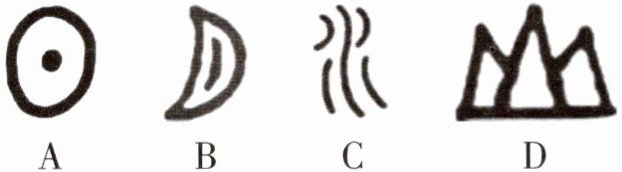
A B C D
(
A. Cang Jie created symbols to record events.
B. The Yellow Emperor created written symbols.
C. People could read and write well before Cang Jie’s time.
D. Animal footprints were used as symbols to record things.
(
A. Cang Jie and His Drawings
B. Cang Jie and the Yellow Emperor
C. The History of Ancient Recording Ways
D. The Invention of Writing Symbols in Ancient China
In the time of the Yellow Emperor, there were no written words. People recorded things by tying knots( 打结) in ropes and carving shapes on stone walls.
One day, the Yellow Emperor was discussing an event with a wise man named Cang Jie. Cang took out a piece of knotted rope, but he found it was destroyed. It was impossible for him to remember the event clearly. Then he turned to a stone wall, but he could hardly read the shapes on it. They were carved by someone else.
“ The ropes were destroyed because of unknown reasons. The shapes could only be read by a few people,” the emperor asked Cang. “Do you have better ideas to record things?”
Cang thought over the problem day and night. On the morning after a heavy snow, the ground was completely white. He saw the footprints of some different animals by accident. These footprints helped him to recognize what animals had passed by just now. Cang suddenly had an idea. He picked a stick and drew on the snow-covered ground. At first, he drew a tiger and a bear to show that they had passed by. But soon, he found it took him too much time to do so. He realized that he had to make the drawings easier.
All the shapes on the stone walls came to his mind. Cang kept making all kinds of shapes on the ground. He focused on drawing. To take the sun for example, he used a circle with a dot in the centre. A half-circle and a line stood for the moon. And five lines that were not straight were used to show water. These symbols shone brightly in the snow.
In the end, Cang created a whole set of symbols to record things. People could easily understand them. Since then, they have been able to record their own history in this way.
(
B
)5. What does the underlined word “it” in Paragraph 2 refer to?A. The stick. B. The stone wall.
C. The event. D. The knotted rope.
(
C
)6. 新考法 图片理解 Which picture best describes the symbol of the water?A B C D
(
A
)7. Which of the following is TRUE according to the text?A. Cang Jie created symbols to record events.
B. The Yellow Emperor created written symbols.
C. People could read and write well before Cang Jie’s time.
D. Animal footprints were used as symbols to record things.
(
D
)8. What’s the best title for the text?A. Cang Jie and His Drawings
B. Cang Jie and the Yellow Emperor
C. The History of Ancient Recording Ways
D. The Invention of Writing Symbols in Ancient China
答案
5. B 6. C 7. A 8. D
解析
【分析】
这是一篇关于仓颉创造记录符号的英语阅读理解题,包含代词指代、细节理解、图片理解、主旨大意四类题型。解题时,需针对不同题型定位原文信息:第5题通过代词所在句的上下文找指代对象;第6题结合文中描述“水”符号的语句对应选项图形;第7题逐一核对选项与原文细节;第8题梳理全文核心内容确定主旨。
【解析】
5. 定位第二段句子“Then he turned to a stone wall, but he could hardly read the shapes on it.”,此处代词“it”指代前面提到的“stone wall”,故选B。
6. 文中第五段明确说明“five lines that were not straight were used to show water”,观察选项图形,C项符合水的符号特征,故选C。
7. 逐一验证选项:A项对应最后一段“Cang created a whole set of symbols to record things”,表述正确;B项是仓颉而非黄帝创造符号,错误;C项第一段提到“no written words”,错误;D项动物脚印是启发而非记录符号,错误,故选A。
8. 全文围绕仓颉创造记录符号的过程展开,核心是中国古代书写符号的发明,A项侧重“drawings”不准确,B项偏离重点,C项范围过大,故选D。
【答案】
5.B 6.C 7.A 8.D
【知识点】
代词指代题、细节理解题、主旨大意题、图片理解题
【点评】
本题以仓颉造符号的故事为载体,综合考查英语阅读的多种核心题型,需学生具备定位原文信息、图文对应、梳理主旨的能力,整体难度适中。
【难度系数】
0.6
