

 登录
登录
七、选出合适的选项完成对话。(10分)
A. How do you come to school?
B. My home is on Blue Street.
C. It's far from school.
D. I come to school on foot.
E. It's near school.
Tim: Hi, Lisa. Where is your home?
Lisa: 1.
Tim: Is your home far from school?
Lisa: No, it isn't. 2.
Tim: How do you come to school?
Lisa: 3.
Tim: It's on Jiefang Street. 4.
Lisa: You live far from school. 5.
Tim: I come to school by bus.
A. How do you come to school?
B. My home is on Blue Street.
C. It's far from school.
D. I come to school on foot.
E. It's near school.
Tim: Hi, Lisa. Where is your home?
Lisa: 1.
B
Tim: Is your home far from school?
Lisa: No, it isn't. 2.
E
Tim: How do you come to school?
Lisa: 3.
D
Where is your home?Tim: It's on Jiefang Street. 4.
C
Lisa: You live far from school. 5.
A
Tim: I come to school by bus.
答案
1. B 2. E 3. D 4. C 5. A
解析
【分析】
做这类补全对话题目,需结合上下文的问句和答句逻辑匹配选项:
1. 第一空,Tim问“Where is your home?”(你家在哪?),需回答家的位置,对应选项B;
2. 第二空,Tim问“Is your home far from school?”(你家离学校远吗?),Lisa答“No, it isn't.”(不,不远),需说明家离学校近,对应选项E;
3. 第三空,Tim问“How do you come to school?”(你怎么来学校?),需回答上学的交通方式,对应选项D;
4. 第四空,Tim说自己家在解放路,后续Lisa说“You live far from school.”(你住得离学校远),此处需说明自己家离学校远,对应选项C;
5. 第五空,Tim答“I come to school by bus.”(我坐公交来学校),此处需问Tim的上学方式,对应选项A。
【解析】
根据对话上下文的问答逻辑逐一匹配选项:
1. 第一空:问句询问家的位置,答句需对应家的位置,选B;
2. 第二空:问句询问是否离学校远,答句说不远,需补充“离学校近”,选E;
3. 第三空:问句询问上学方式,答句需对应交通方式,选D;
4. 第四空:Tim说明家的位置后,后续提到住得远,此处需补充“离学校远”,选C;
5. 第五空:Tim回答上学方式,此处需对应问上学方式,选A。
【答案】
1.B 2.E 3.D 4.C 5.A
【知识点】
情景补全对话、日常交际用语
【点评】
本题为英语日常情景交际补全题,难度较低,只需结合上下文问答逻辑即可选出正确选项,考查学生对日常交际用语的运用能力。
【难度系数】
0.8
做这类补全对话题目,需结合上下文的问句和答句逻辑匹配选项:
1. 第一空,Tim问“Where is your home?”(你家在哪?),需回答家的位置,对应选项B;
2. 第二空,Tim问“Is your home far from school?”(你家离学校远吗?),Lisa答“No, it isn't.”(不,不远),需说明家离学校近,对应选项E;
3. 第三空,Tim问“How do you come to school?”(你怎么来学校?),需回答上学的交通方式,对应选项D;
4. 第四空,Tim说自己家在解放路,后续Lisa说“You live far from school.”(你住得离学校远),此处需说明自己家离学校远,对应选项C;
5. 第五空,Tim答“I come to school by bus.”(我坐公交来学校),此处需问Tim的上学方式,对应选项A。
【解析】
根据对话上下文的问答逻辑逐一匹配选项:
1. 第一空:问句询问家的位置,答句需对应家的位置,选B;
2. 第二空:问句询问是否离学校远,答句说不远,需补充“离学校近”,选E;
3. 第三空:问句询问上学方式,答句需对应交通方式,选D;
4. 第四空:Tim说明家的位置后,后续提到住得远,此处需补充“离学校远”,选C;
5. 第五空:Tim回答上学方式,此处需对应问上学方式,选A。
【答案】
1.B 2.E 3.D 4.C 5.A
【知识点】
情景补全对话、日常交际用语
【点评】
本题为英语日常情景交际补全题,难度较低,只需结合上下文问答逻辑即可选出正确选项,考查学生对日常交际用语的运用能力。
【难度系数】
0.8
八、新素材小男孩汤姆看电影为什么要反复买票呢?阅读材料,判断下列句子正(T)误(F)。(15分)
Tom is a little boy, and he is only seven
years old. Today, he goes to a cinema. It is the
first time for him to do that. He buys a ticket and
goes in. But after two or three minutes, he
comes out and buys the second ticket. Then, he
goes in again. After a few minutes, he comes out
again and buys the third ticket. Two or three
minutes after, he comes out and asks for another
ticket. A girl asks him, "Why do you buy so
many tickets? How many friends do you meet?"
"No, I have no friends here, but a big woman
always stops me at the door and cuts up my
ticket."
(
(
(
(
wants to meet many friends.
(
because a big woman always cuts up
his tickets.
Tom is a little boy, and he is only seven
years old. Today, he goes to a cinema. It is the
first time for him to do that. He buys a ticket and
goes in. But after two or three minutes, he
comes out and buys the second ticket. Then, he
goes in again. After a few minutes, he comes out
again and buys the third ticket. Two or three
minutes after, he comes out and asks for another
ticket. A girl asks him, "Why do you buy so
many tickets? How many friends do you meet?"
"No, I have no friends here, but a big woman
always stops me at the door and cuts up my
ticket."
(
T
)1. Tom is a seven-year-old boy.(
T
)2. Tom goes to watch a film.(
F
)3. Tom buys two tickets in all (总共).(
F
)4. Tom buys so many tickets because hewants to meet many friends.
(
T
)5. Tom thinks he can't watch the filmbecause a big woman always cuts up
his tickets.
答案
1. T 2. T 3. F 4. F 5. T
解析
【分析】
解答本题需先通读短文,理解故事内容,再针对每个小题的表述,回到原文定位对应信息,对比内容判断正误,注意不要被表面表述误导,需准确提取细节信息。
【解析】
1. 由原文第一句“Tom is a little boy, and he is only seven years old.”可知,汤姆是七岁的男孩,表述正确。
2. 由原文“Today, he goes to a cinema.”可知,汤姆去电影院(看电影),表述正确。
3. 原文提到汤姆先后买了第一、第二、第三张票,还要求再买,总共不止两张,表述错误。
4. 由汤姆的回答“No, I have no friends here”可知,他不是因为要见朋友才买很多票,表述错误。
5. 由汤姆的话“but a big woman always stops me at the door and cuts up my ticket.”可知,他以为票被剪了就不能看电影,所以反复买票,表述正确。
【答案】
1.T 2.T 3.F 4.F 5.T
【知识点】
英语阅读理解、细节理解题
【点评】
本题是基于生活场景的英语阅读理解判断题,侧重考查学生对短文细节信息的提取与判断能力,需要学生认真阅读原文,找准对应依据,避免误解文意。
【难度系数】
0.6
解答本题需先通读短文,理解故事内容,再针对每个小题的表述,回到原文定位对应信息,对比内容判断正误,注意不要被表面表述误导,需准确提取细节信息。
【解析】
1. 由原文第一句“Tom is a little boy, and he is only seven years old.”可知,汤姆是七岁的男孩,表述正确。
2. 由原文“Today, he goes to a cinema.”可知,汤姆去电影院(看电影),表述正确。
3. 原文提到汤姆先后买了第一、第二、第三张票,还要求再买,总共不止两张,表述错误。
4. 由汤姆的回答“No, I have no friends here”可知,他不是因为要见朋友才买很多票,表述错误。
5. 由汤姆的话“but a big woman always stops me at the door and cuts up my ticket.”可知,他以为票被剪了就不能看电影,所以反复买票,表述正确。
【答案】
1.T 2.T 3.F 4.F 5.T
【知识点】
英语阅读理解、细节理解题
【点评】
本题是基于生活场景的英语阅读理解判断题,侧重考查学生对短文细节信息的提取与判断能力,需要学生认真阅读原文,找准对应依据,避免误解文意。
【难度系数】
0.6
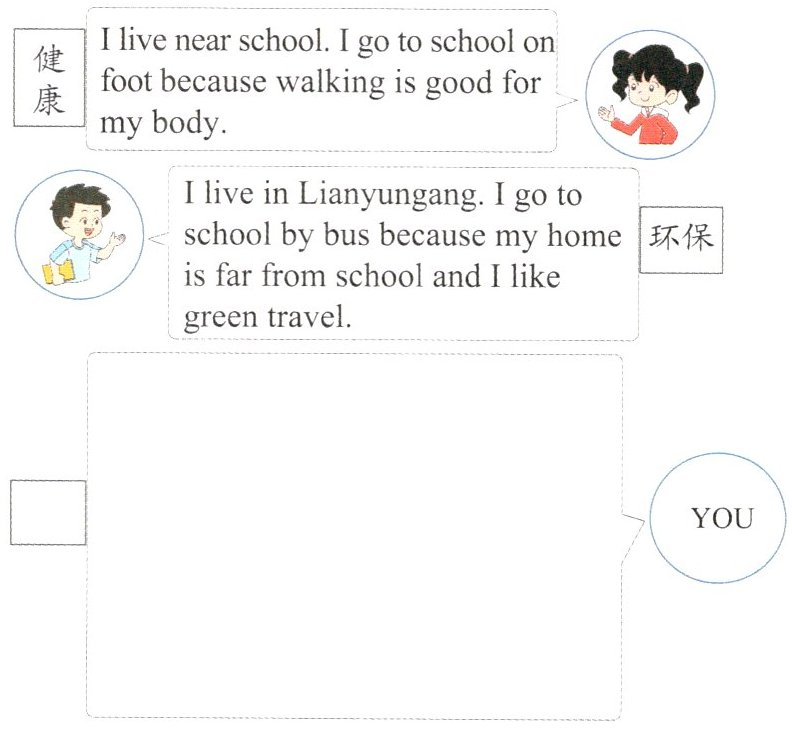
九、新考向英语开放课上大家畅所欲言。根据小朋友们的陈述,仿写一段话来描述自己的居住地和上学方式,并从健康、环保、交通法规等角度谈谈你选择该出行方式的原因。(11分)
答案
【参考范文】
交通法规:
I live in Yangzhou. I can't go to school by
bike because I'm too young. My father drives
me to school. I am a good boy.
交通法规:
I live in Yangzhou. I can't go to school by
bike because I'm too young. My father drives
me to school. I am a good boy.
解析
【分析】本题为英语开放仿写题,解题思路是:先模仿示例的结构,第一步说明自己的居住地;第二步说明上学的方式;第三步从指定角度(如交通法规)阐述选择该出行方式的原因,确保英语表达准确,符合句式逻辑。
【解析】按照示例的结构进行仿写:1. 点明居住地;2. 说明上学方式;3. 结合指定角度说明原因,完成符合要求的英语句子。
【答案】I live in Yangzhou. I can't go to school by bike because I'm too young. My father drives me to school. I am a good boy.
【知识点】英语写作、英语原因状语从句
【点评】本题考查英语开放写作能力,要求学生结合示例仿写,围绕居住地、上学方式及对应角度的原因展开,难度适中,能锻炼学生的英语应用能力。
【难度系数】0.5
【解析】按照示例的结构进行仿写:1. 点明居住地;2. 说明上学方式;3. 结合指定角度说明原因,完成符合要求的英语句子。
【答案】I live in Yangzhou. I can't go to school by bike because I'm too young. My father drives me to school. I am a good boy.
【知识点】英语写作、英语原因状语从句
【点评】本题考查英语开放写作能力,要求学生结合示例仿写,围绕居住地、上学方式及对应角度的原因展开,难度适中,能锻炼学生的英语应用能力。
【难度系数】0.5
