

 登录
登录
情境四 好奇心推动人类进步并助力个人成长。
四、任务型阅读。
阅读下面短文,从短文后的选项中选出可以填入空白处的最佳选项。选项中有一项为多余选项。
[2025 上海市静安区期中]Have you ever wondered why the sky is blue? This natural desire to ask questions and learn is called curiosity. It is one of the most powerful forces driving human progress. 1.
In schools, students with curious minds often enjoy exploring different subjects. They are not afraid to ask "why" or "how". 2.
Curiosity doesn't only help with schoolwork. It is also important for solving real-world problems. Many great scientists and inventors, like Marie Curie and Thomas Edison, achieved great things because of their endless curiosity. 3.
4.
So, next time you find yourself asking a question about something you don't know, don't stop. Keep that curious mind active. 5.
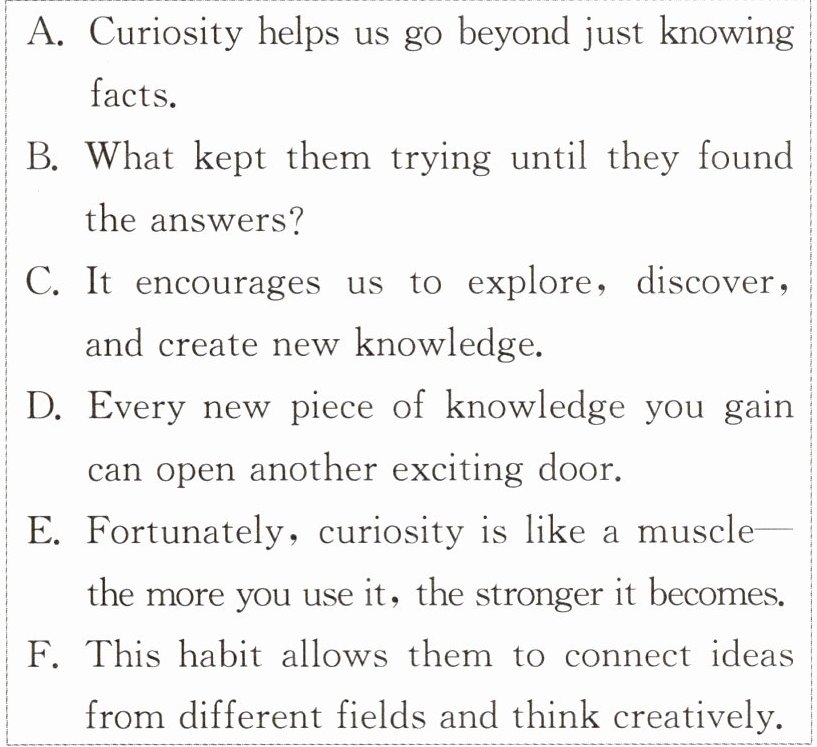
深度阅读·回答问题
6. How can students develop their curiosity?
四、任务型阅读。
阅读下面短文,从短文后的选项中选出可以填入空白处的最佳选项。选项中有一项为多余选项。
[2025 上海市静安区期中]Have you ever wondered why the sky is blue? This natural desire to ask questions and learn is called curiosity. It is one of the most powerful forces driving human progress. 1.
C
In schools, students with curious minds often enjoy exploring different subjects. They are not afraid to ask "why" or "how". 2.
F
For example, when learning history, curious students might research why an event happened, not just remember the date. This helps them understand the world better.Curiosity doesn't only help with schoolwork. It is also important for solving real-world problems. Many great scientists and inventors, like Marie Curie and Thomas Edison, achieved great things because of their endless curiosity. 3.
B
It was their curiosity that drove them. They viewed each failure not as a defeat, but as a valuable lesson that brought them closer to success.4.
E
You can develop your curiosity by reading various books, trying new hobbies, or even just observing the world around you carefully. Curious people tend to be better problem-solvers and are more prepared for future challenges.So, next time you find yourself asking a question about something you don't know, don't stop. Keep that curious mind active. 5.
D
Your curiosity might lead you to discover a new passion, solve an interesting problem, or even make your own small contribution to our collective knowledge.深度阅读·回答问题
6. How can students develop their curiosity?
They can develop it by reading different books, trying new hobbies and observing the world carefully.
答案
1. C 根据“It is one of the most powerful forces driving human progress.”可知,此处是在说明好奇心的重要作用,它能推动人类进步。
2. F 根据“In schools, students with curious minds often enjoy exploring different subjects. They are not afraid to ask ‘why’ or ‘how’.”可知,此处是在描述有好奇心的学生的习惯及其影响。
3. B 根据“Many great scientists and inventors, like Marie Curie and Thomas Edison, achieved great things because of their endless curiosity.”和“It was their curiosity that drove them.”可知,此处是提出一个关于科学家和发明家坚持下去的原因的问题。
4. E 根据“You can develop your curiosity by reading various books, trying new hobbies, or even just observing the world around you carefully.”可知,此处是在说明好奇心可以培养。
5. D 根据“Your curiosity might lead you to discover a new passion, solve an interesting problem, or even make your own small contribution to our collective knowledge.”可知,此处是在强调好奇心带来的收获和意义。
6. They can develop it by reading different books, trying new hobbies and observing the world carefully. 根据第三段内容,通过多读书、尝试新爱好、细心观察世界可以培养好奇心。
2. F 根据“In schools, students with curious minds often enjoy exploring different subjects. They are not afraid to ask ‘why’ or ‘how’.”可知,此处是在描述有好奇心的学生的习惯及其影响。
3. B 根据“Many great scientists and inventors, like Marie Curie and Thomas Edison, achieved great things because of their endless curiosity.”和“It was their curiosity that drove them.”可知,此处是提出一个关于科学家和发明家坚持下去的原因的问题。
4. E 根据“You can develop your curiosity by reading various books, trying new hobbies, or even just observing the world around you carefully.”可知,此处是在说明好奇心可以培养。
5. D 根据“Your curiosity might lead you to discover a new passion, solve an interesting problem, or even make your own small contribution to our collective knowledge.”可知,此处是在强调好奇心带来的收获和意义。
6. They can develop it by reading different books, trying new hobbies and observing the world carefully. 根据第三段内容,通过多读书、尝试新爱好、细心观察世界可以培养好奇心。
解析
【分析】
这是一道任务型阅读题,需结合文章上下文的语境、逻辑关系,选择合适的句子补全短文,同时提取细节信息完成问答。解题时先通读全文把握主题(好奇心的重要性及培养),再逐空分析前后文的内容衔接:第1空承接“好奇心推动人类进步”的表述,需说明其具体作用;第2空承接“有好奇心的学生的表现”,需说明该表现的影响;第3空承接“科学家因好奇心取得成就”,需引出与坚持相关的内容;第4空引出“培养好奇心”的话题;第5空承接“保持好奇心”,需说明其带来的结果;第6空需从文中提取培养好奇心的具体方式。
【解析】
1. 第1空:前文提到“好奇心是推动人类进步的最强大力量之一”,C选项“它鼓励我们去探索、发现和创造新知识”,正好承接好奇心对人类进步的作用,符合语境,故选C。
2. 第2空:前文描述“有好奇心的学生不怕问‘为什么’或‘如何’”,F选项中的“This habit”指代前文的好奇心习惯,“连接不同领域的想法并创造性思考”是该习惯带来的结果,符合语境,故选F。
3. 第3空:前文提到“许多伟大的科学家和发明家因无尽的好奇心取得成就”,后文指出“是好奇心驱动他们”,B选项“什么让他们坚持直到找到答案?”正好引出后文关于坚持的原因,符合逻辑,故选B。
4. 第4空:后文说明“培养好奇心的方法”,E选项“幸运的是,好奇心就像肌肉——你用得越多,它就变得越强”,对应培养好奇心的话题,故选E。
5. 第5空:前文说“保持好奇心”,后文提到“好奇心可能带来的收获”,D选项“你获得的每一个新知识都能打开另一扇令人兴奋的门”,说明好奇心带来的结果,符合语境,故选D。
6. 第6空:根据第四段“You can develop your curiosity by reading various books, trying new hobbies, or even just observing the world around you carefully.”,提取培养好奇心的具体方式,即通过读不同的书、尝试新爱好、细心观察周围世界。
【答案】
1. C
2. F
3. B
4. E
5. D
6. They can develop it by reading different books, trying new hobbies and observing the world carefully.
【知识点】
任务型阅读、上下文逻辑推理、细节理解
【点评】
本题围绕“好奇心”展开,考查学生对文章语境逻辑的把握和细节信息的提取能力,需要学生结合前后文分析句子衔接,同时准确定位细节,难度适中,适合初中阶段学生练习。
【难度系数】
0.6
这是一道任务型阅读题,需结合文章上下文的语境、逻辑关系,选择合适的句子补全短文,同时提取细节信息完成问答。解题时先通读全文把握主题(好奇心的重要性及培养),再逐空分析前后文的内容衔接:第1空承接“好奇心推动人类进步”的表述,需说明其具体作用;第2空承接“有好奇心的学生的表现”,需说明该表现的影响;第3空承接“科学家因好奇心取得成就”,需引出与坚持相关的内容;第4空引出“培养好奇心”的话题;第5空承接“保持好奇心”,需说明其带来的结果;第6空需从文中提取培养好奇心的具体方式。
【解析】
1. 第1空:前文提到“好奇心是推动人类进步的最强大力量之一”,C选项“它鼓励我们去探索、发现和创造新知识”,正好承接好奇心对人类进步的作用,符合语境,故选C。
2. 第2空:前文描述“有好奇心的学生不怕问‘为什么’或‘如何’”,F选项中的“This habit”指代前文的好奇心习惯,“连接不同领域的想法并创造性思考”是该习惯带来的结果,符合语境,故选F。
3. 第3空:前文提到“许多伟大的科学家和发明家因无尽的好奇心取得成就”,后文指出“是好奇心驱动他们”,B选项“什么让他们坚持直到找到答案?”正好引出后文关于坚持的原因,符合逻辑,故选B。
4. 第4空:后文说明“培养好奇心的方法”,E选项“幸运的是,好奇心就像肌肉——你用得越多,它就变得越强”,对应培养好奇心的话题,故选E。
5. 第5空:前文说“保持好奇心”,后文提到“好奇心可能带来的收获”,D选项“你获得的每一个新知识都能打开另一扇令人兴奋的门”,说明好奇心带来的结果,符合语境,故选D。
6. 第6空:根据第四段“You can develop your curiosity by reading various books, trying new hobbies, or even just observing the world around you carefully.”,提取培养好奇心的具体方式,即通过读不同的书、尝试新爱好、细心观察周围世界。
【答案】
1. C
2. F
3. B
4. E
5. D
6. They can develop it by reading different books, trying new hobbies and observing the world carefully.
【知识点】
任务型阅读、上下文逻辑推理、细节理解
【点评】
本题围绕“好奇心”展开,考查学生对文章语境逻辑的把握和细节信息的提取能力,需要学生结合前后文分析句子衔接,同时准确定位细节,难度适中,适合初中阶段学生练习。
【难度系数】
0.6
