

 登录
登录
五、你听说过“曾子杀猪”的故事吗?根据首字母提示补全短文。
Long ago, Zengzi was a wise m
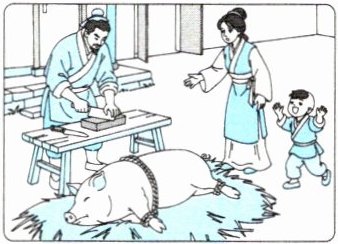
Long ago, Zengzi was a wise m
an
in ancient China. One day, his wife wanted to go to the market. Their son wanted to go with her. To stop him, she said, “I will kill a pig and cook it for you after I get back home.” When she came
back home, she found
that Zengzi was ready to kill the pig. She tried
to stop him and said, “It was a joke(玩笑).” But Zengzi replied, “We should not tell lies
to children. They learn from us.” Then he killed the pig and cooked the meat. He wanted to teach his child that honesty
is more important than everything.答案
man, came, found, tried, lies, honesty
解析
【分析】
首先通读短文,理解“曾子杀猪”的故事大意:曾子是古代智者,妻子为了不让儿子跟着去市场骗他说回家杀猪,回来后曾子要杀猪兑现承诺,妻子说只是玩笑,曾子认为不能对孩子撒谎,要教孩子诚实的道理。然后结合每个空的首字母提示和语境、固定搭配、语法(动词过去式)逐个分析填空:1. 第一空需填表示“人”的名词,结合wise(聪明的)和首字母m,对应“智者”的表达;2. 第二空对应“回家”的动作,用come的过去式;3. 第三空对应“发现”的动作,用find的过去式;4. 第四空对应“试图做某事”的结构,用try的过去式;5. 第五空是固定搭配“tell lies(撒谎)”;6. 第六空结合主旨,填表示“诚实”的名词。
【解析】
1. 第一空:根据语境“Zengzi was a wise m______”,wise后接名词,结合首字母m,填man(wise man意为“智者”);
2. 第二空:“When she c______ back home”表示“当她回到家”,用come的过去式came;
3. 第三空:“she f______ that Zengzi was ready to kill the pig”意为“她发现曾子准备杀猪”,用find的过去式found;
4. 第四空:“She t______ to stop him”表示“她试图阻止他”,用try的过去式tried;
5. 第五空:固定搭配“tell lies”意为“撒谎”,结合首字母l,填lies;
6. 第六空:结合故事主旨“诚实比一切重要”,首字母h,填honesty。
【答案】
man, came, found, tried, lies, honesty
【知识点】
动词过去式、固定搭配、名词词义
【点评】
本题结合经典故事“曾子杀猪”考查词汇运用,既巩固了基础词汇和语法(动词过去式、固定搭配),又渗透了诚信教育,题目难度适中,贴近学生认知。
【难度系数】
0.6
首先通读短文,理解“曾子杀猪”的故事大意:曾子是古代智者,妻子为了不让儿子跟着去市场骗他说回家杀猪,回来后曾子要杀猪兑现承诺,妻子说只是玩笑,曾子认为不能对孩子撒谎,要教孩子诚实的道理。然后结合每个空的首字母提示和语境、固定搭配、语法(动词过去式)逐个分析填空:1. 第一空需填表示“人”的名词,结合wise(聪明的)和首字母m,对应“智者”的表达;2. 第二空对应“回家”的动作,用come的过去式;3. 第三空对应“发现”的动作,用find的过去式;4. 第四空对应“试图做某事”的结构,用try的过去式;5. 第五空是固定搭配“tell lies(撒谎)”;6. 第六空结合主旨,填表示“诚实”的名词。
【解析】
1. 第一空:根据语境“Zengzi was a wise m______”,wise后接名词,结合首字母m,填man(wise man意为“智者”);
2. 第二空:“When she c______ back home”表示“当她回到家”,用come的过去式came;
3. 第三空:“she f______ that Zengzi was ready to kill the pig”意为“她发现曾子准备杀猪”,用find的过去式found;
4. 第四空:“She t______ to stop him”表示“她试图阻止他”,用try的过去式tried;
5. 第五空:固定搭配“tell lies”意为“撒谎”,结合首字母l,填lies;
6. 第六空:结合故事主旨“诚实比一切重要”,首字母h,填honesty。
【答案】
man, came, found, tried, lies, honesty
【知识点】
动词过去式、固定搭配、名词词义
【点评】
本题结合经典故事“曾子杀猪”考查词汇运用,既巩固了基础词汇和语法(动词过去式、固定搭配),又渗透了诚信教育,题目难度适中,贴近学生认知。
【难度系数】
0.6
六、 提素养 人文底蕴 阅读三个中国古代美德小故事,完成下列任务。
1.
2.
3.
任务一:根据故事内容,给故事匹配对应的插图,将序号填在横线上。
A.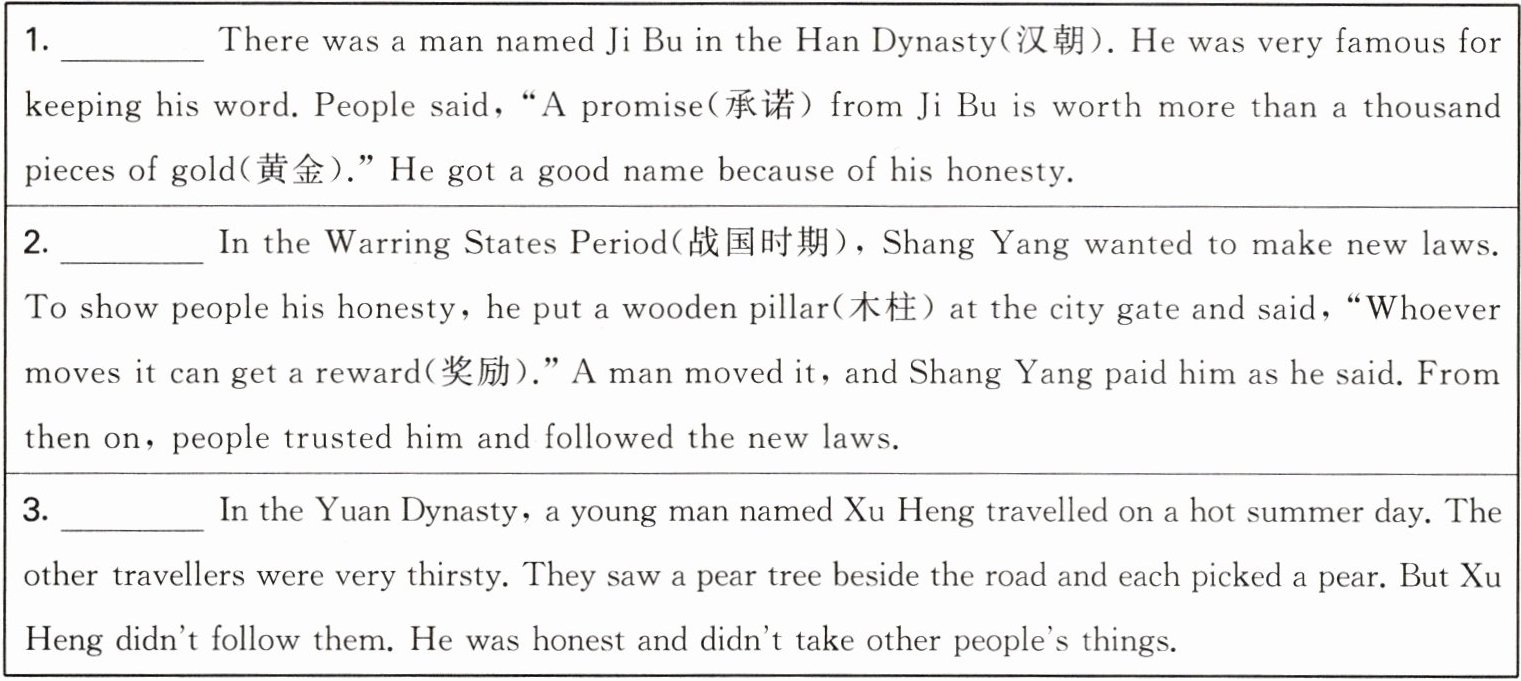 B.
B.  C.
C.
任务二:根据故事内容,回答问题。
1. Did Ji Bu often break his word?
2. Why did people trust Shang Yang and follow the new laws?
3. What did Xu Heng do when the other travellers picked pears?
4. What do you think of these three people? Which one do you like best? Why?
1.
C
There was a man named Ji Bu in the Han Dynasty(汉朝). He was very famous for keeping his word. People said, “A promise(承诺) from Ji Bu is worth more than a thousand pieces of gold(黄金).” He got a good name because of his honesty.2.
A
In the Warring States Period(战国时期), Shang Yang wanted to make new laws. To show people his honesty, he put a wooden pillar(木柱) at the city gate and said, “Whoever moves it can get a reward(奖励).” A man moved it, and Shang Yang paid him as he said. From then on, people trusted him and followed the new laws.3.
B
In the Yuan Dynasty, a young man named Xu Heng travelled on a hot summer day. The other travellers were very thirsty. They saw a pear tree beside the road and each picked a pear. But Xu Heng didn't follow them. He was honest and didn't take other people's things.任务一:根据故事内容,给故事匹配对应的插图,将序号填在横线上。
A.
B. C.任务二:根据故事内容,回答问题。
1. Did Ji Bu often break his word?
No, he didn't.
2. Why did people trust Shang Yang and follow the new laws?
示例:Because Shang Yang was honest and did what he said.
3. What did Xu Heng do when the other travellers picked pears?
示例:He didn't follow them. He didn't take others' things.
4. What do you think of these three people? Which one do you like best? Why?
示例:I think they were all honest and kind. I like Xu Heng best because he didn't take other people's things.
答案
任务一:1. C 2. A 3. B
任务二:
1. No, he didn't.
2. 示例:Because Shang Yang was honest and did what he said.
3. 示例:He didn't follow them. He didn't take others' things.
4. 示例:I think they were all honest and kind. I like Xu Heng best because he didn't take other people's things.
任务二:
1. No, he didn't.
2. 示例:Because Shang Yang was honest and did what he said.
3. 示例:He didn't follow them. He didn't take others' things.
4. 示例:I think they were all honest and kind. I like Xu Heng best because he didn't take other people's things.
解析
【分析】
首先,任务一需梳理每个故事的核心内容,匹配对应插图:故事1讲季布守信(一诺千金),对应插图C;故事2讲商鞅立木取信,对应插图A;故事3讲许衡不摘梨,对应插图B。任务二需从原文中定位关键信息回答细节类问题,第4题是开放性问题,围绕三人的诚实品质作答即可。
【解析】
任务一:1. 故事1核心是季布以守信闻名,匹配插图C;2. 故事2核心是商鞅兑现搬木柱给奖励的承诺,匹配插图A;3. 故事3核心是许衡不拿他人的梨,匹配插图B。
任务二:1. 原文明确季布以守信著称,故回答No, he didn't.;2. 商鞅兑现了搬木柱的奖励承诺,展现诚实,因此人们信任他;3. 许衡没有跟随他人摘梨,也没拿别人的东西;4. 围绕三人的诚实品质评价,选择喜欢的人物并说明理由即可。
【答案】
任务一:1. C 2. A 3. B
任务二:1. No, he didn't. 2. Because Shang Yang was honest and did what he said. 3. He didn't follow them and didn't take others' things. 4. 示例:I think they were all honest people. I like Xu Heng best because he didn't take other people's things even when others did.
【知识点】
英语阅读理解、细节理解、开放性表达
【点评】
本题结合中国古代美德故事,考查英语阅读理解能力,既巩固语言知识,又渗透人文素养,题目难度适中,适合学生练习。
【难度系数】
0.6
首先,任务一需梳理每个故事的核心内容,匹配对应插图:故事1讲季布守信(一诺千金),对应插图C;故事2讲商鞅立木取信,对应插图A;故事3讲许衡不摘梨,对应插图B。任务二需从原文中定位关键信息回答细节类问题,第4题是开放性问题,围绕三人的诚实品质作答即可。
【解析】
任务一:1. 故事1核心是季布以守信闻名,匹配插图C;2. 故事2核心是商鞅兑现搬木柱给奖励的承诺,匹配插图A;3. 故事3核心是许衡不拿他人的梨,匹配插图B。
任务二:1. 原文明确季布以守信著称,故回答No, he didn't.;2. 商鞅兑现了搬木柱的奖励承诺,展现诚实,因此人们信任他;3. 许衡没有跟随他人摘梨,也没拿别人的东西;4. 围绕三人的诚实品质评价,选择喜欢的人物并说明理由即可。
【答案】
任务一:1. C 2. A 3. B
任务二:1. No, he didn't. 2. Because Shang Yang was honest and did what he said. 3. He didn't follow them and didn't take others' things. 4. 示例:I think they were all honest people. I like Xu Heng best because he didn't take other people's things even when others did.
【知识点】
英语阅读理解、细节理解、开放性表达
【点评】
本题结合中国古代美德故事,考查英语阅读理解能力,既巩固语言知识,又渗透人文素养,题目难度适中,适合学生练习。
【难度系数】
0.6
