

 登录
登录
(一)用should或shouldn’t填空,并匹配对应的场景图片。
C.
1. We
2. We
3. We
4. We
5. On the school trip, we
C.
1. We
shouldn't
swim alone in the sea. We should
swim with an adult and use life buoys. (D
)2. We
should
hold on to the handrail on the steps. We shouldn't
run on the steps. (B
)3. We
shouldn't
play on the rocks at the beach. It’s not safe. (E
)4. We
should
look left and right before crossing the road. (A
)5. On the school trip, we
should
always stay with our group and teachers. It is easy to get lost in the old town. (C
)答案
1. shouldn't; should; D 2. should; shouldn't; B 3. shouldn't; E 4. should; A 5. should; C
解析
【分析】首先明确should表示“应该做某事”,shouldn't表示“不应该做某事”,结合每个句子描述的安全行为,匹配对应场景图片:1题涉及独自游泳的安全规则,对应大人带小孩游泳的D图;2题是台阶上的安全行为,对应抓扶手的B图;3题是海滩岩石边的安全禁忌,对应悬崖边的E图;4题是过马路的安全要求,对应斑马线处的A图;5题是学校旅行的安全规则,对应老师带学生队伍的C图。
【解析】1. 句意:我们不应该独自在海里游泳,应该和成人一起游泳并使用救生圈,对应图片D,故填shouldn't; should; D。2. 句意:我们应该在台阶上抓扶手,不应该在台阶上跑,对应图片B,故填should; shouldn't; B。3. 句意:我们不应该在海滩的岩石上玩,这不安全,对应图片E,故填shouldn't; E。4. 句意:我们过马路前应该左右看,对应图片A,故填should; A。5. 句意:学校旅行时,我们应该总是和团队、老师待在一起,在老城区容易迷路,对应图片C,故填should; C。
【答案】1. shouldn't; should; D 2. should; shouldn't; B 3. shouldn't; E 4. should; A 5. should; C
【知识点】情态动词should用法,安全常识
【点评】本题结合生活安全场景考查情态动词should的用法,需结合图片和安全常识判断,贴近生活实际,难度适中。
【难度系数】0.6
【解析】1. 句意:我们不应该独自在海里游泳,应该和成人一起游泳并使用救生圈,对应图片D,故填shouldn't; should; D。2. 句意:我们应该在台阶上抓扶手,不应该在台阶上跑,对应图片B,故填should; shouldn't; B。3. 句意:我们不应该在海滩的岩石上玩,这不安全,对应图片E,故填shouldn't; E。4. 句意:我们过马路前应该左右看,对应图片A,故填should; A。5. 句意:学校旅行时,我们应该总是和团队、老师待在一起,在老城区容易迷路,对应图片C,故填should; C。
【答案】1. shouldn't; should; D 2. should; shouldn't; B 3. shouldn't; E 4. should; A 5. should; C
【知识点】情态动词should用法,安全常识
【点评】本题结合生活安全场景考查情态动词should的用法,需结合图片和安全常识判断,贴近生活实际,难度适中。
【难度系数】0.6
(二)在游览美丽的连云港景点时,我们要注意什么安全规则呢?阅读并判断正(T)误(F)。
Huaguo Mountain
It's a famous place in Lianyungang. The trails can be narrow and steep. Some rocks have wet moss. Remember:
• Walk slowly on the mountain paths.
• Don't run or play near cliffs.
• Wear sports shoes—not slippers!
• Keep away from wild monkeys.
Lian Island
It has beautiful beaches and clean sand. Many children come here to have fun. But the sea tide changes quickly. Remember:
• Never walk far out into deep water.
• Check the tide timetable.
• Don't climb on wet rocks.
• Listen to lifeguards and follow their signs.
(
(
(
Huaguo Mountain
It's a famous place in Lianyungang. The trails can be narrow and steep. Some rocks have wet moss. Remember:
• Walk slowly on the mountain paths.
• Don't run or play near cliffs.
• Wear sports shoes—not slippers!
• Keep away from wild monkeys.
Lian Island
It has beautiful beaches and clean sand. Many children come here to have fun. But the sea tide changes quickly. Remember:
• Never walk far out into deep water.
• Check the tide timetable.
• Don't climb on wet rocks.
• Listen to lifeguards and follow their signs.
(
F
)1. You can wear slippers on Huaguo Mountain.(
F
)2. It is safe to play near the cliffs on Huaguo Mountain.(
T
)3. You should check the tide timetable when going to Lian Island.答案
1. F 2. F 3. T
解析
【分析】本题为英语阅读理解判断题,需先定位每个题目对应的景点段落,再将题目描述与原文给出的安全规则逐一对比判断。具体步骤:1. 定位第1题对应花果山的穿着规则;2. 定位第2题对应花果山的悬崖边活动规则;3. 定位第3题对应连岛的潮汐相关规则,再分别判断正误。
【解析】1. 原文花果山部分明确要求“Wear sports shoes—not slippers!”,即不能穿拖鞋,题目描述错误,故填F;2. 原文花果山部分规定“Don't run or play near cliffs”,即禁止在悬崖边玩耍,此处不安全,题目描述错误,故填F;3. 原文连岛部分要求“Check the tide timetable”,即需要查看潮汐表,题目描述正确,故填T。
【答案】1.F 2.F 3.T
【知识点】英语阅读理解;信息定位与判断
【点评】本题考查学生对英语阅读文本中具体信息的提取与判断能力,题型基础,需仔细对照原文细节即可作答。
【难度系数】0.3
【解析】1. 原文花果山部分明确要求“Wear sports shoes—not slippers!”,即不能穿拖鞋,题目描述错误,故填F;2. 原文花果山部分规定“Don't run or play near cliffs”,即禁止在悬崖边玩耍,此处不安全,题目描述错误,故填F;3. 原文连岛部分要求“Check the tide timetable”,即需要查看潮汐表,题目描述正确,故填T。
【答案】1.F 2.F 3.T
【知识点】英语阅读理解;信息定位与判断
【点评】本题考查学生对英语阅读文本中具体信息的提取与判断能力,题型基础,需仔细对照原文细节即可作答。
【难度系数】0.3
(三)有一些学校靠近铁路,来学习道口安全知识吧。阅读对话并选择正确答案。
Lily: Dad, can we cross the railway now?
Dad: No. We must wait for the barrier to lift.
Lily: But it looks safe ...
Dad: Trains are fast and quiet. It's dangerous to rush. Let's count to 60 together!
Safety Rules at the Railway Crossing
⚠ NEVER walk on tracks.
⚠ ALWAYS wait 1.
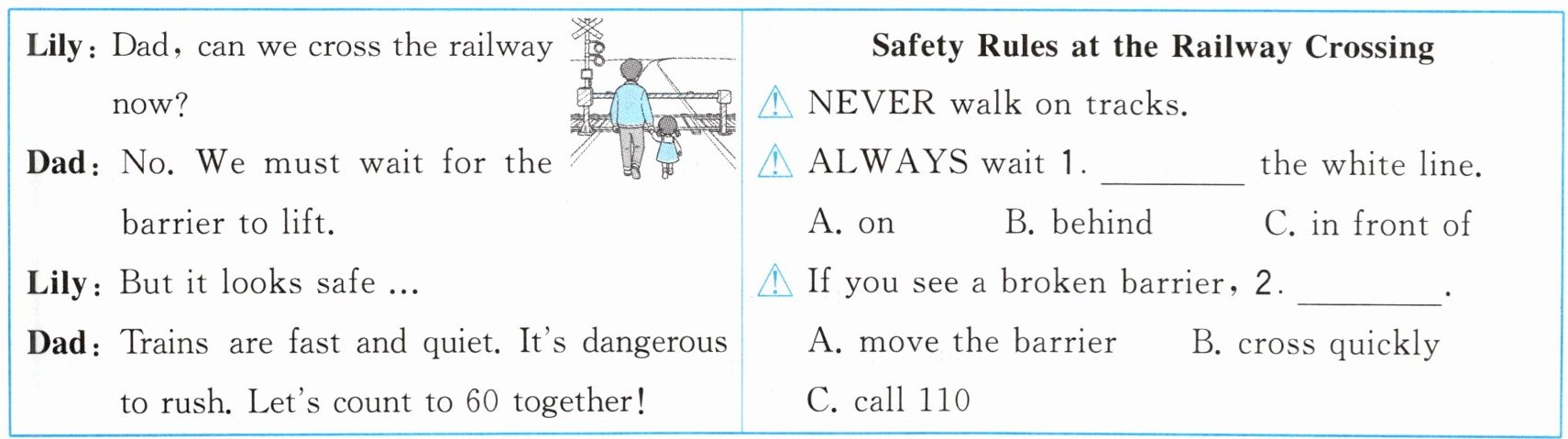 A. on B. behind C. in front of
⚠ If you see a broken barrier, 2.
A.move the barrier
B.cross quickly
C.call 110
Lily: Dad, can we cross the railway now?
Dad: No. We must wait for the barrier to lift.
Lily: But it looks safe ...
Dad: Trains are fast and quiet. It's dangerous to rush. Let's count to 60 together!
Safety Rules at the Railway Crossing
⚠ NEVER walk on tracks.
⚠ ALWAYS wait 1.
B
the white line.A. on B. behind C. in front of⚠ If you see a broken barrier, 2.
C
.A.move the barrier
B.cross quickly
C.call 110
答案
1. B 2. C
解析
【分析】本题为英语阅读理解选择题,需结合铁路道口安全常识与题目给出的对话内容,逐一分析选项。第1题考查铁路道口等待的位置要求,第2题考查遇到损坏栏杆的正确做法,通过排除不符合安全规则的选项得出答案。
【解析】第1题:铁路道口安全规则要求行人需在白线后方等待,避免靠近轨道,A选项“on(在…上)”、C选项“in front of(在…前面)”均不符合安全要求,因此选B。第2题:遇到损坏的栏杆时,不能自行移动栏杆(A选项错误),也不能快速通过(B选项危险),正确做法是拨打报警电话110,因此选C。
【答案】1.B 2.C
【知识点】英语阅读理解,安全常识应用
【点评】本题结合生活实际的铁路道口安全知识,考查学生的阅读理解能力与常识应用能力,贴近生活,难度适中。
【难度系数】0.5
【解析】第1题:铁路道口安全规则要求行人需在白线后方等待,避免靠近轨道,A选项“on(在…上)”、C选项“in front of(在…前面)”均不符合安全要求,因此选B。第2题:遇到损坏的栏杆时,不能自行移动栏杆(A选项错误),也不能快速通过(B选项危险),正确做法是拨打报警电话110,因此选C。
【答案】1.B 2.C
【知识点】英语阅读理解,安全常识应用
【点评】本题结合生活实际的铁路道口安全知识,考查学生的阅读理解能力与常识应用能力,贴近生活,难度适中。
【难度系数】0.5
