登录
1[中]如图,在平面直角坐标系中,以原点O为圆心的圆过点A(5,0),一直线过点D(2,3)且与圆O交于B,C两点,则弦BC的最小值为
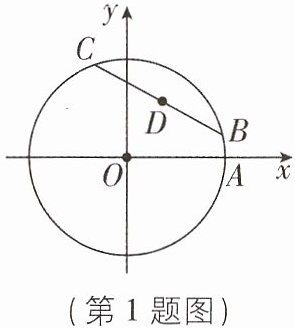
(第1题图)
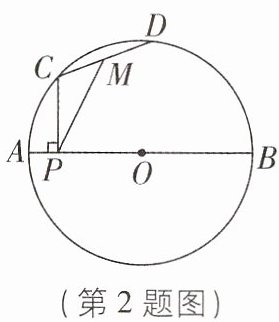
(第2题图)
4√3
.(第1题图)
(第2题图)
答案
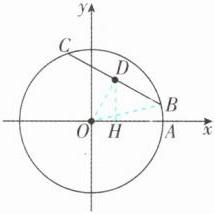
1. $4\sqrt{3}$ 【解析】如图,过点 D 作 $DH ⊥ x$ 轴于点 H,连接 $OD,OB$,则有 $OH=2,DH=3,\therefore$ 根据勾股定理得 $OD = \sqrt{OH^2+DH^2} = \sqrt{13}$.$\because A(5,0),\therefore OA = 5$,$\therefore OB=OA=5$. $\because$ 过圆内定点 $D$ 的所有弦中,与 $OD$ 垂直的弦最短,$\therefore$ 由垂径定理及勾股定理可得 $BC$ 的长的最小值为 $2BD=2\sqrt{OB^2-OD^2}=2×\sqrt{25-13}=4\sqrt{3}$,故答案为 $4\sqrt{3}$.
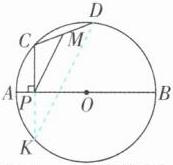
2[2025 四川泸州期末,中]如图,$\odot O$的直径$AB=8$,弦$CD$在圆上滑动($CD$的长度不变,点$C,D$与点$A,B$不重合),过点$C$作$CP ⊥ AB$于点$P$,若$M$是$CD$的中点,则$PM$的最大值是
4
.答案
2. $4$ 【解析】如图,延长 $CP$ 交 $\odot O$ 于点 $K$,连接 $DK$. $\because AB ⊥ CP,\therefore CP = PK$.$\because M$ 是 $CD$ 的中点,$\therefore PM$ 是 $△ CKD$ 的中位线,$\therefore PM=\frac{1}{2} KD$,$\therefore$ 当 $KD$ 的值最大时,$PM$ 的值最大,即当 $KD$ 为直径时,$PM$ 的值最大. $\because \odot O$ 的直径 $AB = 8$,$\therefore PM$ 的最大值为 $\frac{1}{2} KD=\frac{1}{2} AB=4$,故答案为 $4$.
3[2025江苏扬州质检,中]如图,MN为$\odot O$的直径,A,B是$\odot O$上的两点,过A作$AC ⊥ MN$于点C,过B作$BD ⊥ MN$于点D,P为DC上的任意一点,若$MN=20,AC=8,BD=6$,则$PA+PB$的最小值是 (
A.20
B.$14\sqrt{2}$
C.14
D.$12\sqrt{2}$
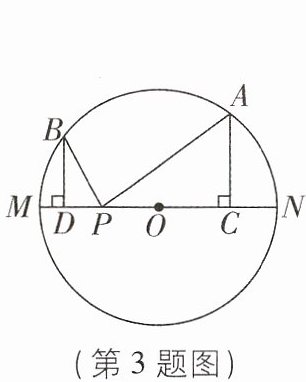
(第3题图)
(第4题图)
B
)A.20
B.$14\sqrt{2}$
C.14
D.$12\sqrt{2}$
(第3题图)
(第4题图)
答案
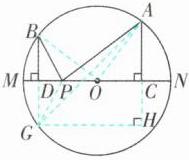
3. $\underline{B}$ 【解析】如图,连接 $OA,OB$. $\because AC ⊥ MN,BD ⊥ MN$,$\therefore OB^2 = BD^2 + OD^2 = 36 + OD^2$,$OA^2 = AC^2 + OC^2 = 64 + OC^2$. $\because MN = 20$, $A, B$ 是 $\odot O$ 上的两点,$\therefore OA = OB = \frac{1}{2} MN = 10$,$\therefore 100 = 36+OD^2$,$100=64+OC^2$,$\therefore OD=8$(负值已舍去),$OC=6$(负值已舍去),$\therefore CD=OD+OC=14$. 延长 $BD$ 与 $\odot O$ 相交于点 $G$,连接 $GP,AG$. $\because MN$ 为 $\odot O$ 的直径,$BD ⊥ MN$,$\therefore BD = GD = 6$,$\therefore BP = GP$,$\therefore PA+PB = PA+GP$,$\therefore$ 当点 $P$ 在 $AG$ 上时,$PA+PB$ 取最小值,最小值为 $AG$ 的长. 过 $G$ 作 $GH ⊥ AC$ 交 $AC$ 的延长线于点 $H$. 又$\because AC ⊥ MN$,$BD ⊥ MN$,$\therefore$ 四边形 $CDGH$ 是矩形,$\therefore GH = CD = 14$,$CH = DG = 6$,$\therefore AH = AC + CH = 14$,$\therefore AG = \sqrt{AH^2+GH^2} = \sqrt{14^2+14^2} = 14\sqrt{2}$,$\therefore PA+PB$ 的最小值是 $14\sqrt{2}$,故选 B.
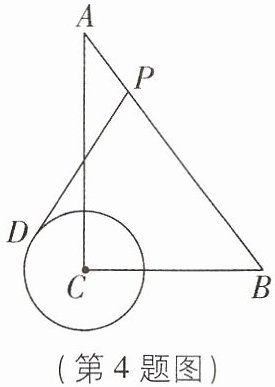
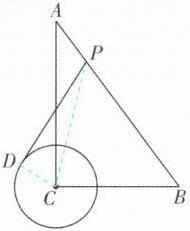
4[2026广东江门质检,中]如图,在△ABC中,∠ACB=90°,AC=4,BC=3,⊙C的半径为1,点P是AB边上的动点,过点P作⊙C的一条切线PD,点D为切点,则线段PD长的最小值为
$\frac{\sqrt{119}}{5}$
.答案
4. $\frac{\sqrt{119}}{5}$ 【解析】连接 $DC$,$PC$,如图所示. $\because PD$ 为 $\odot C$ 的一条切线,$\therefore PD ⊥ DC$,$\therefore PD = \sqrt{PC^2-DC^2}$. $\because DC$ 为半径,$\therefore$ 其长是定值,$\therefore$ 当 $PC$ 的长最小时,$PD$ 的长取得最小值. 由垂线段最短可知,当 $PC ⊥ AB$ 时,$PC$ 的长最小. $\because ∠ ACB=90°$,$AC=4$,$BC=3$,$\therefore AB=5$. 此时,$\frac{1}{2} AC · BC = \frac{1}{2} PC · AB$,$\therefore 5PC=12$,解得 $PC=\frac{12}{5}$,$\therefore PD=\sqrt{(\frac{12}{5})^2 -1^2}=\frac{\sqrt{119}}{5}$,故答案为 $\frac{\sqrt{119}}{5}$.
5[中]如图,$\odot M$的半径为2,圆心M的坐标为$(3,4)$,点P是$\odot M$上的任意一点,$PA ⊥ PB$,且PA,PB与x轴分别交于A,B两点,若点A、点B关于原点对称,当线段AB最短时,点A的坐标为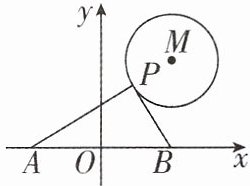
$(-3,0)$
。答案
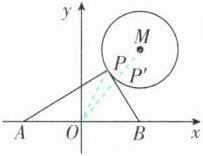
5. $\underline{(-3,0)}$ 【解析】如图,连接 $OP,OM$,$OM$ 交 $\odot M$ 于点 $P'$. $\because$ 点 $M$ 的坐标为 $( 3, 4 )$, $\therefore OM=\sqrt{3^2+4^2}=5$. $\because PA ⊥ PB$,$\therefore ∠ APB=90°$. $\because AO = BO$,$\therefore AB=2PO$,$\therefore$ 当 $PO$ 取得最小值,即点 $P$ 位于 $P'$ 位置时,$AB$ 取得最小值. $\because OM = 5$, $MP' = 2$,$\therefore OP' = 3$,$\therefore OA = 3$,$\therefore$ 点 $A$ 的坐标为 $(-3,0)$,故答案为 $(-3,0)$.
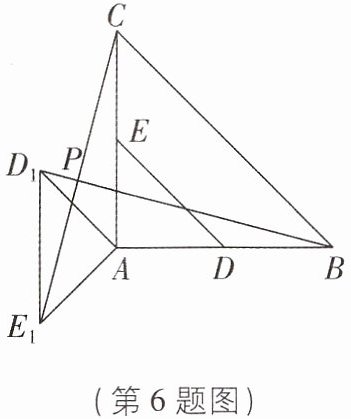
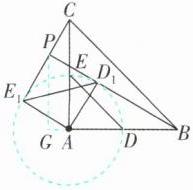
6[中]在$\mathrm{Rt}△ ABC$中,$∠ BAC=90°$,$AC=AB=4$,$D,E$分别是$AB,AC$的中点,若等腰$\mathrm{Rt}△ ADE$绕点$A$逆时针旋转,得到等腰$\mathrm{Rt}△ AD_1E_1$,记直线$BD_1$与$CE_1$的交点为$P$,则点$P$到$AB$所在直线距离的最大值为
(第6题图)
(第7题图)
$1+\sqrt{3}$
。(第6题图)
(第7题图)
答案
6. $\underline{1+\sqrt{3}}$ 【解析】由题意知 $D_1,E_1$ 在以 $A$ 为圆心,$AD$ 为半径的圆上,如图. 当 $BD_1$ 所在直线与 $\odot A$ 相切时,直线 $BD_1$ 与 $CE_1$ 的交点 $P$ 到直线 $AB$ 的距离最大,过点 $P$ 作 $PG ⊥ AB$ 交 $BA$ 延长线于 $G$,此时易证四边形 $AD_1PE_1$ 是正方形,$\therefore PD_1=AD_1=\frac{1}{2} AB=2$,则 $BD_1=\sqrt{AB^2-AD_1^2}=\sqrt{4^2-2^2}=2\sqrt{3}$,$\therefore PB=2+2\sqrt{3}$. 在 $\mathrm{Rt}△ABD_1$ 中,易证 $∠ ABP=30°$,故点 $P$ 到 $AB$ 所在直线的距离的最大值为 $PG=\frac{1}{2} PB=1+\sqrt{3}$,故答案为 $1+\sqrt{3}$.
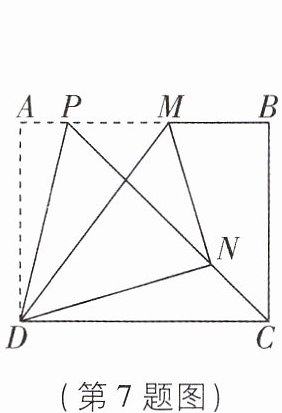
7[2025湖北武汉期末,较难]如图,在矩形ABCD中,AB=5,AD=4,M是边AB上一动点(不含端点),将△ADM沿直线DM翻折,得到△NDM.射线CN交线段AB于点P,连接DP,则△CDP的面积为
10
,DP的最大值为$2\sqrt{5}$
.答案
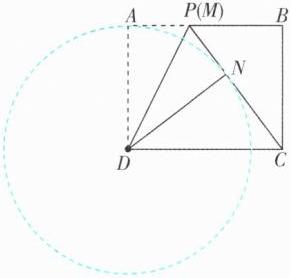
7. $\underline{10}\ \ 2\sqrt{5}$ 【解析】由题意可得 $△ CDP$ 的面积等于矩形 $ABCD$ 面积的一半,$\therefore △ CDP$ 的面积为 $\frac{1}{2} AB× AD = \frac{1}{2} ×5×4 = 10$. 在 $\mathrm{Rt}△APD$ 中,$PD = \sqrt{AD^2+AP^2} = \sqrt{16+AP^2}$,$\therefore$ 当 $AP$ 取最大值时,$DP$ 有最大值. 由题意可得点 $N$ 在以 $D$ 为圆心,$4$ 为半径的圆弧上运动,当射线 $CN$ 与圆 $D$ 相切时,$AP$ 的值最大,此时 $P, M$ 两点重合,$C, N, M$ 三点共线,如图,则 $AD = ND = 4$,$∠ DNC = ∠ B = ∠ DCB=90°$,$\therefore ∠ NDC + ∠ DCN = 90°$, $∠ DCN + ∠ MCB = 90°$,$\therefore ∠ NDC = ∠ MCB$. $\because AD = BC$,$\therefore DN = BC$,$\therefore △ NDC ≌ △ BCM$,$\therefore CN = BM = \sqrt{CD^2-DN^2} = 3$,$\therefore AP = AB - BP = 2$,$\therefore$ 在 $\mathrm{Rt}△APD$ 中,$PD=\sqrt{AD^2+AP^2}=\sqrt{4^2+2^2}=2\sqrt{5}$,故答案为 $10$,$2\sqrt{5}$.
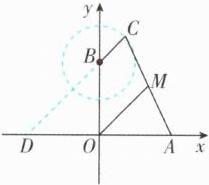
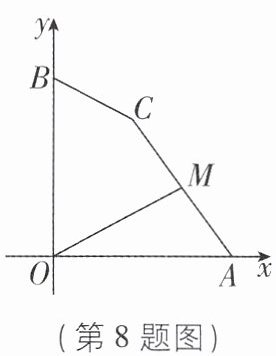
8[中]如图,点A,B的坐标分别是A(4,0),B(0,4),点C为坐标平面内一动点,BC=2,点M为线段AC的中点,连接OM,则OM的最大值为(
A.$\sqrt{2}+1$
B.$\sqrt{2}+\frac{1}{2}$
C.$2\sqrt{2}+1$
D.$2\sqrt{2}-\frac{1}{2}$
C
)A.$\sqrt{2}+1$
B.$\sqrt{2}+\frac{1}{2}$
C.$2\sqrt{2}+1$
D.$2\sqrt{2}-\frac{1}{2}$
答案
8. $\underline{C}$ 【解析】如图. $\because$ 点 $C$ 为坐标平面内一动点,$BC=2$,$\therefore C$ 在以 $B$ 为圆心,$2$ 为半径的圆上运动. 取 $OD = OA = 4$,连接 $BD$. $\because AM = CM$, $OD = OA$,$\therefore OM$ 是 $△ ACD$ 的中位线,$\therefore OM = \frac{1}{2} CD$,$\therefore$ 当 $CD$ 的值最大时,$OM$ 的值最大. 当 $D,B,C$ 三点共线,且 $C$ 在 $DB$ 的延长线上时,$CD$ 的值最大,故此时 $OM$ 的值最大. $\because OB = OD = 4$, $∠ BOD = 90°$,$\therefore BD = 4\sqrt{2}$,$\therefore CD=4\sqrt{2}+2$,$\therefore OM=\frac{1}{2} CD=2\sqrt{2}+1$,即 $OM$ 的最大值为 $2\sqrt{2}+1$. 故选 C.