

 登录
一、听录音,完成表格。录音听两遍
Items Details
Problem brought by Christmas besides joy 1.
Paper used for gifts in the UK (length) about 2.
Number of trees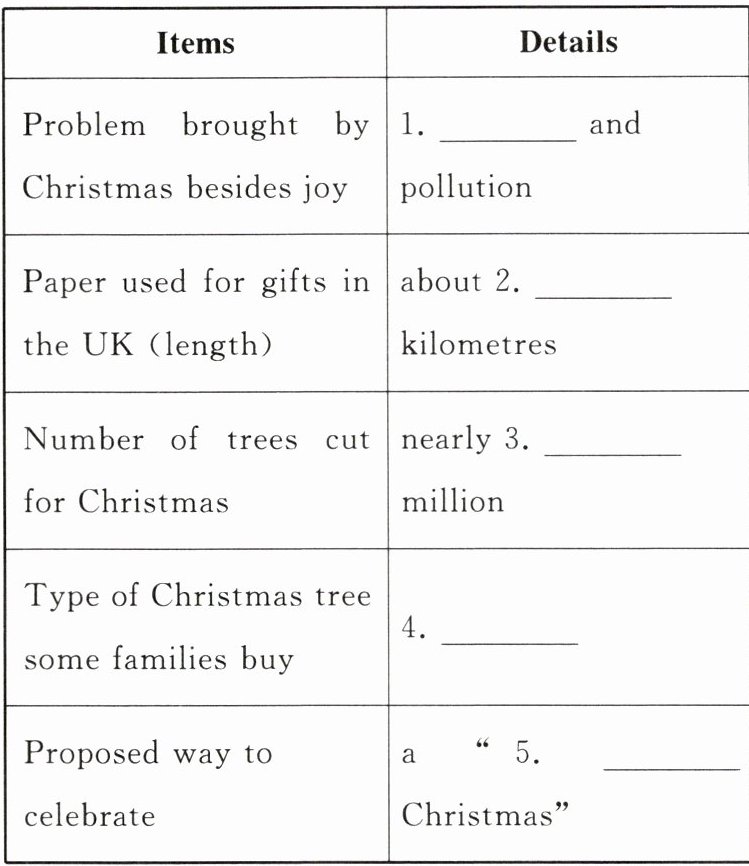 for Christmas nearly 3.
Type of Christmas tree some families buy 4.
Proposed way to celebrate a “5.
Items Details
Problem brought by Christmas besides joy 1.
waste
and pollutionPaper used for gifts in the UK (length) about 2.
365,000
kilometresNumber of trees
for Christmas nearly 3. 120
millionType of Christmas tree some families buy 4.
plastic
Proposed way to celebrate a “5.
green
Christmas”答案
1. waste
2. 365,000
3. 120
4. plastic
5. green
2. 365,000
3. 120
4. plastic
5. green
二、就录音中的话题阐释你的观点
要求:结合一个案例,50词以内,可使用take...for example等句型。
要求:结合一个案例,50词以内,可使用take...for example等句型。
答案
Festivals carry cultural values and connect people. Take Songkran for example, its water fights wash away bad luck and bring people closer.
1. For Chinese people, festivals usually mean a break from work and happy family reunions. 对于中国人来说,节日通常意味着放下工作,享受家庭团聚的欢乐时光。
点拨 • mean 主要有以下含义:
作为动词,意为“意思是……,意味着……”,常见短语有:mean doing sth 意味着做某事;mean to do sth 打算做某事
Success means working hard. 成功意味
着要努力工作。
I didn't mean to hurt you. 我不是故意伤害你的。
作为动词,还有“意图是……,目的是……”的含义,用于表示某人的意图或目的,常与well、ill、no harm等词连用,表示出于好意、没有恶意等。
I'm sure she meant well, but her advice wasn't very helpful. 我相信她是出于好意,但她给的建议并没有什么帮助。
mean 的名词形式是 meaning,指词、句子或行动等的含义或意义;形容词形式是 meaningful,用来形容事物具有意义或价值,而 meaningless 则是其反义词,用来形容事物没有意义或价值。
Sometimes, a word has different meanings. 有时候,一个单词会有多个不同的含义。
A meaningful gift can bring joy and warmth to people. 一个有意义的礼物能够给人们带来快乐和温暖。
An action that is meaningless is considered a waste of time and energy. 一个无意义的行动被认为是浪费时间和精力。
• break 有以下用法和含义:
作名词时,表示中断、休息或断裂等状态或行为,常见短语为 take/have a break。
He took a break from work. 他停下工作,稍作休息。
There was a break in the conversation. 谈话中断了片刻。
作动词时,意为“打破;损坏;违反(规则)”。
He broke the rules. 他违反了规则。
常见短语有:
break into 强行进入,突然开始做某事
break down 分解,失败,崩溃
break out 爆发,逃出,突然响起
break the ice 打破僵局,开始交谈或建立关系
▷迁移
(1)成为一名好学生意味着在课堂上要认真听讲。
Being a good student
(2)我本打算给自己买一个新笔记本,但我没找到喜欢的。
I
(3)尽管是节假日,急诊科的医生们也只能休息一小会儿来吃饭。
Even though it was a festival, the doctors in the emergency room could only
(4)小偷们试图在节日期间强行进入银行,但值班的警察迅速阻止了他们。
The thieves try to
2. As a doctor in the emergency room, Leng misses many family meals with her loved ones. 作为急诊科医生,冷医生错过了许多与家人共进晚餐的时光。
点拨 miss 是一个多义词,根据不同语
境,其含义和用法不同:
作为名词,意为“小姐”,通常用于称呼未婚女性,如 Miss Smith 史密斯小姐。
作为动词,意为“想念;错过;遗漏(某事或某人)”,后面可接名词、代词或动名词。
I miss reading books. 我怀念读书的日子。
She missed the meeting because of the traffic. 她因交通问题错过了会议。
▷迁移
我不想错过今晚的电影。
点拨 • mean 主要有以下含义:
作为动词,意为“意思是……,意味着……”,常见短语有:mean doing sth 意味着做某事;mean to do sth 打算做某事
Success means working hard. 成功意味
着要努力工作。
I didn't mean to hurt you. 我不是故意伤害你的。
作为动词,还有“意图是……,目的是……”的含义,用于表示某人的意图或目的,常与well、ill、no harm等词连用,表示出于好意、没有恶意等。
I'm sure she meant well, but her advice wasn't very helpful. 我相信她是出于好意,但她给的建议并没有什么帮助。
mean 的名词形式是 meaning,指词、句子或行动等的含义或意义;形容词形式是 meaningful,用来形容事物具有意义或价值,而 meaningless 则是其反义词,用来形容事物没有意义或价值。
Sometimes, a word has different meanings. 有时候,一个单词会有多个不同的含义。
A meaningful gift can bring joy and warmth to people. 一个有意义的礼物能够给人们带来快乐和温暖。
An action that is meaningless is considered a waste of time and energy. 一个无意义的行动被认为是浪费时间和精力。
• break 有以下用法和含义:
作名词时,表示中断、休息或断裂等状态或行为,常见短语为 take/have a break。
He took a break from work. 他停下工作,稍作休息。
There was a break in the conversation. 谈话中断了片刻。
作动词时,意为“打破;损坏;违反(规则)”。
He broke the rules. 他违反了规则。
常见短语有:
break into 强行进入,突然开始做某事
break down 分解,失败,崩溃
break out 爆发,逃出,突然响起
break the ice 打破僵局,开始交谈或建立关系
▷迁移
(1)成为一名好学生意味着在课堂上要认真听讲。
Being a good student
means listening to the teachers carefully
in class.(2)我本打算给自己买一个新笔记本,但我没找到喜欢的。
I
meant to buy
a new notebook for myself, but I couldn't find one I liked.(3)尽管是节假日,急诊科的医生们也只能休息一小会儿来吃饭。
Even though it was a festival, the doctors in the emergency room could only
take/have a short break
to eat their meals.(4)小偷们试图在节日期间强行进入银行,但值班的警察迅速阻止了他们。
The thieves try to
break into
the bank during the festival, but the police on duty quickly stop them.2. As a doctor in the emergency room, Leng misses many family meals with her loved ones. 作为急诊科医生,冷医生错过了许多与家人共进晚餐的时光。
点拨 miss 是一个多义词,根据不同语
境,其含义和用法不同:
作为名词,意为“小姐”,通常用于称呼未婚女性,如 Miss Smith 史密斯小姐。
作为动词,意为“想念;错过;遗漏(某事或某人)”,后面可接名词、代词或动名词。
I miss reading books. 我怀念读书的日子。
She missed the meeting because of the traffic. 她因交通问题错过了会议。
▷迁移
我不想错过今晚的电影。
I don't want to miss the movie tonight.
.答案
1. (1) means listening to the teachers carefully
(2) meant to buy
(3) take/have a short break
(4) break into
2. I don't want to miss the movie tonight.
(2) meant to buy
(3) take/have a short break
(4) break into
2. I don't want to miss the movie tonight.
