

 登录
三、Daniel 最敬佩的是著名建筑设计师贝聿铭,他向大家讲述了这位大师的故事。一起来品鉴这位建筑设计奇才的卓越成就吧。
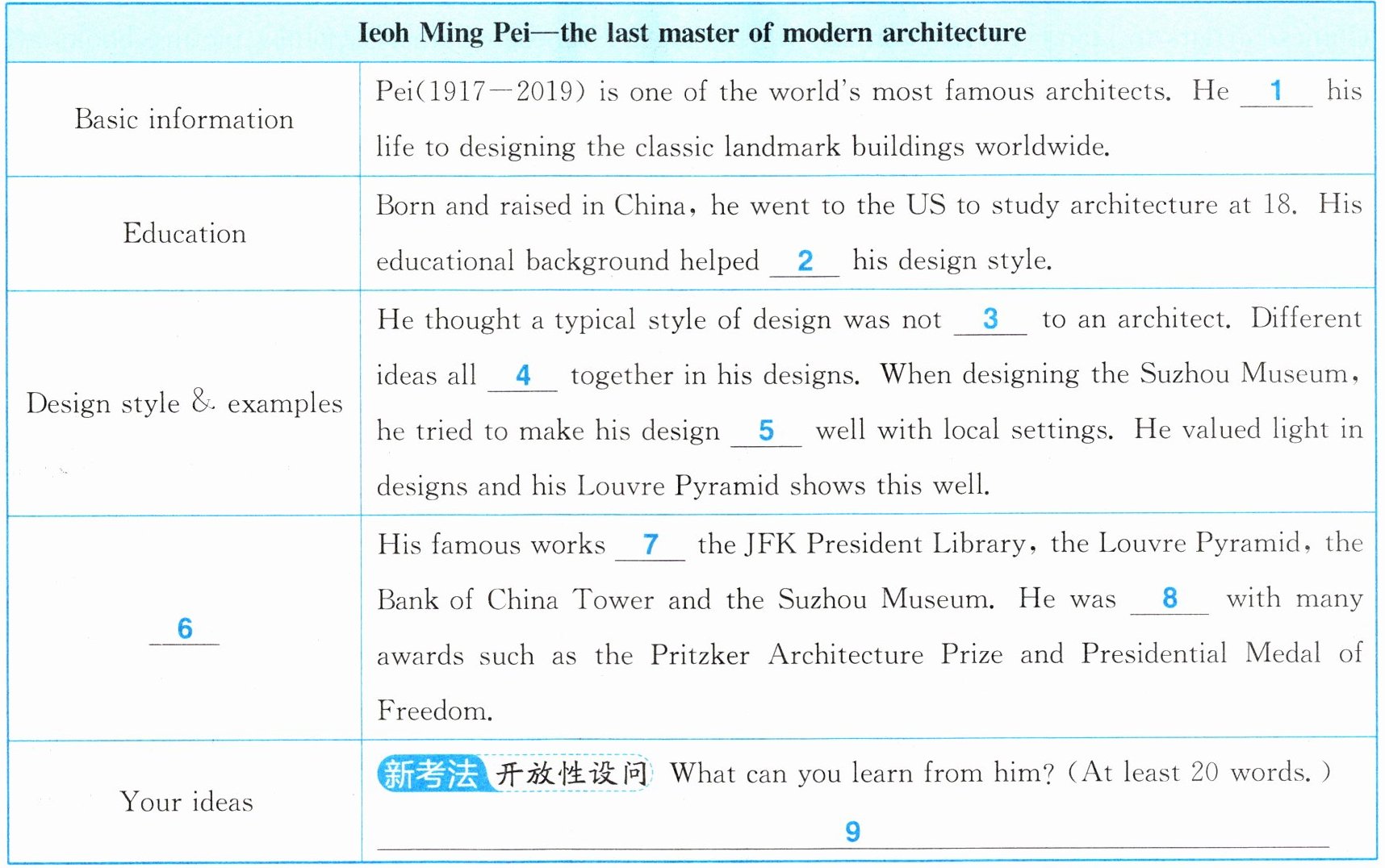
Most architects hope to bring special features to a city, and Ieoh Ming Pei, one of the world's most famous architects, achieved this by designing many classic buildings in cities around the world. The JFK President Library in Boston, the US(1979), the Louvre Pyramid in Paris(1989), the Bank of China Tower in Hong Kong(1990) and the Museum of Islamic Art in Doha, Qatar (2008) are just a few of his many creations. The man behind these landmark buildings passed away on May 16, 2019 at the age of 102.
Pei once said that a typical(典型的) style of design is of no help to an architect. Instead, he was known for his special style, bringing together seemingly opposite ideas into each design—East and West, ancient and modern, natural and man-made. This may come from his education. Born and raised in China, he went to the US to study architecture(建筑学) at 18. He studied at Massachusetts Institute of Technology and then completed his Master of Arts study at Harvard. "My family's been there for 600 years," Pei tried to add local and historical ideas to his designs. When designing the Suzhou Museum in the 2000s, he took new ideas from the city's beautiful classical gardens. Instead of building a giant to overshadow(使……失色) them, Pei built small halls with traditional white walls and dark roofs, in the style of other gardens.
Besides matching his design to the local setting, Pei also thought that light played an important role in creating a lively mood. He cared a lot about sunshine in his designs. The glass pyramid of the Louvre Museum in Paris is a good example. It doesn't hide the buildings around it. Instead, it reflects(映照) them in the sunlight. It also serves as a huge window, letting sunlight into the museum.
His wonderful works earned him many awards, like the Pritzker Architecture Prize(1983), AIA Gold Medal(1979), RIBA Royal Gold Medal(2010), Presidential Medal of Freedom(1993) and Praemium Imperiale(1989).
What Pei valued most in architecture was that the buildings could "stand the test of time". As *The New York Times* sums up, he didn't just want to solve problems but also to produce "an architecture of ideas".
Most architects hope to bring special features to a city, and Ieoh Ming Pei, one of the world's most famous architects, achieved this by designing many classic buildings in cities around the world. The JFK President Library in Boston, the US(1979), the Louvre Pyramid in Paris(1989), the Bank of China Tower in Hong Kong(1990) and the Museum of Islamic Art in Doha, Qatar (2008) are just a few of his many creations. The man behind these landmark buildings passed away on May 16, 2019 at the age of 102.
Pei once said that a typical(典型的) style of design is of no help to an architect. Instead, he was known for his special style, bringing together seemingly opposite ideas into each design—East and West, ancient and modern, natural and man-made. This may come from his education. Born and raised in China, he went to the US to study architecture(建筑学) at 18. He studied at Massachusetts Institute of Technology and then completed his Master of Arts study at Harvard. "My family's been there for 600 years," Pei tried to add local and historical ideas to his designs. When designing the Suzhou Museum in the 2000s, he took new ideas from the city's beautiful classical gardens. Instead of building a giant to overshadow(使……失色) them, Pei built small halls with traditional white walls and dark roofs, in the style of other gardens.
Besides matching his design to the local setting, Pei also thought that light played an important role in creating a lively mood. He cared a lot about sunshine in his designs. The glass pyramid of the Louvre Museum in Paris is a good example. It doesn't hide the buildings around it. Instead, it reflects(映照) them in the sunlight. It also serves as a huge window, letting sunlight into the museum.
His wonderful works earned him many awards, like the Pritzker Architecture Prize(1983), AIA Gold Medal(1979), RIBA Royal Gold Medal(2010), Presidential Medal of Freedom(1993) and Praemium Imperiale(1989).
What Pei valued most in architecture was that the buildings could "stand the test of time". As *The New York Times* sums up, he didn't just want to solve problems but also to produce "an architecture of ideas".
答案
1. devoted 2. shape 3. helpful 4. came
5. fit/match 6. Achievements 7. include
8. honoured/presented 9. We should learn from his spirit of pursuing excellence and combining local features with modern designs in our study and lives.(言之有理即可)
5. fit/match 6. Achievements 7. include
8. honoured/presented 9. We should learn from his spirit of pursuing excellence and combining local features with modern designs in our study and lives.(言之有理即可)
