

 登录
登录
三、(名师原创)信息还原(七选五)
<传统文化> Do you like wearing bright and colourful clothes? Today, we can get all kinds of colourful clothes easily in stores. But how about people in ancient times? 1.
One old method that was very popular in China was tie-dye(扎染). Tie-dye is a traditional Chinese method of dyeing clothes. 2.
3.
In 2006, the tie-dye skill became China's national intangible cultural heritage(国家非物质文化遗产). Anning City in Yunnan Province is well-known for its tie-dye skills.
Yang Cheng learned this traditional skill from his mother in the 1980s. Since then, he has been working hard to improve it. 4.
Nowadays he still dyes clothes and teaches his daughter this skill. His love for the art and hard work make him a great teacher. 5.
A. It has a history of more than 1,000 years.
B. He is one of the most successful artists.
C. The process of tie-dyeing is quite simple but very creative.
D. How did they get their cloth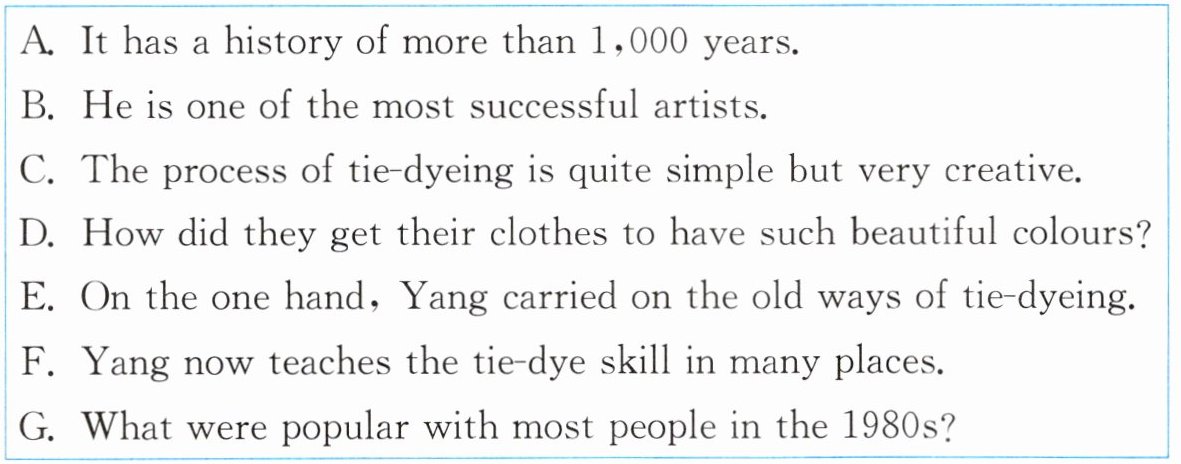 to have such beautiful colours?
E. On the one hand, Yang carried on the old ways of tie-dyeing.
F. Yang now teaches the tie-dye skill in many places.
G. What were popular with most people in the 1980s?
<传统文化> Do you like wearing bright and colourful clothes? Today, we can get all kinds of colourful clothes easily in stores. But how about people in ancient times? 1.
D
One old method that was very popular in China was tie-dye(扎染). Tie-dye is a traditional Chinese method of dyeing clothes. 2.
A
During the Tang and Song dynasties, people presented tie-dyed clothes to the emperors as valuable gifts. People at that time made dyes(染料) by hand, and blue dyes usually came from special plants.3.
C
First, you need to use ropes to tie your cloth together. Then you put the cloth into the dye. As the cloth is folded and dyed, some parts of the cloth will become dark colours, while other parts will be lighter in colour. When you open the cloth, you'll see beautiful patterns and colours.In 2006, the tie-dye skill became China's national intangible cultural heritage(国家非物质文化遗产). Anning City in Yunnan Province is well-known for its tie-dye skills.
Yang Cheng learned this traditional skill from his mother in the 1980s. Since then, he has been working hard to improve it. 4.
E
On the other hand, he studied new skills from other countries.Nowadays he still dyes clothes and teaches his daughter this skill. His love for the art and hard work make him a great teacher. 5.
F
More than 100,000 people have learned from him. His love and efforts have kept this old art form alive and popular in modern times.A. It has a history of more than 1,000 years.
B. He is one of the most successful artists.
C. The process of tie-dyeing is quite simple but very creative.
D. How did they get their cloth
to have such beautiful colours?E. On the one hand, Yang carried on the old ways of tie-dyeing.
F. Yang now teaches the tie-dye skill in many places.
G. What were popular with most people in the 1980s?
答案
1.D 2.A 3.C 4.E 5.F
解析
【分析】
本题为信息还原题,需结合上下文语境、逻辑关系及句子间的呼应来选择答案。第1空前文询问古代人如何获得彩色衣服,后文介绍扎染,需选衔接古代人获取彩色衣服方式的句子;第2空前文介绍扎染是传统工艺,后文提及唐宋时期,需选说明扎染历史的句子;第3空后文详细描述扎染步骤,需选总起扎染过程的句子;第4空后文有“On the other hand”,需选与之对应“On the one hand”的句子;第5空后文提到很多人向他学习,需选说明他传授扎染技能的句子。
【解析】
1. 第1空:前文提出“how about people in ancient times?”的疑问,后文引出扎染工艺,D选项“How did they get their clothes to have such beautiful colours?”恰好承接上文对古代人获取彩色衣服方式的询问,符合语境,故选D。
2. 第2空:前文介绍扎染是中国传统染色方法,后文提到唐宋时期将扎染衣物作为珍贵礼物,A选项“It has a history of more than 1,000 years.”说明扎染的历史,与后文唐宋时期的时间线索呼应,故选A。
3. 第3空:后文详细描述扎染的具体操作步骤,C选项“The process of tie-dyeing is quite simple but very creative.”总起该段,引出扎染的过程,与后文步骤衔接自然,故选C。
4. 第4空:后文出现“On the other hand”表示并列关系,E选项“On the one hand, Yang carried on the old ways of tie-dyeing.”与之对应,构成“on one hand...on the other hand...”的固定结构,符合逻辑,故选E。
5. 第5空:后文提到“More than 100,000 people have learned from him.”,F选项“Yang now teaches the tie-dye skill in many places.”说明他传授扎染技能的情况,与下文很多人向他学习的内容衔接,故选F。
【答案】
1.D 2.A 3.C 4.E 5.F
【知识点】
信息还原(七选五)、上下文逻辑衔接
【点评】
本题围绕中国传统扎染文化展开,考查学生对语篇语境和逻辑关系的理解能力,解题时需关注句子间的呼应(如固定搭配、时间线索、内容衔接),难度适中,既考查语言运用能力,又渗透了传统文化教育。
【难度系数】
0.6
本题为信息还原题,需结合上下文语境、逻辑关系及句子间的呼应来选择答案。第1空前文询问古代人如何获得彩色衣服,后文介绍扎染,需选衔接古代人获取彩色衣服方式的句子;第2空前文介绍扎染是传统工艺,后文提及唐宋时期,需选说明扎染历史的句子;第3空后文详细描述扎染步骤,需选总起扎染过程的句子;第4空后文有“On the other hand”,需选与之对应“On the one hand”的句子;第5空后文提到很多人向他学习,需选说明他传授扎染技能的句子。
【解析】
1. 第1空:前文提出“how about people in ancient times?”的疑问,后文引出扎染工艺,D选项“How did they get their clothes to have such beautiful colours?”恰好承接上文对古代人获取彩色衣服方式的询问,符合语境,故选D。
2. 第2空:前文介绍扎染是中国传统染色方法,后文提到唐宋时期将扎染衣物作为珍贵礼物,A选项“It has a history of more than 1,000 years.”说明扎染的历史,与后文唐宋时期的时间线索呼应,故选A。
3. 第3空:后文详细描述扎染的具体操作步骤,C选项“The process of tie-dyeing is quite simple but very creative.”总起该段,引出扎染的过程,与后文步骤衔接自然,故选C。
4. 第4空:后文出现“On the other hand”表示并列关系,E选项“On the one hand, Yang carried on the old ways of tie-dyeing.”与之对应,构成“on one hand...on the other hand...”的固定结构,符合逻辑,故选E。
5. 第5空:后文提到“More than 100,000 people have learned from him.”,F选项“Yang now teaches the tie-dye skill in many places.”说明他传授扎染技能的情况,与下文很多人向他学习的内容衔接,故选F。
【答案】
1.D 2.A 3.C 4.E 5.F
【知识点】
信息还原(七选五)、上下文逻辑衔接
【点评】
本题围绕中国传统扎染文化展开,考查学生对语篇语境和逻辑关系的理解能力,解题时需关注句子间的呼应(如固定搭配、时间线索、内容衔接),难度适中,既考查语言运用能力,又渗透了传统文化教育。
【难度系数】
0.6
四、阅读表达
Welcome to the Amazon Rainforest. As the largest rainforest in the world, it plays an important role in keeping the balanced ecosystem on earth. With an area of around 6 million square kilometres, the Amazon Rainforest is more than half the size of China. This area has a great many species. Actually, one in ten known species in the world can be found here.
There are different levels in the forest. At the bottom is a system of roots under the ground. Above that is leaf litter on the dark forest floor. The next level is made up of shorter plants with large leaves. Then there are the towering ancient hardwoods, and finally the tops of the trees which are taller than any other level of trees in the forest. Each level of the forest forms its own little world, home to different kinds of living things.
More than 1,300 species of birds and over 400 species of mammals(哺乳动物) hide among the forest's plant life. The jaguar is one example. While a large number of jaguars survive here, they are only one part of this forest's food chain. They feed on at least 87 species, including frogs. These frogs, in turn, feed on insects which eat leaves and fruit.
The Amazon Rainforest is a treasure house of species that can be used for food or medicine. What's more, the Amazon Rainforest breathes life into the planet by producing over 20 per cent of all the earth's oxygen(O₂). So it is often known as the "lungs of the planet".
1. How many levels are there in the Amazon Rainforest?
2. Why is the Amazon Rainforest called "the lungs of the planet"?
3. What percentage of the earth's oxygen does the Amazon Rainforest produce?
4. What do jaguars feed on in the Amazon Rainforest?
5. What can we do for the Amazon Rainforest?
Welcome to the Amazon Rainforest. As the largest rainforest in the world, it plays an important role in keeping the balanced ecosystem on earth. With an area of around 6 million square kilometres, the Amazon Rainforest is more than half the size of China. This area has a great many species. Actually, one in ten known species in the world can be found here.
There are different levels in the forest. At the bottom is a system of roots under the ground. Above that is leaf litter on the dark forest floor. The next level is made up of shorter plants with large leaves. Then there are the towering ancient hardwoods, and finally the tops of the trees which are taller than any other level of trees in the forest. Each level of the forest forms its own little world, home to different kinds of living things.
More than 1,300 species of birds and over 400 species of mammals(哺乳动物) hide among the forest's plant life. The jaguar is one example. While a large number of jaguars survive here, they are only one part of this forest's food chain. They feed on at least 87 species, including frogs. These frogs, in turn, feed on insects which eat leaves and fruit.
The Amazon Rainforest is a treasure house of species that can be used for food or medicine. What's more, the Amazon Rainforest breathes life into the planet by producing over 20 per cent of all the earth's oxygen(O₂). So it is often known as the "lungs of the planet".
1. How many levels are there in the Amazon Rainforest?
5 levels.
2. Why is the Amazon Rainforest called "the lungs of the planet"?
Because it produces over 20% of all the earth's oxygen.
3. What percentage of the earth's oxygen does the Amazon Rainforest produce?
Over 20 per cent.
4. What do jaguars feed on in the Amazon Rainforest?
At least 87 species, including frogs.
5. What can we do for the Amazon Rainforest?
We can promote eco-tourism programmes that respect the rainforest.(言之有理即可)
答案
1. 5 levels.
2. Because it produces over 20% of all the earth's oxygen.
3. Over 20 per cent.
4. At least 87 species, including frogs.
5. We can promote eco-tourism programmes that respect the rainforest.(言之有理即可)
2. Because it produces over 20% of all the earth's oxygen.
3. Over 20 per cent.
4. At least 87 species, including frogs.
5. We can promote eco-tourism programmes that respect the rainforest.(言之有理即可)
解析
【分析】
本题为英语阅读理解题,解题思路是:先通读全文把握主旨,再针对每个问题,带着问题回到原文定位对应段落,提取关键信息;细节类问题直接查找原文数据或描述,开放性问题结合文章主题及常识合理作答。
【解析】
1. 定位文章第二段,梳理雨林的层次:地下根系层、落叶层、短植物层、高大硬木层、树顶层,共5层,故答案为5 levels。
2. 定位文章第四段末尾,因亚马逊雨林产生地球20%以上的氧气,因此被称为“地球之肺”,故答案为Because it produces over 20% of all the earth's oxygen。
3. 定位文章第四段,明确提到亚马逊雨林产生超过20%的地球氧气,故答案为Over 20 per cent。
4. 定位文章第三段,提到美洲虎以至少87种物种(包括青蛙)为食,故答案为At least 87 species, including frogs。
5. 本题为开放性问题,结合保护雨林的主题,可提出如促进尊重雨林的生态旅游项目等合理措施,故答案为We can promote eco-tourism programmes that respect the rainforest.(言之有理即可)
【答案】
1. 5 levels.
2. Because it produces over 20% of all the earth's oxygen.
3. Over 20 per cent.
4. At least 87 species, including frogs.
5. We can promote eco-tourism programmes that respect the rainforest.(言之有理即可)
【知识点】
英语阅读理解、细节信息定位、开放性问题解答
【点评】
本题考查学生对英语文章的理解与信息提取能力,涵盖细节查找和开放类题型,符合初中英语阅读题的常规考查形式,既注重基础信息的掌握,也考查学生的合理表达能力。
【难度系数】
0.6
本题为英语阅读理解题,解题思路是:先通读全文把握主旨,再针对每个问题,带着问题回到原文定位对应段落,提取关键信息;细节类问题直接查找原文数据或描述,开放性问题结合文章主题及常识合理作答。
【解析】
1. 定位文章第二段,梳理雨林的层次:地下根系层、落叶层、短植物层、高大硬木层、树顶层,共5层,故答案为5 levels。
2. 定位文章第四段末尾,因亚马逊雨林产生地球20%以上的氧气,因此被称为“地球之肺”,故答案为Because it produces over 20% of all the earth's oxygen。
3. 定位文章第四段,明确提到亚马逊雨林产生超过20%的地球氧气,故答案为Over 20 per cent。
4. 定位文章第三段,提到美洲虎以至少87种物种(包括青蛙)为食,故答案为At least 87 species, including frogs。
5. 本题为开放性问题,结合保护雨林的主题,可提出如促进尊重雨林的生态旅游项目等合理措施,故答案为We can promote eco-tourism programmes that respect the rainforest.(言之有理即可)
【答案】
1. 5 levels.
2. Because it produces over 20% of all the earth's oxygen.
3. Over 20 per cent.
4. At least 87 species, including frogs.
5. We can promote eco-tourism programmes that respect the rainforest.(言之有理即可)
【知识点】
英语阅读理解、细节信息定位、开放性问题解答
【点评】
本题考查学生对英语文章的理解与信息提取能力,涵盖细节查找和开放类题型,符合初中英语阅读题的常规考查形式,既注重基础信息的掌握,也考查学生的合理表达能力。
【难度系数】
0.6
