

 登录
请阅读下面短文,根据所提供的信息,回答五个问题,要求所写答案语法正确、信息完整切题。
(2026山西中考)Money is part of our life. So we are faced with the same question: what to do with our money?
Smart spending(理性消费) means using money in a way that fits real needs, real value and real plans.
In daily life, teenagers usually spend most of their money buying something necessary—food, clothes or school things. But sometimes, they buy things they don't really need. Following the crowd may lead teenagers to buy something unnecessary. For example, when some classmates have the same kind of pencil case, a teenager may feel unhappy about having a different one. So he will buy a new one like theirs.
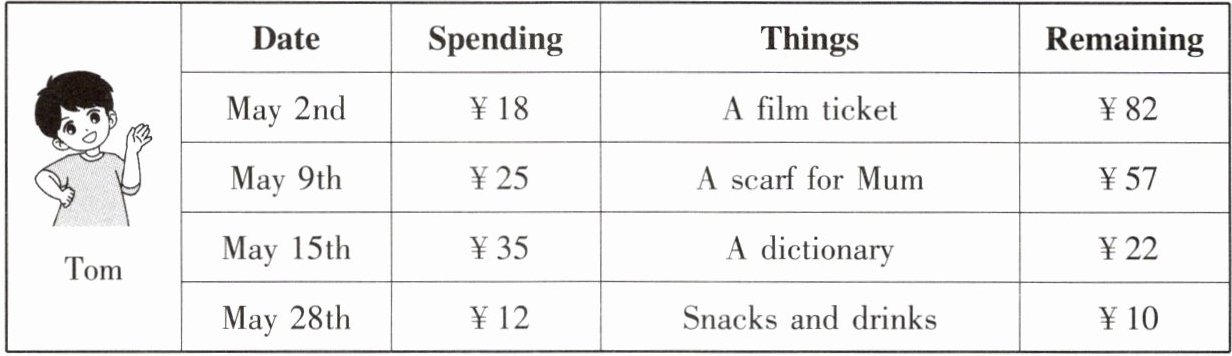
Teenagers can start learning how to manage money wisely at an early age. On Tom's 6th birthday, his grandmother gave him several jars (罐子) to help him make good use of money. One was for spending, one for saving and another for giving. It was at that time that Tom started his own money journal(记账本) to record where the money had gone. He has had this habit since then.
Tom
Date | Spending | Things | Remaining
May 2nd | ¥18 | A film ticket | ¥82
May 9th | ¥25 | 图1 A scarf for Mum | ¥57
May 15th | ¥35 | A dictionary | ¥22
May 28th | ¥12 | Snacks and drinks | ¥10
Tom's birthday present is more than several jars. His grandmother has given a kid the chance to learn lifelong values. The wider goal of the jars is to encourage teenagers to think more wisely about the money and the things they can do.
News
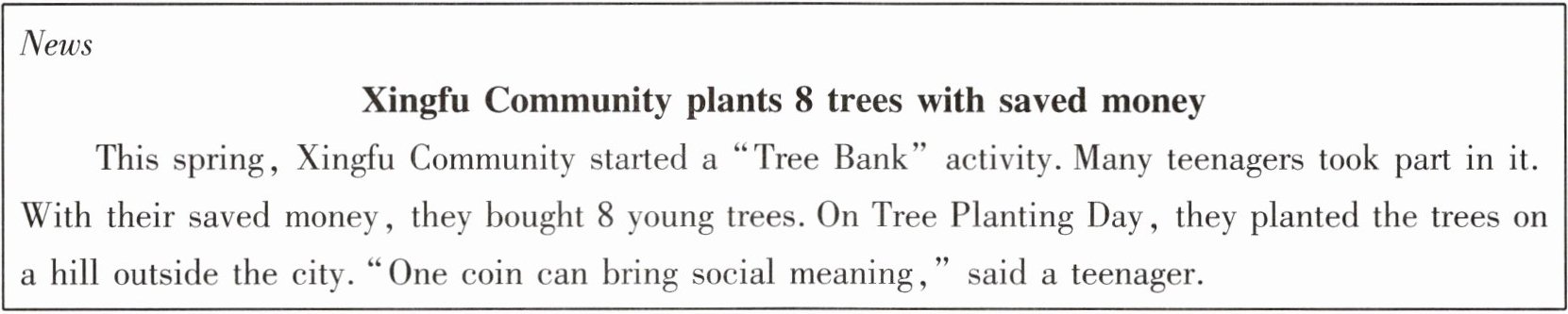
Xingfu Community plants 8 trees with saved money
This spring, Xingfu Community started a "图2 Bank" activity. Many teenagers took part in it. With their saved money, they bought 8 young trees. On Tree Planting Day, they planted the trees on a hill outside the city. "One coin can bring social meaning," said a teenager.
1. What does smart spending mean?
2. What may lead teenagers to buy something unnecessary?
3. Why did Tom's grandmother give him several jars?
4. What were the top two things Tom spent money on in May?
5. Will you give away money like the teenagers in Xingfu Community? Why or why not?
(2026山西中考)Money is part of our life. So we are faced with the same question: what to do with our money?
Smart spending(理性消费) means using money in a way that fits real needs, real value and real plans.
In daily life, teenagers usually spend most of their money buying something necessary—food, clothes or school things. But sometimes, they buy things they don't really need. Following the crowd may lead teenagers to buy something unnecessary. For example, when some classmates have the same kind of pencil case, a teenager may feel unhappy about having a different one. So he will buy a new one like theirs.
Teenagers can start learning how to manage money wisely at an early age. On Tom's 6th birthday, his grandmother gave him several jars (罐子) to help him make good use of money. One was for spending, one for saving and another for giving. It was at that time that Tom started his own money journal(记账本) to record where the money had gone. He has had this habit since then.
Tom
Date | Spending | Things | Remaining
May 2nd | ¥18 | A film ticket | ¥82
May 9th | ¥25 | 图1 A scarf for Mum | ¥57
May 15th | ¥35 | A dictionary | ¥22
May 28th | ¥12 | Snacks and drinks | ¥10
Tom's birthday present is more than several jars. His grandmother has given a kid the chance to learn lifelong values. The wider goal of the jars is to encourage teenagers to think more wisely about the money and the things they can do.
News
Xingfu Community plants 8 trees with saved money
This spring, Xingfu Community started a "图2 Bank" activity. Many teenagers took part in it. With their saved money, they bought 8 young trees. On Tree Planting Day, they planted the trees on a hill outside the city. "One coin can bring social meaning," said a teenager.
1. What does smart spending mean?
It means using money in a way that fits real needs, real value and real plans.
2. What may lead teenagers to buy something unnecessary?
Following the crowd may lead teenagers to buy something unnecessary.
3. Why did Tom's grandmother give him several jars?
To help him make good use of money. /To encourage him to learn how to manage money wisely at an early age. /She wanted to give Tom a chance to learn lifelong values.
4. What were the top two things Tom spent money on in May?
A scarf for Mum and a dictionary.
5. Will you give away money like the teenagers in Xingfu Community? Why or why not?
示例一: Yes, I will. /Yes. Because the world will be a better place to live in if everyone does something good for society.
示例二: No, I won't. /No. Because I would like to use my saved money to develop hobbies so that I can be better prepared for the future.
答案
1. It means using money in a way that fits real needs, real value and real plans.
2. Following the crowd may lead teenagers to buy something unnecessary.
3. To help him make good use of money. /To encourage him to learn how to manage money wisely at an early age. /She wanted to give Tom a chance to learn lifelong values.
4. A scarf for Mum and a dictionary.
5. 示例一: Yes, I will. /Yes. Because the world will be a better place to live in if everyone does something good for society.
示例二: No, I won't. /No. Because I would like to use my saved money to develop hobbies so that I can be better prepared for the future.
