

 登录
Ⅰ. Complete the passage with the proper form of the words and expressions in the box.
rapid disappear nature cut down get along with
If we do not protect the environment, many forests will 1.
What should we do? We should respect 4.
rapid disappear nature cut down get along with
If we do not protect the environment, many forests will 1.
disappear
forever, and this will cause serious problems for all living things. Every year, people 2. cut down
millions of trees for farming and building cities. As a result, the number of wild animals may drop 3. rapidly
.What should we do? We should respect 4.
nature
and we need to learn how to 5. get along with
other living things on this planet. Only in this way can we keep the earth healthy and beautiful.答案
1. disappear 2. cut down 3. rapidly 4. nature 5. get along with
解析
【分析】
解题思路:先通读全文理解语境,再分析每个空缺处的词性和语义需求,结合方框内词汇的词义及形式变化,匹配对应词汇。1. 空在will后,需动词原形,结合“森林永远消失”的语义选disappear;2. 空作谓语,主语people为复数,需动词短语原形,结合“砍树耕种建城”的语义选cut down;3. 空修饰动词drop,需副词,将形容词rapid转换为副词rapidly;4. 空作respect的宾语,需名词,选nature;5. 空是“疑问词+不定式”结构,需动词短语原形,结合“与其他生物相处”的语义选get along with。
【解析】
1. 句意为“如果不保护环境,很多森林将永远消失”,will后接动词原形,故填disappear;
2. 句意为“每年人们砍伐数百万棵树用于耕种和建城市”,主语people为复数,一般现在时谓语用动词短语原形,故填cut down;
3. 句意为“结果野生动物的数量可能快速下降”,此处需副词修饰动词drop,形容词rapid的副词形式为rapidly,故填rapidly;
4. 句意为“我们应该尊重自然”,respect后接名词作宾语,故填nature;
5. 句意为“我们需要学习如何与这个星球上的其他生物相处”,“how to + 动词短语原形”构成不定式作learn的宾语,故填get along with。
【答案】
1. disappear 2. cut down 3. rapidly 4. nature 5. get along with
【知识点】
动词的适当形式、副词的用法、名词的用法
【点评】
本题为语境词汇填空题,考查词汇在具体语境中的正确运用,需结合句子语义、语法结构(时态、词性、不定式结构)选择并变形方框内的词汇,侧重基础词汇的掌握,难度适中。
【难度系数】
0.6
Ⅱ. Complete the book introduction with proper words according to the textbook.
Alan Weisman wrote a book called The World Without Us, which showed a world without humans.
If humans disappeared, animals would soon 1.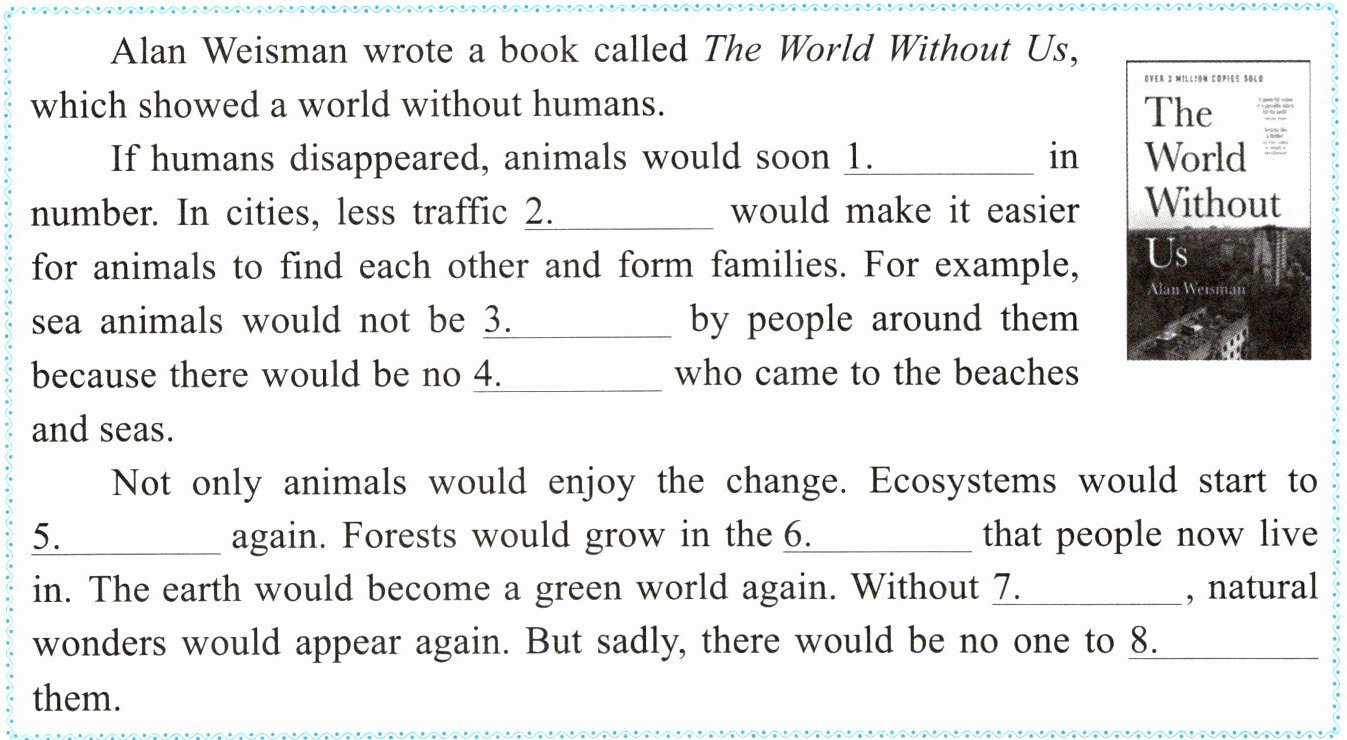 who came to the beaches and seas.
Not only animals would enjoy the change. Ecosystems would start to 5.
Alan Weisman wrote a book called The World Without Us, which showed a world without humans.
If humans disappeared, animals would soon 1.
increase
in number. In cities, less traffic 2. noise
would make it easier for animals to find each other and form families. For example, sea animals would not be 3. troubled
by people around them because there would be no 4. tourist(s)
who came to the beaches and seas.Not only animals would enjoy the change. Ecosystems would start to 5.
balance
again. Forests would grow in the 6. space
that people now live in. The earth would become a green world again. Without 7. pollution
, natural wonders would appear again. But sadly, there would be no one to 8. admire
them.答案
1. increase 2. noise 3. troubled 4. tourist(s) 5. balance 6. space 7. pollution 8. admire
解析
【分析】
这是一道根据短文语境和词汇搭配完成填空的题目,解题思路为:首先通读全文,理解文章主旨(人类消失后的世界变化);再逐个分析每个空格,结合空格前后的语境、固定搭配、语法规则(如被动语态),选择合适的单词填入。例如第1空需结合“动物数量”的语境,第2空需用固定搭配“traffic noise”,第3空需用被动语态结构等。
【解析】
1. 结合语境,人类消失后动物数量会上升,故填increase;
2. 固定搭配“traffic noise”表示交通噪音,符合城市环境的语境,故填noise;
3. 此处为被动语态,海洋动物不会被周围的人打扰,需用过去分词troubled,故填troubled;
4. 定语从句修饰人,来海滩和海边的是游客,用tourist的复数形式tourists,故填tourists;
5. 生态系统重新平衡,balance符合语境,故填balance;
6. 人类居住的空间,space合适,故填space;
7. 没有污染时自然奇观会重现,故填pollution;
8. 自然奇观出现后,没人会欣赏它们,故填admire。
【答案】
1. increase 2. noise 3. troubled 4. tourist(s) 5. balance 6. space 7. pollution 8. admire
【知识点】
英语词汇运用、语境填空、固定搭配
【点评】
本题围绕“人类消失后的世界”主题,考查学生对英语词汇的掌握及上下文语境的理解,需结合词汇搭配和语法规则解题,难度适中。
【难度系数】
0.5
Ⅲ. Read and complete the tasks.
I am an ecologist. Today, I speak for the small creatures—the insects, worms, and other tiny life forms that most people ignore or even fear.
What would happen if insects disappeared? Within months, most life on land, including humans, would die. Plants would stop growing, too. Insects mean a lot to our ecosystems. If they are gone, everything else falls apart.
But here is the sad truth: we live on an unknown planet. Scientists have named only 1.8 million species. But the real number could be 10 million—or even more! We know less than 10% of life on Earth.
Worse still, we are causing the sixth great extinction. I use a word to help you remember the threats—HIPPO: Habitat loss, Invasive species, Pollution, Population growth, and Overharvesting.
If we do not stop this, half of all species may perish by the end of this century.
So what is my wish? To build an Encyclopedia of Life—a free, online database(数据库)of every known species on Earth. Everyone—students, teachers, scientists, and nature lovers—can use it to learn about the amazing life around us.
A. Match the words with the meanings.
(
(
(
(
B. Answer the questions.
(
A. Lands. B. Humans. C. Plants. D. Insects.
(
A. Ten million. B. One point eight million.
C. Ten percent of all species. D. Half of all species.
(
A. To make people afraid of insects.
B. To sell his new book about nature.
C. To encourage people to discover and protect species.
D. To explain why humans are stronger than other species.
4. What is the writer’s wish? Why does he have this wish?
5. According to HIPPO, what can you do to help the writer realise his wish?
I am an ecologist. Today, I speak for the small creatures—the insects, worms, and other tiny life forms that most people ignore or even fear.
What would happen if insects disappeared? Within months, most life on land, including humans, would die. Plants would stop growing, too. Insects mean a lot to our ecosystems. If they are gone, everything else falls apart.
But here is the sad truth: we live on an unknown planet. Scientists have named only 1.8 million species. But the real number could be 10 million—or even more! We know less than 10% of life on Earth.
Worse still, we are causing the sixth great extinction. I use a word to help you remember the threats—HIPPO: Habitat loss, Invasive species, Pollution, Population growth, and Overharvesting.
If we do not stop this, half of all species may perish by the end of this century.
So what is my wish? To build an Encyclopedia of Life—a free, online database(数据库)of every known species on Earth. Everyone—students, teachers, scientists, and nature lovers—can use it to learn about the amazing life around us.
A. Match the words with the meanings.
(
B
)1. ecologist n. A. when a type of animal or plant no longer exists(
D
)2. ignore v. B. a person who studies the relationship between living things and nature(
A
)3. extinction n. C. to be gone(
C
)4. perish v. D. to pay no attention to something or someoneB. Answer the questions.
(
D
)1. What does the underlined word “they” in Paragraph 2 refer to?A. Lands. B. Humans. C. Plants. D. Insects.
(
B
)2. How many species have scientists named?A. Ten million. B. One point eight million.
C. Ten percent of all species. D. Half of all species.
(
C
)3. What was the writer’s purpose of this talk?A. To make people afraid of insects.
B. To sell his new book about nature.
C. To encourage people to discover and protect species.
D. To explain why humans are stronger than other species.
4. What is the writer’s wish? Why does he have this wish?
One possible version: The writer’s wish is to build an Encyclopedia of Life because he wants to protect all the amazing life around us.
5. According to HIPPO, what can you do to help the writer realise his wish?
One possible version: I can recycle paper and plastic.
答案
A. 1. B 2. D 3. A 4. C
B. 1. D 2. B 3. C
4. One possible version: The writer’s wish is to build an Encyclopedia of Life because he wants to protect all the amazing life around us.
5. One possible version: I can recycle paper and plastic.
B. 1. D 2. B 3. C
4. One possible version: The writer’s wish is to build an Encyclopedia of Life because he wants to protect all the amazing life around us.
5. One possible version: I can recycle paper and plastic.
解析
【分析】
本题分为A组词义匹配和B组阅读理解两部分。A组需先明确每个单词的含义,再匹配对应释义;B组需根据原文内容,通过定位关键信息、理解代词指代、分析作者意图等方式解答。具体思路:A组先掌握各单词词义,匹配对应选项;B组1.代词指代需找前文复数名词,2.细节题直接定位原文数字,3.主旨题结合作者呼吁保护物种的目的判断,4、5题从原文提取相关信息作答。
【解析】
A. 词义匹配:
1. ecologist意为“生态学家”,指研究生物与自然关系的人,对应选项B;
2. ignore意为“忽视”,指不关注某人或某物,对应选项D;
3. extinction意为“灭绝”,指动植物不再存在,对应选项A;
4. perish意为“消亡”,指消失,对应选项C。
B. 阅读理解:
1. 代词指代题:第二段围绕昆虫消失的后果展开,划线词“they”指代前文的“insects”,故选D;
2. 细节理解题:原文第三段明确提到“Scientists have named only 1.8 million species”,故选B;
3. 主旨大意题:作者呼吁保护物种,提出建免费在线物种数据库的愿望,目的是鼓励人们发现和保护物种,故选C;
4. 主观问答题:从原文第六段提取,作者的愿望是建立《生命百科全书》,原因是想让大家了解周围的奇妙生命;
5. 主观问答题:结合HIPPO的威胁(如污染),可通过回收纸塑减少污染,助力愿望实现。
【答案】
A. 1. B 2. D 3. A 4. C
B. 1. D 2. B 3. C
4. The writer’s wish is to build an Encyclopedia of Life because he wants to protect all the amazing life around us.
5. I can recycle paper and plastic.
【知识点】
英语阅读理解、词义匹配、细节理解
【点评】
本题为英语综合阅读理解题,涵盖词义匹配、代词指代、细节理解及主观问答,考查学生的词汇掌握、信息定位和文本理解能力,需学生仔细阅读原文提取关键信息,难度适中。
【难度系数】
0.6
