

 登录
【例题启思】
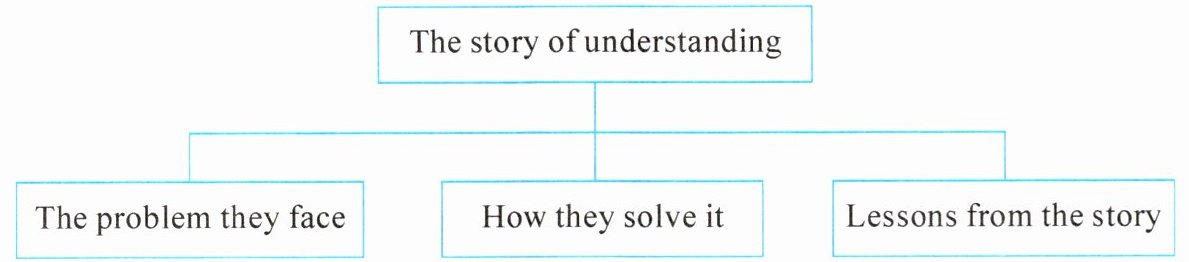
在生活中,人与人之间难免会有误解或矛盾(如家人争吵、朋友误会等)。请你根据下面的思维导图写一个关于“理解”的短篇故事。
Possible version 1: Complete the passage with proper words or the proper form of the words given.
Mr Davies and his new neighbour, Lily, faced a problem. Mr Davies, 1.
Instead of 4.
This story teaches us that good relationships need communication 8.
Possible version 2: Complete the passage with proper words according to the Chinese given.
Xiao Ming and Li Hua were best friends 1.
Weeks later, Xiao Ming 4.
The story teaches us: In relationships, jumping to conclusions 8.
在生活中,人与人之间难免会有误解或矛盾(如家人争吵、朋友误会等)。请你根据下面的思维导图写一个关于“理解”的短篇故事。
Possible version 1: Complete the passage with proper words or the proper form of the words given.
Mr Davies and his new neighbour, Lily, faced a problem. Mr Davies, 1.
an
elderly man, loved quiet evenings. Lily, a teenage girl, practised her piano 2. eagerly
(eager) every night after school. The loud music disturbed Mr Davies, making 3. it
hard for him to relax.Instead of 4.
complaining
(complain) angrily, Mr Davies knocked on Lily's door one evening. He explained his need for peace calmly. Lily felt 5. surprised
(surprise) and apologized to Mr Davies sincerely—she hadn't realised 6. how
loud it was. Together, they found a solution: Lily would practise 7. earlier
(early), before 7 pm, and Mr Davies would try using soft earplugs (耳塞) sometimes.This story teaches us that good relationships need communication 8.
and
compromise(妥协). When people talk honestly and try to see the 9. other's
(other) point of view, most problems can be solved 10. with
understanding. A little effort from both sides builds bridges.Possible version 2: Complete the passage with proper words according to the Chinese given.
Xiao Ming and Li Hua were best friends 1.
until
(直到) a maths test changed everything. Xiao Ming saw Li Hua looking at his paper and shouted, "You cheated!" Li Hua tried to 2. explain
(解释), but Xiao Ming walked away 3. angrily
(生气地).Weeks later, Xiao Ming 4.
noticed
(注意到) Li Hua helping a classmate who 5. failed
(失败) the test. "I wasn't cheating," Li Hua said softly. "I saw you had a wrong answer and wanted to tell you after class, but the teacher saw me looking." Xiao Ming felt 6. ashamed
(内疚的). He apologized to Li Hua, "I should have listened first." Li Hua smiled, "Friends make mistakes, but 7. trust
(信任) makes us stronger."The story teaches us: In relationships, jumping to conclusions 8.
hurts
(伤害) others. We should always listen and seek 9. truth
(真相) before judging. Like a puzzle, understanding needs 10. patience
(耐心) to put every piece in place. Only then can friendship shine brightly.答案
Possible version 1:
1. an 2. eagerly 3. it 4. complaining 5. surprised 6. how 7. earlier
8. and 9. other's 10. with
Possible version 2:
1. until 2. explain 3. angrily 4. noticed 5. failed 6. ashamed 7. trust
8. hurts 9. truth 10. patience
1. an 2. eagerly 3. it 4. complaining 5. surprised 6. how 7. earlier
8. and 9. other's 10. with
Possible version 2:
1. until 2. explain 3. angrily 4. noticed 5. failed 6. ashamed 7. trust
8. hurts 9. truth 10. patience
解析
【分析】
本题是围绕“理解”主题的两篇完形填空,需结合语境、语法规则及词汇知识填空。解题时先通读全文把握主旨,再分析每个空的句子结构、所需词性,结合上下文逻辑和语法要求确定答案:如泛指单数可数名词用不定冠词,修饰动词用副词,介词后接动名词,it作形式宾语等;版本2需根据中文提示,结合时态、词性等填写对应单词。
【解析】
Possible version 1:
1. 泛指“一位老人”,elder以元音音素开头,用不定冠词an;
2. 修饰动词practise,需用副词形式,故填eagerly;
3. it作形式宾语,真正宾语为后面的不定式短语to relax,构成make it + adj. + to do结构,故填it;
4. instead of是介词短语,后接动名词,故填complaining;
5. 此处描述Lily的感受,修饰人用-ed形式的形容词surprised;
6. 感叹句结构为how + 形容词,故填how;
7. 结合语境“更早练习”,用副词比较级earlier;
8. 连接两个并列名词communication和compromise,用并列连词and;
9. 表示“另一个人的观点”,用名词所有格other's;
10. 表示“带着理解”,用介词with。
Possible version 2:
1. 根据中文提示“直到”,填until;
2. try to后接动词原形,结合中文“解释”,填explain;
3. 修饰动词walked,用副词形式angrily;
4. 时态为一般过去时,结合中文“注意到”,填noticed;
5. 时态为一般过去时,结合中文“失败”,填failed;
6. 结合中文“内疚的”,填ashamed;
7. 此处作主语,用名词形式,结合中文“信任”,填trust;
8. 主语为动名词短语,谓语动词用第三人称单数形式,结合中文“伤害”,填hurts;
9. 结合中文“真相”,填名词truth;
10. 结合中文“耐心”,填名词patience。
【答案】
Possible version 1: 1. an 2. eagerly 3. it 4. complaining 5. surprised 6. how 7. earlier 8. and 9. other's 10. with
Possible version 2: 1. until 2. explain 3. angrily 4. noticed 5. failed 6. ashamed 7. trust 8. hurts 9. truth 10. patience
【知识点】
冠词用法、副词用法、非谓语动词
【点评】
本题以“理解”为主题设置完形填空,既考查英语基础语法和词汇运用能力,又传递了沟通、换位思考的重要性,符合英语学习的语境运用要求,难度适中。
【难度系数】
0.6
