

 登录
登录
3. 如图,AE 与 BD 相交于点 C,$AC=EC,BC=DC$,$AB=4\ \mathrm{cm}$,点 P 从点 A 出发,沿 $A\to B\to A$ 方向以 3 cm/s 的速度运动,点 Q 从点 D 出发,沿$D\to E$ 方向以 1 cm/s 的速度运动,P,Q 两点同时出发.当点 P 到达点 A 时,P,Q 两点同时停止运动.设点 P 的运动时间为 $t(\mathrm{s})$.
(1)求证:$AB// DE$;
(2)写出线段 AP 的长(用含 t 的式子表示);
(3)连接 PQ,当线段 PQ 经过点 C 时,求 t的值.
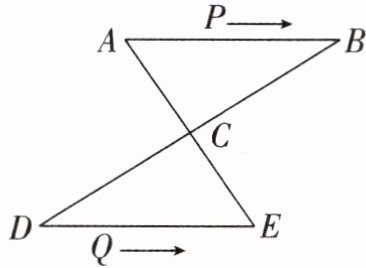
(1)求证:$AB// DE$;
(2)写出线段 AP 的长(用含 t 的式子表示);
(3)连接 PQ,当线段 PQ 经过点 C 时,求 t的值.
答案
(1) 在 $△ ABC$ 和 $△ EDC$ 中,$\begin{cases} AC=EC,\\ ∠ ACB=∠ ECD,\therefore△ ABC≌\\ BC=DC, \end{cases}$ $△ EDC(\mathrm{SAS}),\therefore∠ A=∠ E,AB=DE=4\ \mathrm{cm},\therefore AB// DE.$
(2) 当 $0≤ t≤\frac{4}{3}$ 时,$AP=3t\ \mathrm{cm}$;当 $\frac{4}{3}<t≤\frac{8}{3}$ 时,$BP=(3t-4)\mathrm{cm}$,则 $AP=4-(3t-4)=(8-3t)\mathrm{cm}.$
(3) 如图, 由 (1) 得 $∠ A=∠ E$, $ED=AB=4\ \mathrm{cm}$, 当线段 $PQ$ 经过点 $C$ 时,在 $△ ACP$ 和 $△ ECQ$ 中,
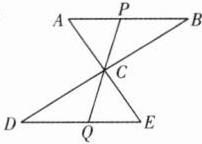
$\begin{cases} ∠ A=∠ E,\\ AC=EC,\\ ∠ ACP=∠ ECQ, \end{cases} \therefore△ ACP≌△ ECQ(\mathrm{ASA}),\therefore AP=EQ.$ 当 $0≤ t≤\frac{4}{3}$ 时,$3t=4-t$,解得 $t=1$;当 $\frac{4}{3}<t≤\frac{8}{3}$ 时,$8-3t=4-t$,解得 $t=2$. 综上所述, 当线段 $PQ$ 经过点 $C$ 时,$t$ 的值为 1 或 2.
4. (2026·长春期中) 如图,长方形 $ABCD$ 中,
$AB=CD=12,AD=BC=6,M,N$ 分别是 $AB,BC$ 的中点,动点 $P$ 从点 $A$ 出发,沿折线 $AD-DC$ 向终点 $C$ 运动,过点 $P$ 作 $PH ⊥ AB$ 于点 $H$,连接 $PM,MN$,设点 $P$ 的运动时间为 $t$ 秒$(t>0)$.
(1)当点 $P$ 运动到 $AD$ 的中点时,证明$△ PAM ≌ △ NBM$.
(2)若点 $P$ 以每秒 2 个单位长度的速度运动.
① 如图 ①, 当点 $P$ 在边 $AD$ 上时, $PD=$
②如图②,当点 $P$ 在边 $DC$ 上时(点 $P$ 不与点$D$ 重合),易知 $PH=DA,DP=AH$,若 $HM=4$,求$t$的值.
(3)若点 $P$ 以每秒$\dfrac{3}{2}$个单位长度的速度运动,在点 $P$ 运动过程中,直接写出能使$△ PHM$ 和$△ NBM$ 全等的所有 $t$ 的值:
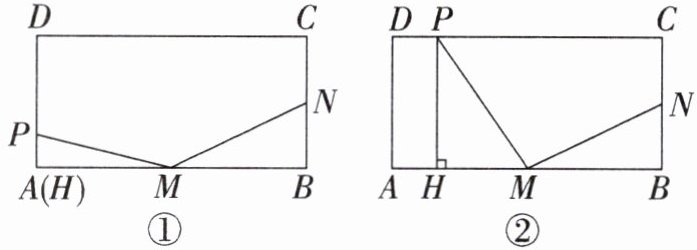
$AB=CD=12,AD=BC=6,M,N$ 分别是 $AB,BC$ 的中点,动点 $P$ 从点 $A$ 出发,沿折线 $AD-DC$ 向终点 $C$ 运动,过点 $P$ 作 $PH ⊥ AB$ 于点 $H$,连接 $PM,MN$,设点 $P$ 的运动时间为 $t$ 秒$(t>0)$.
(1)当点 $P$ 运动到 $AD$ 的中点时,证明$△ PAM ≌ △ NBM$.
(2)若点 $P$ 以每秒 2 个单位长度的速度运动.
① 如图 ①, 当点 $P$ 在边 $AD$ 上时, $PD=$
6-2t
(用含$t$的代数式表示);②如图②,当点 $P$ 在边 $DC$ 上时(点 $P$ 不与点$D$ 重合),易知 $PH=DA,DP=AH$,若 $HM=4$,求$t$的值.
(3)若点 $P$ 以每秒$\dfrac{3}{2}$个单位长度的速度运动,在点 $P$ 运动过程中,直接写出能使$△ PHM$ 和$△ NBM$ 全等的所有 $t$ 的值:
2 或 6 或 10
.答案
(1) 当点 $P$ 运动到 $AD$ 中点时,则 $PA=PD=\frac{1}{2}AD,\because M,N$ 分别是 $AB,BC$ 的中点,$AD=BC=6,\therefore AP=BN,AM=BM$. 又 $\because∠ A=∠ B,\therefore△ PAM≌△ NBM(\mathrm{SAS}).$
(2) ① $6-2t$ 解析: 当点 $P$ 在边 $AD$ 上时,$PH=PA=2t$, $\therefore PD=AD-PA=6-2t.$
②当点 $P$ 在边 $DC$ 上时(点 $P$ 不与点 $D$ 重合),则 $PH=DA=$ $6,AH=DP=2t-6,\therefore HM=|AM-AH|=|6-(2t-6)|=$ $|12-2t|$,若 $HM=4$,则 $|12-2t|=4$,解得 $t=8$ 或 $t=4.$
(3) 2 或 6 或 10 解析: 若点 $P$ 以每秒 $\frac{3}{2}$ 个单位长度的速度运动,$t$ 秒后,当点 $P$ 在边 $AD$ 上,$△ PHM$ 与 $△ NBM$ 全等时,$\because AM=BM,BN=CN=3$,则 $AP=BN,\therefore\frac{3}{2}t=3$,解得 $t=2$;当点 $P$ 在边 $CD$ 上时,$\because PH=AD=BM=6,∠ PHM=∠ B=$ $90°$,则需要 $HM=BN$ 才能使 $△ PHM≌△ MBN.\because HM=$ $|AM-AH|=|AM-DP|=\left|6-(\frac{3}{2}t-6)\right|=\left|12-\frac{3}{2}t\right|,$ $\therefore\left|12-\frac{3}{2}t\right|=3$,解得 $t=6$ 或 $t=10$. 综上,$t$ 的值为 2 或 6 或 10.
(2) ① $6-2t$ 解析: 当点 $P$ 在边 $AD$ 上时,$PH=PA=2t$, $\therefore PD=AD-PA=6-2t.$
②当点 $P$ 在边 $DC$ 上时(点 $P$ 不与点 $D$ 重合),则 $PH=DA=$ $6,AH=DP=2t-6,\therefore HM=|AM-AH|=|6-(2t-6)|=$ $|12-2t|$,若 $HM=4$,则 $|12-2t|=4$,解得 $t=8$ 或 $t=4.$
(3) 2 或 6 或 10 解析: 若点 $P$ 以每秒 $\frac{3}{2}$ 个单位长度的速度运动,$t$ 秒后,当点 $P$ 在边 $AD$ 上,$△ PHM$ 与 $△ NBM$ 全等时,$\because AM=BM,BN=CN=3$,则 $AP=BN,\therefore\frac{3}{2}t=3$,解得 $t=2$;当点 $P$ 在边 $CD$ 上时,$\because PH=AD=BM=6,∠ PHM=∠ B=$ $90°$,则需要 $HM=BN$ 才能使 $△ PHM≌△ MBN.\because HM=$ $|AM-AH|=|AM-DP|=\left|6-(\frac{3}{2}t-6)\right|=\left|12-\frac{3}{2}t\right|,$ $\therefore\left|12-\frac{3}{2}t\right|=3$,解得 $t=6$ 或 $t=10$. 综上,$t$ 的值为 2 或 6 或 10.
