

 登录
登录
六我们在选择交通工具的同时还需要注意什么呢?从方框中选择合适的选项补全对话。(有多余项)
A. Do you have a helmet (头盔)?
B. Let's go to the park.
C. Can I ride a bike?
D. Please take the helmet with you.
E. Shall we go there by bike?
F. We should pay attention to the traffic lights.
Bob: Good morning, Ben. 1.
Ben: Great! But how do we get there?
Bob: 2.
Ben: OK. I can ride my new bike.
Bob: 3.
Ben: Yes, I do.
Bob: 4.
Ben: OK. What else should we pay attention to (注意)?
Bob: 5.
Ben: I see.
A. Do you have a helmet (头盔)?
B. Let's go to the park.
C. Can I ride a bike?
D. Please take the helmet with you.
E. Shall we go there by bike?
F. We should pay attention to the traffic lights.
Bob: Good morning, Ben. 1.
B
Ben: Great! But how do we get there?
Bob: 2.
E
Ben: OK. I can ride my new bike.
Bob: 3.
A
Ben: Yes, I do.
Bob: 4.
D
Ben: OK. What else should we pay attention to (注意)?
Bob: 5.
F
Ben: I see.
答案
六、1.B 2.E 3.A 4.D 5.F
解析
【分析】首先通读对话,明确对话围绕“出行去公园的方式及注意事项”展开。结合上下文语境逐一匹配选项:第1空,Bob打招呼后Ben回应“Great!”,说明Bob提出了去公园的提议,对应选项B;第2空,Ben询问出行方式,Bob需提出出行方案,对应选项E;第3空,Ben提到可以骑新自行车,Bob需询问与骑车相关的物品,对应选项A;第4空,Ben回答有头盔后,Bob需提醒带头盔,对应选项D;第5空,Ben问还有什么要注意的,Bob需回答交通注意事项,对应选项F。
【解析】1. 第1空:Bob打招呼后,Ben以“Great!”回应,说明Bob提出了一个积极的提议,选项B“Let's go to the park.”(我们去公园吧)符合语境,故选B。
2. 第2空:Ben问“how do we get there?”(我们怎么去那里),Bob需回答出行方式,选项E“Shall we go there by bike?”(我们骑车去好吗)符合语境,故选E。
3. 第3空:Ben说“OK. I can ride my new bike.”(好的,我可以骑我的新自行车),Bob需询问与骑车相关的物品,选项A“Do you have a helmet (头盔)?”(你有头盔吗)符合语境,故选A。
4. 第4空:Ben回答“Yes, I do.”(是的,我有),Bob需提醒带头盔,选项D“Please take the helmet with you.”(请带上头盔)符合语境,故选D。
5. 第5空:Ben问“What else should we pay attention to (注意)?”(还有什么要注意的),Bob需回答交通注意事项,选项F“We should pay attention to the traffic lights.”(我们应该注意交通灯)符合语境,故选F。
【答案】1.B 2.E 3.A 4.D 5.F
【知识点】补全对话、日常交际用语、交通出行常识
【点评】本题为日常交际类补全对话,围绕出行话题展开,需结合上下文逻辑匹配选项,考查学生对日常英语表达的运用能力,难度适中。
【难度系数】0.6
【解析】1. 第1空:Bob打招呼后,Ben以“Great!”回应,说明Bob提出了一个积极的提议,选项B“Let's go to the park.”(我们去公园吧)符合语境,故选B。
2. 第2空:Ben问“how do we get there?”(我们怎么去那里),Bob需回答出行方式,选项E“Shall we go there by bike?”(我们骑车去好吗)符合语境,故选E。
3. 第3空:Ben说“OK. I can ride my new bike.”(好的,我可以骑我的新自行车),Bob需询问与骑车相关的物品,选项A“Do you have a helmet (头盔)?”(你有头盔吗)符合语境,故选A。
4. 第4空:Ben回答“Yes, I do.”(是的,我有),Bob需提醒带头盔,选项D“Please take the helmet with you.”(请带上头盔)符合语境,故选D。
5. 第5空:Ben问“What else should we pay attention to (注意)?”(还有什么要注意的),Bob需回答交通注意事项,选项F“We should pay attention to the traffic lights.”(我们应该注意交通灯)符合语境,故选F。
【答案】1.B 2.E 3.A 4.D 5.F
【知识点】补全对话、日常交际用语、交通出行常识
【点评】本题为日常交际类补全对话,围绕出行话题展开,需结合上下文逻辑匹配选项,考查学生对日常英语表达的运用能力,难度适中。
【难度系数】0.6
七、完形填空。
My name is Joe. I'm a student in No. 3 Primary School. I have a brother and a sister. They are Tony and Mary. Every morning, we
(
(
(
(
(
My name is Joe. I'm a student in No. 3 Primary School. I have a brother and a sister. They are Tony and Mary. Every morning, we
A
1 up at six thirty. At seven o'clock, we have breakfast C
2 our parents. Then we go to school. Tony's school is about two kilometers (千米) from our home. So he goes to school byB
3. He thinks it's healthy (健康的). He needs about ten C
4 to get to school. Mary is in No. 6 Middle School. She has to take the metro. It takes her forty minutes to get to school every day. I usually B
5 to school because my school is only about one kilometer from my home. So I'm never (从不) late for school.(
A
)1. A. get B. take C. make(
C
)2. A. for B. and C. with(
B
)3. A. bus B. bike C. car(
C
)4. A. days B. hours C. minutes(
B
)5. A. drive B. walk C. like答案
七、1.A 2.C 3.B 4.C 5.B
解析
【分析】
这是一道完形填空题,需结合语境、固定搭配及词汇辨析选择正确选项。第1空考查固定搭配“起床”的表达;第2空考查表伴随的介词用法;第3空结合语境和健康属性选交通方式;第4空考查时间单位的辨析;第5空结合距离选出行方式。
【解析】
1. 固定搭配“get up”意为“起床”,符合“每天早上六点半起床”的语境,故选A;
2. 介词with表示“和……一起”,“have breakfast with our parents”即“和父母一起吃早餐”,符合语境,故选C;
3. 由后文“it's healthy(健康的)”及距离约2公里,可知骑自行车是健康的出行方式,故选B;
4. 结合语境,到学校需要的时间单位是“分钟”,10分钟符合逻辑,故选C;
5. 由后文“学校离家仅约1公里”,可知是步行上学,故选B。
【答案】
1.A 2.C 3.B 4.C 5.B
【知识点】
完形填空、固定搭配、词汇辨析
【点评】
本题为基础完形填空题,主要考查日常词汇、固定搭配及语境理解,难度较低,适合学生巩固基础。
【难度系数】
0.8
这是一道完形填空题,需结合语境、固定搭配及词汇辨析选择正确选项。第1空考查固定搭配“起床”的表达;第2空考查表伴随的介词用法;第3空结合语境和健康属性选交通方式;第4空考查时间单位的辨析;第5空结合距离选出行方式。
【解析】
1. 固定搭配“get up”意为“起床”,符合“每天早上六点半起床”的语境,故选A;
2. 介词with表示“和……一起”,“have breakfast with our parents”即“和父母一起吃早餐”,符合语境,故选C;
3. 由后文“it's healthy(健康的)”及距离约2公里,可知骑自行车是健康的出行方式,故选B;
4. 结合语境,到学校需要的时间单位是“分钟”,10分钟符合逻辑,故选C;
5. 由后文“学校离家仅约1公里”,可知是步行上学,故选B。
【答案】
1.A 2.C 3.B 4.C 5.B
【知识点】
完形填空、固定搭配、词汇辨析
【点评】
本题为基础完形填空题,主要考查日常词汇、固定搭配及语境理解,难度较低,适合学生巩固基础。
【难度系数】
0.8
八、新素材 阅读幽默小故事,选择正确的选项。
It's a rainy day.
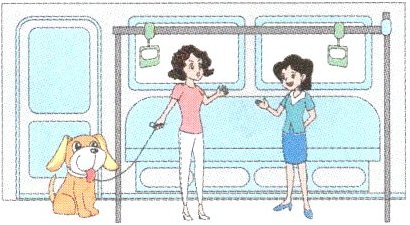
A woman with a dog
gets on a bus. It's a big dog and its feet are not clean. The conductor (售票员) doesn't want the dog to sit on the chair. But the woman says to the conductor," Oh, I will pay for my dog. Can he sit here like other people? " The conductor looks at the dog and says, "Yes, madam. But like other people, he must not put his feet on the chair."
(
A. sunny B. rainy C. cloudy
(
A. big B. small C. short
(
A. floor B. chair C. desk
(
A. friend B. dog C. son
(
A. She will feel happy.
B. She will feel angry.
C. She will feel tired.
It's a rainy day.
A woman with a dog
gets on a bus. It's a big dog and its feet are not clean. The conductor (售票员) doesn't want the dog to sit on the chair. But the woman says to the conductor," Oh, I will pay for my dog. Can he sit here like other people? " The conductor looks at the dog and says, "Yes, madam. But like other people, he must not put his feet on the chair."
(
B
)1. It's a rainy
day.A. sunny B. rainy C. cloudy
(
A
)2. A woman with a big
dog gets on the bus.A. big B. small C. short
(
B
)3. The woman wants her dog to sit on the chair
.A. floor B. chair C. desk
(
B
)4. The woman will pay for her dog
on the bus.A. friend B. dog C. son
(
B
)5. How will the woman feel at last?A. She will feel happy.
B. She will feel angry.
C. She will feel tired.
答案
八、1.B 【解析】由“It's a rainy day.”可知,这
是一个雨天。
2.A 【解析】由“A woman with a dog gets
on a bus. It's a big dog and its feet are not
clean.”可知,这条狗是一条大狗。
3.B 【解析】由“Oh, I will pay for my dog.
Can he sit here like other people?”可知,女士想要让她的狗坐在椅子上。
4.B 【解析】由“Oh, I will pay for my dog.”可知,女士要为她的狗买票。
5.B 【解析】由文章末尾可知,售票员看
着这只狗说:“是的,夫人。但是它得像
其他人一样,不能把脚放在椅子上。”因
为狗不能像人一样坐在椅子上,所以可
以推测出售票员的话将会令这位女土生
气。angry意为“生气的”,符合题意。
是一个雨天。
2.A 【解析】由“A woman with a dog gets
on a bus. It's a big dog and its feet are not
clean.”可知,这条狗是一条大狗。
3.B 【解析】由“Oh, I will pay for my dog.
Can he sit here like other people?”可知,女士想要让她的狗坐在椅子上。
4.B 【解析】由“Oh, I will pay for my dog.”可知,女士要为她的狗买票。
5.B 【解析】由文章末尾可知,售票员看
着这只狗说:“是的,夫人。但是它得像
其他人一样,不能把脚放在椅子上。”因
为狗不能像人一样坐在椅子上,所以可
以推测出售票员的话将会令这位女土生
气。angry意为“生气的”,符合题意。
解析
【分析】
这是一道英语阅读理解题,解题思路为:先通读短文理解故事大意,再针对每道题的问题,回到原文中定位相关语句,细节类题目直接匹配原文信息,推理类题目结合上下文逻辑合理推断。具体步骤:1. 定位天气相关信息;2. 定位狗的特征;3. 定位女士想让狗坐的位置;4. 定位付费对象;5. 结合售票员的回应推断女士的感受。
【解析】
1. 由原文第一句“It's a rainy day.”可知,当天是雨天,对应选项B。
2. 由原文“It's a big dog and its feet are not clean.”可知,这是一条大狗,对应选项A。
3. 由女士的话“Can he sit here like other people?”可知,她想让狗坐在椅子上,对应选项B。
4. 由女士说“I will pay for my dog.”可知,她要为狗付费,对应选项B。
5. 售票员同意狗坐,但要求狗不能把脚放在椅子上,意味着狗无法像人一样正常坐椅子,女士的要求未达成,会感到生气,对应选项B。
【答案】
1.B 2.A 3.B 4.B 5.B
【知识点】
英语阅读理解、细节理解、推理判断
【点评】
本题以幽默小故事为素材,考查学生从短文中提取信息和简单推理的能力,贴近生活,趣味性较强,适合小学阶段学生练习。
【难度系数】
0.6
这是一道英语阅读理解题,解题思路为:先通读短文理解故事大意,再针对每道题的问题,回到原文中定位相关语句,细节类题目直接匹配原文信息,推理类题目结合上下文逻辑合理推断。具体步骤:1. 定位天气相关信息;2. 定位狗的特征;3. 定位女士想让狗坐的位置;4. 定位付费对象;5. 结合售票员的回应推断女士的感受。
【解析】
1. 由原文第一句“It's a rainy day.”可知,当天是雨天,对应选项B。
2. 由原文“It's a big dog and its feet are not clean.”可知,这是一条大狗,对应选项A。
3. 由女士的话“Can he sit here like other people?”可知,她想让狗坐在椅子上,对应选项B。
4. 由女士说“I will pay for my dog.”可知,她要为狗付费,对应选项B。
5. 售票员同意狗坐,但要求狗不能把脚放在椅子上,意味着狗无法像人一样正常坐椅子,女士的要求未达成,会感到生气,对应选项B。
【答案】
1.B 2.A 3.B 4.B 5.B
【知识点】
英语阅读理解、细节理解、推理判断
【点评】
本题以幽默小故事为素材,考查学生从短文中提取信息和简单推理的能力,贴近生活,趣味性较强,适合小学阶段学生练习。
【难度系数】
0.6
