

 登录
登录
3. 新考法 思维导图 阅读短文,补全下方思维导图,每空不限一词。
Social
Spiders
Discovery$\begin{cases} \mathrm{Found in the Amazon rainforest} \\ \mathrm{A huge (1) \_\_\_\_\_\_ (up to 7.6 m long and 1.5 m wide)} \\ \mathrm{Thousands of spiders (2) \_\_\_\_\_\_ together (up to 50,000)} \end{cases}$
Who Lives
in the Web$\begin{cases} \mathrm{(3) \_\_\_\_\_\_ female spiders} \\ \mathrm{Male spiders and youngsters are in a minority} \end{cases}$
How They
Work Together$\begin{cases} \mathrm{• Build and Clean We$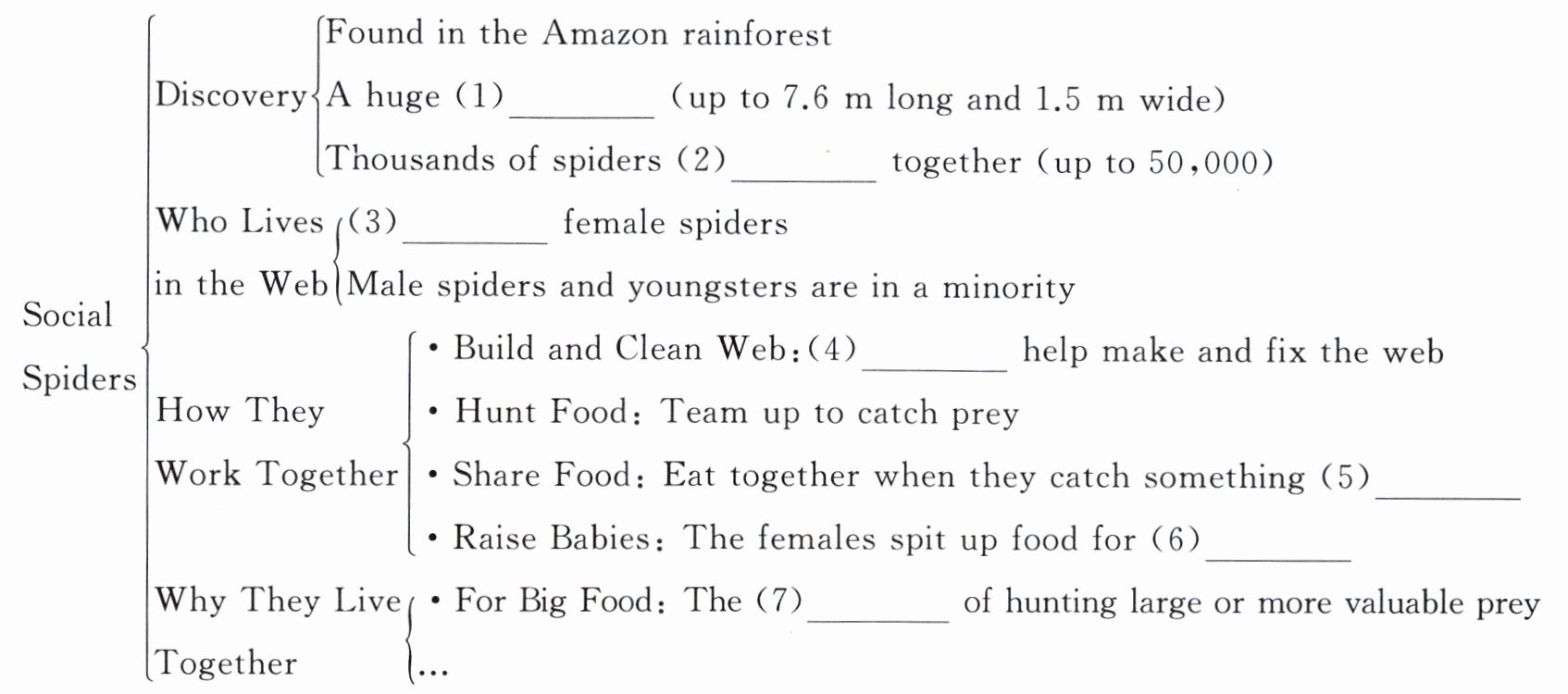 $(4) \_\_\_\_\_\_ help make and fix the web} \\ \mathrm{• Hunt Food: Team up to catch prey} \\ \mathrm{• Share Food: Eat together when they catch something (5) \_\_\_\_\_\_} \\ \mathrm{• Raise Babies: The females spit up food for (6) \_\_\_\_\_\_} \end{cases}$
Why They Live
Together$\begin{cases} \mathrm{• For Big Food: The (7) \_\_\_\_\_\_ of hunting large or more valuable prey} \\ \mathrm{...} \end{cases}$
Social
Spiders
Discovery$\begin{cases} \mathrm{Found in the Amazon rainforest} \\ \mathrm{A huge (1) \_\_\_\_\_\_ (up to 7.6 m long and 1.5 m wide)} \\ \mathrm{Thousands of spiders (2) \_\_\_\_\_\_ together (up to 50,000)} \end{cases}$
Who Lives
in the Web$\begin{cases} \mathrm{(3) \_\_\_\_\_\_ female spiders} \\ \mathrm{Male spiders and youngsters are in a minority} \end{cases}$
How They
Work Together$\begin{cases} \mathrm{• Build and Clean We$
$(4) \_\_\_\_\_\_ help make and fix the web} \\ \mathrm{• Hunt Food: Team up to catch prey} \\ \mathrm{• Share Food: Eat together when they catch something (5) \_\_\_\_\_\_} \\ \mathrm{• Raise Babies: The females spit up food for (6) \_\_\_\_\_\_} \end{cases}$Why They Live
Together$\begin{cases} \mathrm{• For Big Food: The (7) \_\_\_\_\_\_ of hunting large or more valuable prey} \\ \mathrm{...} \end{cases}$
答案
(1)web 解析:根据第二段“Anelosimus eximius ... does construct the biggest webs. Some can reach more than 7.6 m long and 1.5 m wide.”可知,发现的是巨大的蜘蛛网。
(2)living/live 解析:根据第一段“They appeared to act as a society”和第二段“A web of that size could contain as many as 50,000 individual spiders.”可知,成千上万的蜘蛛一起生活。
(3)Mostly/Mainly 解析:根据第三段“the majority of spiders on the web are females”可知,网上大部分是雌性蜘蛛。
(4)All the spiders 解析:根据第三段“Social spiders work together to build, maintain and clean their webs.”可知,所有蜘蛛都参与建网和修网。
(5)big/large 解析:根据第五段“Social spiders tend to feed on bigger prey”可知,蜘蛛一起捕捉大的猎物。
(6)the young/youngsters 解析:根据第三段“The females work together to care for the young in the colony. They feed their youngsters by vomiting up food for them.”可知,雌性蜘蛛为幼蛛喂食。
(7)need/interest 解析:根据第五段“it is in their interest to work together”可知,合作捕猎大型猎物是为了自身的需求/利益。
(2)living/live 解析:根据第一段“They appeared to act as a society”和第二段“A web of that size could contain as many as 50,000 individual spiders.”可知,成千上万的蜘蛛一起生活。
(3)Mostly/Mainly 解析:根据第三段“the majority of spiders on the web are females”可知,网上大部分是雌性蜘蛛。
(4)All the spiders 解析:根据第三段“Social spiders work together to build, maintain and clean their webs.”可知,所有蜘蛛都参与建网和修网。
(5)big/large 解析:根据第五段“Social spiders tend to feed on bigger prey”可知,蜘蛛一起捕捉大的猎物。
(6)the young/youngsters 解析:根据第三段“The females work together to care for the young in the colony. They feed their youngsters by vomiting up food for them.”可知,雌性蜘蛛为幼蛛喂食。
(7)need/interest 解析:根据第五段“it is in their interest to work together”可知,合作捕猎大型猎物是为了自身的需求/利益。
解析
【分析】本题为阅读理解补全思维导图题,解题时需先明确每个空所属的分支主题,再根据主题定位原文对应内容,提取符合语境的词汇或短语,确保答案与原文信息一致,同时注意每空不限词的要求。
【解析】
(1) 根据原文“Anelosimus eximius ... does construct the biggest webs. Some can reach more than 7.6 m long and 1.5 m wide.”可知,发现的是巨大的蜘蛛网,故填web;
(2) 根据原文“A web of that size could contain as many as 50,000 individual spiders.”及语境,成千上万的蜘蛛一起生活,故填living/live;
(3) 根据原文“the majority of spiders on the web are females”可知,网上大部分是雌性蜘蛛,故填Mostly/Mainly;
(4) 根据原文“Social spiders work together to build, maintain and clean their webs.”可知,所有蜘蛛都参与建网和修网,故填All the spiders;
(5) 根据原文“Social spiders tend to feed on bigger prey”可知,蜘蛛一起捕捉大的猎物,故填big/large;
(6) 根据原文“The females work together to care for the young in the colony. They feed their youngsters by vomiting up food for them.”可知,雌性蜘蛛为幼蛛喂食,故填the young/youngsters;
(7) 根据原文“it is in their interest to work together”可知,合作捕猎大型猎物是为了自身的需求/利益,故填need/interest。
【答案】
(1) web
(2) living/live
(3) Mostly/Mainly
(4) All the spiders
(5) big/large
(6) the young/youngsters
(7) need/interest
【知识点】
阅读理解补全、语篇细节提取
【点评】
本题以思维导图形式考查学生对语篇细节信息的定位与提取能力,需结合原文对应内容匹配答案,题型新颖,难度适中,能有效考查学生的信息处理能力。
【难度系数】
0.5
【解析】
(1) 根据原文“Anelosimus eximius ... does construct the biggest webs. Some can reach more than 7.6 m long and 1.5 m wide.”可知,发现的是巨大的蜘蛛网,故填web;
(2) 根据原文“A web of that size could contain as many as 50,000 individual spiders.”及语境,成千上万的蜘蛛一起生活,故填living/live;
(3) 根据原文“the majority of spiders on the web are females”可知,网上大部分是雌性蜘蛛,故填Mostly/Mainly;
(4) 根据原文“Social spiders work together to build, maintain and clean their webs.”可知,所有蜘蛛都参与建网和修网,故填All the spiders;
(5) 根据原文“Social spiders tend to feed on bigger prey”可知,蜘蛛一起捕捉大的猎物,故填big/large;
(6) 根据原文“The females work together to care for the young in the colony. They feed their youngsters by vomiting up food for them.”可知,雌性蜘蛛为幼蛛喂食,故填the young/youngsters;
(7) 根据原文“it is in their interest to work together”可知,合作捕猎大型猎物是为了自身的需求/利益,故填need/interest。
【答案】
(1) web
(2) living/live
(3) Mostly/Mainly
(4) All the spiders
(5) big/large
(6) the young/youngsters
(7) need/interest
【知识点】
阅读理解补全、语篇细节提取
【点评】
本题以思维导图形式考查学生对语篇细节信息的定位与提取能力,需结合原文对应内容匹配答案,题型新颖,难度适中,能有效考查学生的信息处理能力。
【难度系数】
0.5
Ⅱ. 生存危机 每时每刻,全球有多个物种濒临灭绝或已经灭绝。同学们需要了解动物面临的生存危机,深刻认识到保护野生动物的紧迫性。
A report has found that more than one in five of the world's migrating species are at risk of extinction(灭绝). Migrating species are ones that regularly travel to another area in order to continue to live. They might be looking for food, better weather or a mate.
The report was released by the United Nations(UN). In 1979, members of the UN signed an agreement to protect 1,189 migrating species. The recent report looked at the health of these protected species and found that nearly half of the populations are getting smaller, and more than one-fifth are at risk of disappearing.
It's difficult to protect migrating species because of the long way they travel. Monarch butterflies travel up to 3,000 miles every autumn from northeastern North America to Mexico. It's such a long way that they might meet different dangers and be short of energy. However, the report suggests that countries create areas of protected land to help animals migrate safely. It also suggests that governments do more to solve climate change, as well as noise, light and plastic pollution. The report highlights projects that have helped migrating species. In the South Atlantic Ocean, rules that stopped the hunting of humpback whales helped increase their numbers from 440 in the 1950s to about 25,000 today. Inger Andersen from the UN Environment Programme said that there was hope.
1. 跨学科 数学 How many protected species are facing the danger of dying out according to the UN?
A. About 193.
B. About 240.
C. About 600.
D. About 1,189.
2. 新考法 补全文章 Which of the following can be put into the blank "▲" in Paragraph 3?
A. Migrating species face many dangers
B. Migrating species travel far away from homes
C. Migrating species don't like migrating
D. Migrating species prepare well before migrating
3. What's Inger Andersen's attitude(态度 ) towards protecting migrating species?
A. Angry.
B. Doubtful.
C. Positive.
D. Uncertain.
4. What is the best title for the text?
A. Migrating for More Food
B. The Ways to Protect Migrating Species
C. A Meaningful Migrating
D. Migrating Species Need Protection
Task: As a student, what can you do to help migratory animals?
A report has found that more than one in five of the world's migrating species are at risk of extinction(灭绝). Migrating species are ones that regularly travel to another area in order to continue to live. They might be looking for food, better weather or a mate.
The report was released by the United Nations(UN). In 1979, members of the UN signed an agreement to protect 1,189 migrating species. The recent report looked at the health of these protected species and found that nearly half of the populations are getting smaller, and more than one-fifth are at risk of disappearing.
A
▲, because they often move through many different kinds of habitats(栖息地). For example, more than 1.5 million wildebeest(牛羚) migrate through Tanzania and Kenya to follow seasonal rains each year, crossing rivers where hungry Nile crocodiles live. However, the biggest danger to migrating wildlife is human activities, such as hunting, fishing and building projects.It's difficult to protect migrating species because of the long way they travel. Monarch butterflies travel up to 3,000 miles every autumn from northeastern North America to Mexico. It's such a long way that they might meet different dangers and be short of energy. However, the report suggests that countries create areas of protected land to help animals migrate safely. It also suggests that governments do more to solve climate change, as well as noise, light and plastic pollution. The report highlights projects that have helped migrating species. In the South Atlantic Ocean, rules that stopped the hunting of humpback whales helped increase their numbers from 440 in the 1950s to about 25,000 today. Inger Andersen from the UN Environment Programme said that there was hope.
1. 跨学科 数学 How many protected species are facing the danger of dying out according to the UN?
A. About 193.
B. About 240.
C. About 600.
D. About 1,189.
2. 新考法 补全文章 Which of the following can be put into the blank "▲" in Paragraph 3?
A. Migrating species face many dangers
B. Migrating species travel far away from homes
C. Migrating species don't like migrating
D. Migrating species prepare well before migrating
3. What's Inger Andersen's attitude(
A. Angry.
B. Doubtful.
C. Positive.
D. Uncertain.
4. What is the best title for the text?
A. Migrating for More Food
B. The Ways to Protect Migrating Species
C. A Meaningful Migrating
D. Migrating Species Need Protection
Task: As a student, what can you do to help migratory animals?
We should use less plastic products.(答案不唯一,言之有理即可)
答案
1.B 2.A 3.C 4.D
【语篇解读】本文是一篇说明文。文章主要介绍了世界上有超过五分之一的迁徙物种面临灭绝的危险,并分析了迁徙物种面临的威胁以及保护措施。
1. B 解析:数字计算题。根据“In 1979, members of the UN signed an agreement to protect 1,189 migrating species.”和“... nearly half of the populations are getting smaller, and more than one-fifth are at risk of disappearing.”可知,受保护的物种中有超过五分之一濒临灭绝。根据 1979 年签署的协议,受保护的物种有 1189 种,因此濒临灭绝的物种数量约为 1189 的五分之一,即约 240 种。故选 B。
2. A 解析:补全文章题。根据“because they often move through many different kinds of habitats”和“However, the biggest danger to migrating wildlife is human activities, such as hunting, fishing and building projects.”可知,此处与迁徙物种经常穿越多种不同的栖息地会带来危险有关。选项 A“迁徙物种面临许多危险”符合语境。故选 A。
3. C 解析:观点态度题。根据“Inger Andersen from the UN Environment Programme said that there was hope.”可知,Inger Andersen 对保护迁徙物种持积极态度。故选 C。
4. D 解析:标题归纳题。通读全文可知,文章主要介绍了迁徙物种面临的威胁以及保护措施,因此最佳标题应为“迁徙物种需要保护”。故选 D。
Task: We should use less plastic products.(答案不唯一,言之有理即可)
【语篇解读】本文是一篇说明文。文章主要介绍了世界上有超过五分之一的迁徙物种面临灭绝的危险,并分析了迁徙物种面临的威胁以及保护措施。
1. B 解析:数字计算题。根据“In 1979, members of the UN signed an agreement to protect 1,189 migrating species.”和“... nearly half of the populations are getting smaller, and more than one-fifth are at risk of disappearing.”可知,受保护的物种中有超过五分之一濒临灭绝。根据 1979 年签署的协议,受保护的物种有 1189 种,因此濒临灭绝的物种数量约为 1189 的五分之一,即约 240 种。故选 B。
2. A 解析:补全文章题。根据“because they often move through many different kinds of habitats”和“However, the biggest danger to migrating wildlife is human activities, such as hunting, fishing and building projects.”可知,此处与迁徙物种经常穿越多种不同的栖息地会带来危险有关。选项 A“迁徙物种面临许多危险”符合语境。故选 A。
3. C 解析:观点态度题。根据“Inger Andersen from the UN Environment Programme said that there was hope.”可知,Inger Andersen 对保护迁徙物种持积极态度。故选 C。
4. D 解析:标题归纳题。通读全文可知,文章主要介绍了迁徙物种面临的威胁以及保护措施,因此最佳标题应为“迁徙物种需要保护”。故选 D。
Task: We should use less plastic products.(答案不唯一,言之有理即可)
解析
【分析】
1. 第1题是数字计算题,需先定位文中受保护迁徙物种总数为1189种,再找到“超过五分之一濒临灭绝”的比例,计算得出约240种,对应选项B;
2. 第2题是补全文章题,结合空格后原因(穿越多种栖息地)及后文转折(最大危险是人类活动),判断空格应引出迁徙物种面临危险的内容,选项A符合;
3. 第3题是观点态度题,定位Inger Andersen的表述“there was hope”,判断其态度为积极,对应选项C;
4. 第4题是标题归纳题,通读全文明确核心是迁徙物种需保护,对应选项D;Task为开放题,需结合实际提出保护迁徙动物的可行做法,言之有理即可。
【解析】
1. 根据文中“In 1979, members of the UN signed an agreement to protect 1,189 migrating species.”和“more than one-fifth are at risk of disappearing”,计算1189×1/5≈240,故选B;
2. 空格后说明迁徙物种穿越多种栖息地,后文转折指出最大危险是人类活动,因此空格应引出迁徙物种面临诸多危险的内容,选项A符合语境,故选A;
3. 根据“Inger Andersen from the UN Environment Programme said that there was hope.”可知,她对保护迁徙物种持积极态度,故选C;
4. 文章主要介绍迁徙物种面临的灭绝危险及保护措施,核心是呼吁保护迁徙物种,故最佳标题为“Migrating Species Need Protection”,选D;
Task示例:We should use less plastic products.(答案不唯一,合理即可)
【答案】
1.B 2.A 3.C 4.D
Task: We should use less plastic products.
【知识点】
英语阅读理解、数字计算、观点态度
【点评】
本题围绕迁徙物种保护展开,融合跨学科(数学计算)与新考法(补全文章),考查学生信息定位、逻辑推理及主旨归纳能力,引导学生树立保护野生动物的意识。
【难度系数】
0.6
1. 第1题是数字计算题,需先定位文中受保护迁徙物种总数为1189种,再找到“超过五分之一濒临灭绝”的比例,计算得出约240种,对应选项B;
2. 第2题是补全文章题,结合空格后原因(穿越多种栖息地)及后文转折(最大危险是人类活动),判断空格应引出迁徙物种面临危险的内容,选项A符合;
3. 第3题是观点态度题,定位Inger Andersen的表述“there was hope”,判断其态度为积极,对应选项C;
4. 第4题是标题归纳题,通读全文明确核心是迁徙物种需保护,对应选项D;Task为开放题,需结合实际提出保护迁徙动物的可行做法,言之有理即可。
【解析】
1. 根据文中“In 1979, members of the UN signed an agreement to protect 1,189 migrating species.”和“more than one-fifth are at risk of disappearing”,计算1189×1/5≈240,故选B;
2. 空格后说明迁徙物种穿越多种栖息地,后文转折指出最大危险是人类活动,因此空格应引出迁徙物种面临诸多危险的内容,选项A符合语境,故选A;
3. 根据“Inger Andersen from the UN Environment Programme said that there was hope.”可知,她对保护迁徙物种持积极态度,故选C;
4. 文章主要介绍迁徙物种面临的灭绝危险及保护措施,核心是呼吁保护迁徙物种,故最佳标题为“Migrating Species Need Protection”,选D;
Task示例:We should use less plastic products.(答案不唯一,合理即可)
【答案】
1.B 2.A 3.C 4.D
Task: We should use less plastic products.
【知识点】
英语阅读理解、数字计算、观点态度
【点评】
本题围绕迁徙物种保护展开,融合跨学科(数学计算)与新考法(补全文章),考查学生信息定位、逻辑推理及主旨归纳能力,引导学生树立保护野生动物的意识。
【难度系数】
0.6
