

 登录
登录
C
【文章导读】短文通过介绍“brain rot(大脑腐化)”现象,讨论了人们过度沉迷网络对思维和生活的影响,并倡导大家在假期中选择更有意义的生活方式。
①How did you spend your last holiday? Did you just stare at a screen from morning until night? Well, you are not alone. A new survey shows that the average Chinese person spends over five and a half hours online every day. That's a lot of time scrolling and watching videos! But is this really helping us relax, or is it just making our brains tired?
②First, let's think about how we spend our time online. Most of us watch short videos rather than learning something new. This kind of low-value material doesn't help us relax—it actually makes our thinking less clear. The term "brain rot" perfectly describes what happens when we spend too much time on meaningless online content.
③Meanwhile, using the internet is like eating your favourite snack. It's hard to stop. Our phones and tablets are full of endless short videos and memes, making them like personal fun factories. It's easy and comfortable to just sit and scroll for hours, but this "easy fun" comes at a cost. The more time we spend on screens, the less we enjoy real life. We're missing out on beautiful sunsets, heartfelt talks, and fun hobbies. When did our lives become so boring?
④Also, we're forgetting how to relax in a meaningful way. Free time shouldn't just be about watching short videos. Instead, it should be a chance to connect with the world. Nature doesn't have Wi-Fi, but it has fresh air, sunlight, and birdsong. Spending time with friends in real life is much better than laughing alone at a meme on your screen.
⑤In short, life isn't about how much time you have—it's about how you use it. Screens are here to stay, but they shouldn't take over our free time. The summer holiday is coming soon. Will you choose to do something more meaningful? Remember, "brain rot" is real!
(
A. Enjoying real-life activities.
B. Learning something new online.
C. Feeling sad after watching videos.
D. Thinking less clearly because of screen time.
(
A. It's a waste of time.
B. It's not easy to control.
C. It's bad for one's health.
D. It's one way to have fun.
(
A. Chatting with friends online.
B. Staying indoors and using Wi-Fi.
C. Spending time in nature or with friends.
D. Watching more educational videos.
(
D
【文章导读】短文通过介绍“brain rot(大脑腐化)”现象,讨论了人们过度沉迷网络对思维和生活的影响,并倡导大家在假期中选择更有意义的生活方式。
①How did you spend your last holiday? Did you just stare at a screen from morning until night? Well, you are not alone. A new survey shows that the average Chinese person spends over five and a half hours online every day. That's a lot of time scrolling and watching videos! But is this really helping us relax, or is it just making our brains tired?
②First, let's think about how we spend our time online. Most of us watch short videos rather than learning something new. This kind of low-value material doesn't help us relax—it actually makes our thinking less clear. The term "brain rot" perfectly describes what happens when we spend too much time on meaningless online content.
③Meanwhile, using the internet is like eating your favourite snack. It's hard to stop. Our phones and tablets are full of endless short videos and memes, making them like personal fun factories. It's easy and comfortable to just sit and scroll for hours, but this "easy fun" comes at a cost. The more time we spend on screens, the less we enjoy real life. We're missing out on beautiful sunsets, heartfelt talks, and fun hobbies. When did our lives become so boring?
④Also, we're forgetting how to relax in a meaningful way. Free time shouldn't just be about watching short videos. Instead, it should be a chance to connect with the world. Nature doesn't have Wi-Fi, but it has fresh air, sunlight, and birdsong. Spending time with friends in real life is much better than laughing alone at a meme on your screen.
⑤In short, life isn't about how much time you have—it's about how you use it. Screens are here to stay, but they shouldn't take over our free time. The summer holiday is coming soon. Will you choose to do something more meaningful? Remember, "brain rot" is real!
(
D
)1. What does "brain rot" mean in Paragraph 2?A. Enjoying real-life activities.
B. Learning something new online.
C. Feeling sad after watching videos.
D. Thinking less clearly because of screen time.
(
B
)2. Why does the author compare the Internet to snacks?A. It's a waste of time.
B. It's not easy to control.
C. It's bad for one's health.
D. It's one way to have fun.
(
C
)3. What does the author suggest for a meaningful holiday?A. Chatting with friends online.
B. Staying indoors and using Wi-Fi.
C. Spending time in nature or with friends.
D. Watching more educational videos.
(
A
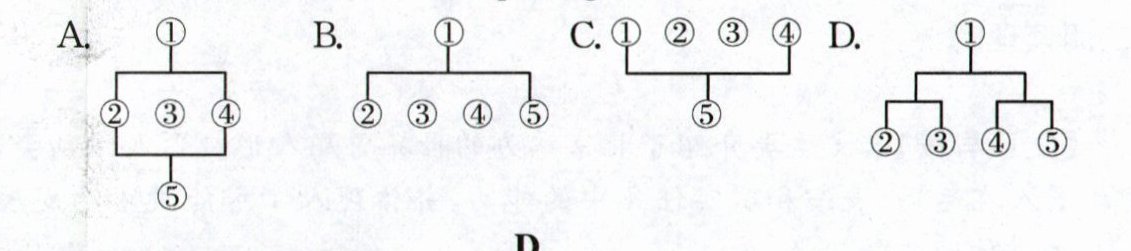
)4. What's the structure of the passage?D
答案
1.D 2.B 3.C 4.A
解析
【分析】
1. 第1题是词义猜测题,需定位到第二段,结合上下文语境理解“brain rot”的含义;2. 第2题是细节理解题,需找到作者将互联网比作零食的相关语句,分析原因;3. 第3题是作者观点题,需定位到第四段,提取作者对有意义假期的建议;4. 第4题是文章结构题,需梳理各段落的逻辑关系,匹配对应的结构图示。
【解析】
1. 第1题:定位到第二段,文中提到“这种低价值的内容不会帮助我们放松,反而会让我们的思维更不清晰,‘brain rot’这个术语完美描述了这种情况”,可知“brain rot”指因屏幕时间过长导致思维不清晰,故选D。
2. 第2题:定位到第三段,作者说“使用互联网就像吃你最喜欢的零食,很难停下来”,可知将互联网比作零食是因为它不容易控制,故选B。
3. 第3题:定位到第四段,作者指出“空闲时间应该是与世界建立联系的机会,没有Wi-Fi的大自然有新鲜空气、阳光和鸟鸣,和现实生活中的朋友相处比独自看屏幕上的梗更棒”,可知作者建议花时间在自然中或和朋友相处,故选C。
4. 第4题:梳理文章结构:第一段(①)引出假期上网时间长的问题,第二段(②)解释“brain rot”的含义,第三段(③)说明沉迷网络会错过现实生活,第四段(④)提出有意义的放松方式,第五段(⑤)总结观点,整体为“总-分-总”结构,对应选项A的图示,故选A。
【答案】
1.D 2.B 3.C 4.A
【知识点】
词义猜测题、细节理解题、文章结构题
【点评】
本题围绕网络沉迷现象展开,考查了阅读理解中常见的词义猜测、细节查找、作者观点及文章结构分析,需学生精准定位原文信息,难度适中,适合中等水平学生作答。
【难度系数】
0.6
1. 第1题是词义猜测题,需定位到第二段,结合上下文语境理解“brain rot”的含义;2. 第2题是细节理解题,需找到作者将互联网比作零食的相关语句,分析原因;3. 第3题是作者观点题,需定位到第四段,提取作者对有意义假期的建议;4. 第4题是文章结构题,需梳理各段落的逻辑关系,匹配对应的结构图示。
【解析】
1. 第1题:定位到第二段,文中提到“这种低价值的内容不会帮助我们放松,反而会让我们的思维更不清晰,‘brain rot’这个术语完美描述了这种情况”,可知“brain rot”指因屏幕时间过长导致思维不清晰,故选D。
2. 第2题:定位到第三段,作者说“使用互联网就像吃你最喜欢的零食,很难停下来”,可知将互联网比作零食是因为它不容易控制,故选B。
3. 第3题:定位到第四段,作者指出“空闲时间应该是与世界建立联系的机会,没有Wi-Fi的大自然有新鲜空气、阳光和鸟鸣,和现实生活中的朋友相处比独自看屏幕上的梗更棒”,可知作者建议花时间在自然中或和朋友相处,故选C。
4. 第4题:梳理文章结构:第一段(①)引出假期上网时间长的问题,第二段(②)解释“brain rot”的含义,第三段(③)说明沉迷网络会错过现实生活,第四段(④)提出有意义的放松方式,第五段(⑤)总结观点,整体为“总-分-总”结构,对应选项A的图示,故选A。
【答案】
1.D 2.B 3.C 4.A
【知识点】
词义猜测题、细节理解题、文章结构题
【点评】
本题围绕网络沉迷现象展开,考查了阅读理解中常见的词义猜测、细节查找、作者观点及文章结构分析,需学生精准定位原文信息,难度适中,适合中等水平学生作答。
【难度系数】
0.6
