

 登录
Ⅰ. Read and choose the best answers.
Have you ever imagined a garbage burning factory does not have enough rubbish to burn? In some cities, this is becoming true.
In the past, people made too much rubbish. Cities built waste-to-energy factories to burn rubbish and make electricity. But now, some factories get less daily household waste. They are becoming “hungry”. This is actually good news for us.
Why does this happen? Because waste recycling works well today. People sort their rubbish carefully; kitchen waste can be made into fertilizer(肥料), while plastic, paper, glass and metal can be used again. There is less leftover rubbish to burn. Besides, people learn to cut down waste and reuse things in daily life.
Even so, waste-to-energy factories are still useful. Here is how they work:
• Arriving: Trucks put rubbish into a big storage area. A machine mixes it up.
• Reacting: Then the rubbish goes into a hot oven with a temperature over 850℃.
• Cleaning the smoke: Before smoke goes into the air, cleaners make it clean. About 90% of the waste at the beginning is gone. The ash(灰) left can be used for building houses, and metal in the ash can be collected and recycled again.
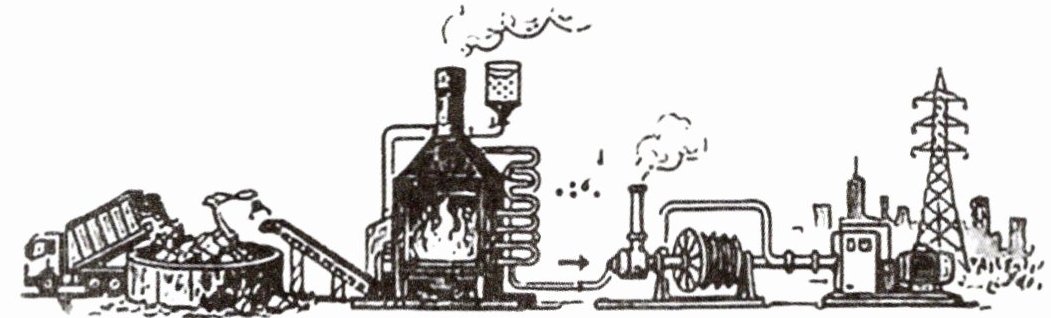
Good points: It cuts down waste greatly, saves ground space for rubbish, makes electricity and collects metal for reuse.
Bad points: Burning rubbish still makes CO₂ gas. What's more, people may think burning can solve all problems and forget to reduce and reuse waste first.
Right recycling is the most useful way to protect our home. The future will be a greener world where no waste is left useless.
(
A. It can be made into fertilizer.
B. It can be sold for money.
C. It can be kept in storage forever.
D. It can be used to clean water.
(
A. This is where math is recorded!
B. This is where chemistry happens!
C. This is where physics takes control!
D. This is where biology starts working!
(
A. Because they show the writer's personal feelings.
B. Because they tell readers what to do immediately.
C. Because they give a balanced and complete opinion.
D. Because they make the passage longer and easier to read.
(
A. To warn people not to build rubbish-burning factories.
B. To teach students how to sort kitchen waste at home.
C. To explain how a turbine works to make electricity.
D. To introduce garbage factories and ways to deal with waste.
Have you ever imagined a garbage burning factory does not have enough rubbish to burn? In some cities, this is becoming true.
In the past, people made too much rubbish. Cities built waste-to-energy factories to burn rubbish and make electricity. But now, some factories get less daily household waste. They are becoming “hungry”. This is actually good news for us.
Why does this happen? Because waste recycling works well today. People sort their rubbish carefully; kitchen waste can be made into fertilizer(肥料), while plastic, paper, glass and metal can be used again. There is less leftover rubbish to burn. Besides, people learn to cut down waste and reuse things in daily life.
Even so, waste-to-energy factories are still useful. Here is how they work:
• Arriving: Trucks put rubbish into a big storage area. A machine mixes it up.
• Reacting: Then the rubbish goes into a hot oven with a temperature over 850℃.
B
▲ Heat causes a burning reaction here. Natural waste such as food, paper and wood reacts with oxygen(O₂), breaking down to give off heat, carbon dioxide(CO₂) and water vapor(H₂O). The high-pressure vapor makes a machine called a turbine(涡轮) run fast. The fast-moving turbine is connected to another machine to make electricity.• Cleaning the smoke: Before smoke goes into the air, cleaners make it clean. About 90% of the waste at the beginning is gone. The ash(灰) left can be used for building houses, and metal in the ash can be collected and recycled again.
Good points: It cuts down waste greatly, saves ground space for rubbish, makes electricity and collects metal for reuse.
Bad points: Burning rubbish still makes CO₂ gas. What's more, people may think burning can solve all problems and forget to reduce and reuse waste first.
Right recycling is the most useful way to protect our home. The future will be a greener world where no waste is left useless.
(
A
)1. What can people do with kitchen waste according to the passage?A. It can be made into fertilizer.
B. It can be sold for money.
C. It can be kept in storage forever.
D. It can be used to clean water.
(
B
)2. Which sentence can be put into ▲ in Paragraph 6?A. This is where math is recorded!
B. This is where chemistry happens!
C. This is where physics takes control!
D. This is where biology starts working!
(
C
)3. Why are the good and bad points included in the passage?A. Because they show the writer's personal feelings.
B. Because they tell readers what to do immediately.
C. Because they give a balanced and complete opinion.
D. Because they make the passage longer and easier to read.
(
D
)4. What is the writer's main purpose in writing this passage?A. To warn people not to build rubbish-burning factories.
B. To teach students how to sort kitchen waste at home.
C. To explain how a turbine works to make electricity.
D. To introduce garbage factories and ways to deal with waste.
答案
1.A 2.B 3.C 4.D
解析
【分析】
本题为英语阅读理解题,共4道选择题,考查细节理解、推理判断及主旨大意。解题思路:先通读全文把握文章主旨(介绍垃圾焚烧厂及垃圾处理方式),再针对每个问题定位原文对应内容,逐一分析选项,排除错误选项后选出最佳答案。
【解析】
1. 细节理解题:根据原文第三段“kitchen waste can be made into fertilizer”可知,厨余垃圾可制成肥料,对应选项A,故选A。
2. 推理判断题:▲处前文提到垃圾进入高温烤箱,后文描述物质与氧气发生燃烧反应、分解等化学变化,因此此处应是“化学变化发生的地方”,对应选项B,故选B。
3. 推理判断题:文章列出垃圾焚烧厂的优缺点,是为了给出平衡、全面的观点,而非个人感受、指导行动或凑篇幅,对应选项C,故选C。
4. 主旨大意题:文章围绕垃圾焚烧厂的运作、垃圾处理方式展开,目的是介绍垃圾焚烧厂及垃圾处理方法,对应选项D,故选D。
【答案】
1.A 2.B 3.C 4.D
【知识点】
英语阅读理解,细节理解,主旨大意
【点评】
文章贴近生活实际,考查学生对原文信息的定位、理解及归纳能力,需仔细研读原文对应内容,避免主观臆断。
【难度系数】
0.7
