

 登录
一、手工小组九年级(1)班的同学研究世界民间手工艺品。阅读下面短文,了解俄罗斯套娃的外形、起源与发展,感受俄罗斯传统工艺的独特魅力。
You have seen many kinds of art. You have also seen many kinds of dolls. But do you know that some dolls are considered to be forms of art?
Folk art is a form of art that shows 1 about the life, culture, or traditions of an area. It is usually made by common people, not great artists, but it shows 2 the people of a specific area find important or interesting.
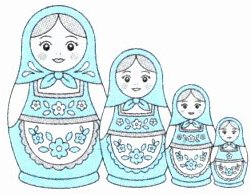
A 3 of folk art from Russia is matryoshka dolls or nesting dolls. The word "matryoshka" 4 from a Russian name—Matryona, which means "little mother". Matryoshka dolls are made in decreasing(减小的) 5 that nest inside one another. All of the dolls except the 6 one can be pulled apart to show a smaller figure inside. The smallest doll is often made 7 a piece of wood.
Matryoshka dolls are shaped like cylinders(圆柱), 8 that they are long and round. They have rounded heads and they have no hands 9 they are not painted. Usually, there are five dolls in a set, but some sets have twelve 10 more dolls.
People in Russia began to make these dolls more than 130 years ago. 11 learnt about nesting dolls from folk artists in Japan, who had actually learnt about that skill from folk artists in China. Chinese artists began 12 nesting boxes about a thousand years ago. Later, they began making nesting dolls. In the first Chinese set, the smallest doll held a grain of rice.
The 13 matryoshka dolls were figures of women. Today, matryoshka dolls are made in many different 14 . They include animals, famous people, fairy-tale 15 , and even film stars. Clearly, this form of folk art still shows that people can find something interesting in it.
(
B. anything
C. everything
D. nothing
(
B. how
C. which
D. what
(
B. form
C. piece
D. part
(
B. avoids
C. comes
D. lends
(
B. sides
C. sizes
D. numbers
(
B. thinnest
C. biggest
D. smallest
(
B. from
C. by
D. in
(
B. depending
C. causing
D. meaning
(
B. if
C. until
D. while
(
B. but
C. or
D. so
(
B. I
C. You
D. They
(
B. making
C. reporting
D. interviewing
(
B. second
C. third
D. fourth
(
B. colours
C. shapes
D. backgrounds
(
B. stories
C. materials
D. legends
You have seen many kinds of art. You have also seen many kinds of dolls. But do you know that some dolls are considered to be forms of art?
Folk art is a form of art that shows 1 about the life, culture, or traditions of an area. It is usually made by common people, not great artists, but it shows 2 the people of a specific area find important or interesting.
A 3 of folk art from Russia is matryoshka dolls or nesting dolls. The word "matryoshka" 4 from a Russian name—Matryona, which means "little mother". Matryoshka dolls are made in decreasing(减小的) 5 that nest inside one another. All of the dolls except the 6 one can be pulled apart to show a smaller figure inside. The smallest doll is often made 7 a piece of wood.
Matryoshka dolls are shaped like cylinders(圆柱), 8 that they are long and round. They have rounded heads and they have no hands 9 they are not painted. Usually, there are five dolls in a set, but some sets have twelve 10 more dolls.
People in Russia began to make these dolls more than 130 years ago. 11 learnt about nesting dolls from folk artists in Japan, who had actually learnt about that skill from folk artists in China. Chinese artists began 12 nesting boxes about a thousand years ago. Later, they began making nesting dolls. In the first Chinese set, the smallest doll held a grain of rice.
The 13 matryoshka dolls were figures of women. Today, matryoshka dolls are made in many different 14 . They include animals, famous people, fairy-tale 15 , and even film stars. Clearly, this form of folk art still shows that people can find something interesting in it.
(
A
)1. A. somethingB. anything
C. everything
D. nothing
(
D
)2. A. whyB. how
C. which
D. what
(
B
)3. A. pairB. form
C. piece
D. part
(
C
)4. A. turnsB. avoids
C. comes
D. lends
(
C
)5. A. pointsB. sides
C. sizes
D. numbers
(
D
)6. A. tallestB. thinnest
C. biggest
D. smallest
(
A
)7. A. ofB. from
C. by
D. in
(
D
)8. A. feelingB. depending
C. causing
D. meaning
(
B
)9. A. unlessB. if
C. until
D. while
(
C
)10. A. andB. but
C. or
D. so
(
D
)11. A. WeB. I
C. You
D. They
(
B
)12. A. learningB. making
C. reporting
D. interviewing
(
A
)13. A. firstB. second
C. third
D. fourth
(
C
)14. A. placesB. colours
C. shapes
D. backgrounds
(
A
)15. A. charactersB. stories
C. materials
D. legends
答案
1. A 【解析】句意:民间艺术是一种能展现某个地区生活、文化或传统的艺术形式。空处所在句为肯定句,应用 something。
2. D 【解析】分析句子结构可知,空处所在句为宾语从句,且宾语从句中缺少宾语,应用 what 引导该宾语从句。
3. B 【解析】根据语境可知,此处是说俄罗斯套娃是民间艺术的一种形式。
4. C 【解析】此处说的是“matryoshka”这个词来自一个俄罗斯名字——Matryona。
5. C 【解析】句意:俄罗斯套娃按尺寸(sizes)递减制作,一个套一个。
6. D 【解析】除了最小的那个娃娃外,所有的娃娃都可以拆开,里面的娃娃会变小。
7. A 【解析】根据空后的“a piece of wood”可知,最小的娃娃是用木头制成的。此处看得出原材料,应用固定搭配 be made of。
8. D 【解析】句意:俄罗斯套娃的形状像圆柱,这意味着它们又长又圆。
9. B 【解析】根据语境可知,此处是说如果俄罗斯套娃没有被上色的话,它们就没有手。空处应用 if 引导条件状语从句。
10. C 【解析】句意:通常一套有 5 个娃娃,但有些有 12 个娃娃或者更多。
11. D
12. B 【解析】句意:中国艺术家大约在 1 000 年前就开始制作嵌套盒子。
13. A 【解析】根据下文中“Today, matryoshka dolls are made...”可知,最初的俄罗斯套娃是女性形象。
14. C 【解析】根据后句可知,俄罗斯套娃的外形包括动物、名人、童话人物甚至电影明星。由此可知,此处指如今的俄罗斯套娃有许多不同的外形。
15. A
