

 登录
登录
五、阅读理解
The Diary of a Young Girl, written by Anne Frank, records a teenager's true experiences during World War II and has become a symbol of the victory of the human spirit. Born in Germany in 1929, Anne moved to the Netherlands with her family in 1933. After Germany took control of the Netherlands in 1940, she and her sister had to go to an all-Jewish school the next year.
On her 13th birthday, Anne got a red-and-white diary and began writing in it, hoping to pour out all her thoughts and find comfort from it. On July 6 that year, her family went into hiding in a secret annex(密室)at her father's business. Over the following two years, Anne wrote faithfully in her diary, treating it as a friend. She recorded daily life in the annex, her teenage troubles, and her hopes for the future—to be a journalist or a writer.
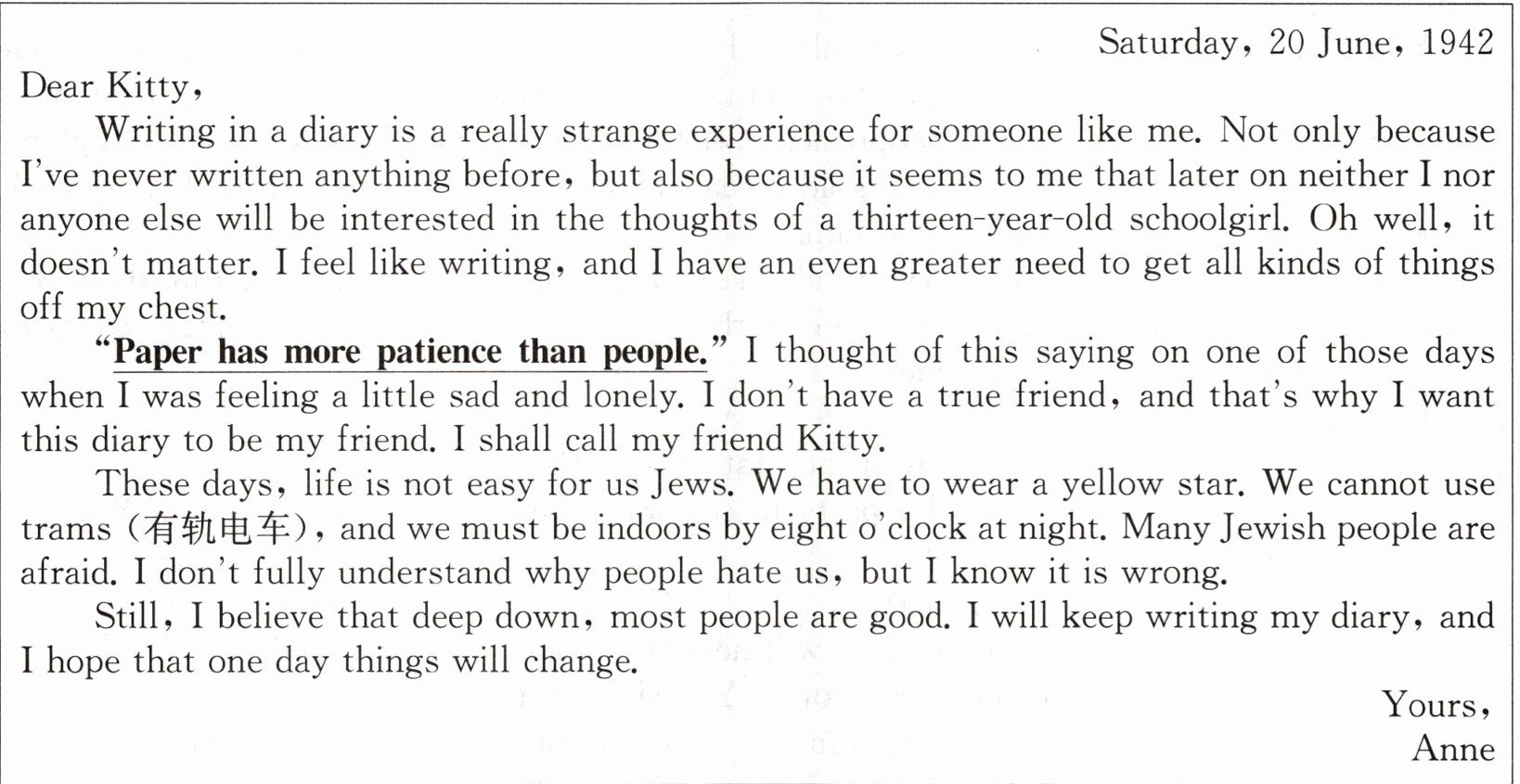
Here's one of Anne's diaries.
(
A. Because she had nothing else to do.
B. Because her parents asked her to write it.
C. Because she wanted to record her school life.
D. Because she hoped to express her feelings freely.
(
A. Anne liked writing on paper.
B. Anne believed people were not friendly.
C. Paper held Anne's feelings when she was lonely.
D. Anne thought her friends were not as patient as paper.
(
A. They lived a quiet life.
B. They could take trams only on weekdays.
C. They were treated unfairly.
D. They wore yellow stars for decoration.
(
A. Free and fun.
B. Hard and lonely.
C. Simple and safe.
D. Busy and colourful.
The Diary of a Young Girl, written by Anne Frank, records a teenager's true experiences during World War II and has become a symbol of the victory of the human spirit. Born in Germany in 1929, Anne moved to the Netherlands with her family in 1933. After Germany took control of the Netherlands in 1940, she and her sister had to go to an all-Jewish school the next year.
On her 13th birthday, Anne got a red-and-white diary and began writing in it, hoping to pour out all her thoughts and find comfort from it. On July 6 that year, her family went into hiding in a secret annex(密室)at her father's business. Over the following two years, Anne wrote faithfully in her diary, treating it as a friend. She recorded daily life in the annex, her teenage troubles, and her hopes for the future—to be a journalist or a writer.
Here's one of Anne's diaries.
(
D
)1. Why did Anne start writing the diary?A. Because she had nothing else to do.
B. Because her parents asked her to write it.
C. Because she wanted to record her school life.
D. Because she hoped to express her feelings freely.
(
C
)2. What does the underlined sentence "Paper has more patience than people" mean?A. Anne liked writing on paper.
B. Anne believed people were not friendly.
C. Paper held Anne's feelings when she was lonely.
D. Anne thought her friends were not as patient as paper.
(
C
)3. What can we learn about the Jews in the Netherlands in 1942?A. They lived a quiet life.
B. They could take trams only on weekdays.
C. They were treated unfairly.
D. They wore yellow stars for decoration.
(
B
)4. What was Anne's life like in the secret annex?A. Free and fun.
B. Hard and lonely.
C. Simple and safe.
D. Busy and colourful.
答案
1.D 2.C 3.C 4.B
解析
【分析】
本题为阅读理解题,需结合原文内容逐一分析各小题:
1. 第1题:定位原文中安妮写日记的目的相关语句,明确其是为了表达内心感受,对应选项。
2. 第2题:结合划线句的语境(安妮孤独无友),理解该句的引申含义,即纸能承载她的情绪。
3. 第3题:定位原文中1942年荷兰犹太人的遭遇,判断其受到的对待性质。
4. 第4题:结合安妮对自身状态的描述,推断密室生活的特点。
【解析】
1. 第1题:原文第一段提到安妮“have an even greater need to get all kinds of things off my chest(倾诉所有心事)”,说明她写日记是为了自由表达感受,A(无事可做)、B(父母要求)、C(记录学校生活)均不符合,故选D。
2. 第2题:划线句出自安妮孤独时的感悟,她没有真正的朋友,纸能耐心承载她的情绪,A(喜欢写在纸上)、B(人不友好)、D(朋友不如纸有耐心)均偏离原意,故选C。
3. 第3题:原文提到1942年荷兰犹太人被要求戴黄星、禁用电车、限时回家,这些都是不公平的对待,A(安静生活)、B(仅工作日坐电车)、D(黄星是装饰)均错误,故选C。
4. 第4题:安妮提到自己“sad and lonely”,且犹太人生活艰难,密室中无法自由活动,所以生活艰难孤独,A(自由有趣)、C(简单安全)、D(忙碌多彩)均不符合,故选B。
【答案】
1.D 2.C 3.C 4.B
【知识点】
阅读理解、细节理解、推理判断
【点评】
本题围绕《安妮日记》的内容设置,考查学生对文章细节的定位与理解能力,难度适中,需学生仔细阅读原文,找准对应信息。
【难度系数】
0.6
本题为阅读理解题,需结合原文内容逐一分析各小题:
1. 第1题:定位原文中安妮写日记的目的相关语句,明确其是为了表达内心感受,对应选项。
2. 第2题:结合划线句的语境(安妮孤独无友),理解该句的引申含义,即纸能承载她的情绪。
3. 第3题:定位原文中1942年荷兰犹太人的遭遇,判断其受到的对待性质。
4. 第4题:结合安妮对自身状态的描述,推断密室生活的特点。
【解析】
1. 第1题:原文第一段提到安妮“have an even greater need to get all kinds of things off my chest(倾诉所有心事)”,说明她写日记是为了自由表达感受,A(无事可做)、B(父母要求)、C(记录学校生活)均不符合,故选D。
2. 第2题:划线句出自安妮孤独时的感悟,她没有真正的朋友,纸能耐心承载她的情绪,A(喜欢写在纸上)、B(人不友好)、D(朋友不如纸有耐心)均偏离原意,故选C。
3. 第3题:原文提到1942年荷兰犹太人被要求戴黄星、禁用电车、限时回家,这些都是不公平的对待,A(安静生活)、B(仅工作日坐电车)、D(黄星是装饰)均错误,故选C。
4. 第4题:安妮提到自己“sad and lonely”,且犹太人生活艰难,密室中无法自由活动,所以生活艰难孤独,A(自由有趣)、C(简单安全)、D(忙碌多彩)均不符合,故选B。
【答案】
1.D 2.C 3.C 4.B
【知识点】
阅读理解、细节理解、推理判断
【点评】
本题围绕《安妮日记》的内容设置,考查学生对文章细节的定位与理解能力,难度适中,需学生仔细阅读原文,找准对应信息。
【难度系数】
0.6
