

 登录
四、从方框中选择最佳选项补全对话(有两项多余)
[2025 重庆外国语学校三模]
A: Hey, John. You look upset. What's up?
B: 1.
A: Don't be too hard on yourself. Everyone fails sometimes.
B: You always do well in exams. Can you give me some suggestions?
A: Of course! Reading aloud every day can be of great help.
B: Really? I tried. 2.
A: You can improve by listening to the radio or watching English movies.
B: That sounds good. 3.
A: You can also go to the English corner in our school.
B: Wonderful! 4.
A: Every Tuesday night. We can go there together next time.
B: OK. 5.
A: You're welcome.
A. When is it?
B. See you then!
C. What else can I do?
D. Thanks for your help.
E. Did you read other books?
F. I failed the English speaking exam.
G. But it's hard to improve my spoken English.
[2025 重庆外国语学校三模]
A: Hey, John. You look upset. What's up?
B: 1.
F
I studied so hard, but it still didn't work!A: Don't be too hard on yourself. Everyone fails sometimes.
B: You always do well in exams. Can you give me some suggestions?
A: Of course! Reading aloud every day can be of great help.
B: Really? I tried. 2.
G
A: You can improve by listening to the radio or watching English movies.
B: That sounds good. 3.
C
A: You can also go to the English corner in our school.
B: Wonderful! 4.
A
A: Every Tuesday night. We can go there together next time.
B: OK. 5.
D
A: You're welcome.
A. When is it?
B. See you then!
C. What else can I do?
D. Thanks for your help.
E. Did you read other books?
F. I failed the English speaking exam.
G. But it's hard to improve my spoken English.
答案
1—5 FGCAD
解析
【分析】本题为英语补全对话,需结合上下文语境的问答逻辑选择合适选项。先通读对话,明确人物交流场景:A关心B的状况,B说明考试失利的困扰,A给出学习建议,B逐步询问更多方法、时间,最后表达感谢,据此匹配对应选项。
【解析】1. 上文A询问B的状况(What's up?),下文B提到努力却没效果,对应选项F“我英语口语考试挂了”;2. A建议大声朗读,B表示试过了,接着说明自身问题,对应选项G“但提升口语很难”;3. A给出听广播、看电影的方法后,B询问更多建议,对应选项C“我还能做什么?”;4. A提到学校的英语角,B询问时间,对应选项A“什么时候?”;5. A回应“You're welcome”,B表达感谢,对应选项D“谢谢你的帮助”。
【答案】1—5 FGCAD
【知识点】英语日常交际用语、补全对话
【点评】本题考查英语补全对话的运用,需结合上下文语境逻辑关系选选项,属于基础交际类题型,难度适中。
【难度系数】0.6
阅读理解 瑞典语
素养:学习能力 难度:中 用时:7 分钟
[2025 西安高新第一中学模拟改编]Come to learn Swedish (瑞典语). It seems challenging, but it could be easier if you are a good English speaker. The two languages have a lot in common.
The Swedish alphabet (字母表) is almost the same as the English alphabet, but it has three more letters: Ä, Å and Ö. Although some letters like O and Ö look alike, they are actually different. Take the Swedish words “lov” and “löv” as an example. The word “lov” can refer to “holidays” while “löv” means “leaves”.
Many words are close in Swedish and English. “Bok” in Swedish is only a one-letter change to “book”, and “äpple” is an easy change to “apple”. “Man” and “piano” are the same in both languages.
Another similarity is the word order. It's often possible to directly translate sentences between the two languages. One big difference is that Swedish always puts the verb in the second place of a sentence. In English sentences, words like “always” or “hardly” often appear in the second place. However, Swedish is strict about that verb-second rule and will put them after the verb.
There are many reasons that make Swedish hard, but with your English learning experience, you'll find it easier.
1. 新考法·写作手法题 How does the writer develop the idea in Paragraph 2?
A. By explaining the results.
B. By raising questions.
C. By showing differences.
D. By listing numbers.
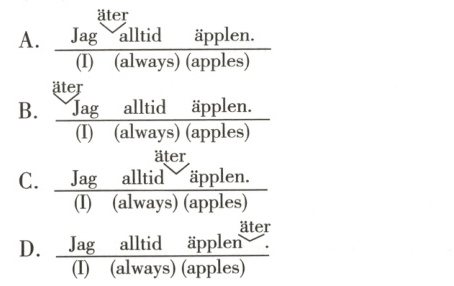
2. 新考法·创新性设问 To say “I always eat apples” in Swedish, which of the following shows the right way to place the verb “äter (eat)”?
3. What is the main purpose of the passage?
A. To introduce the development of Swedish.
B. To show Swedish is not so difficult to learn.
C. To share how to learn English more quickly.
D. To tell the difference between English and Swedish.
素养:学习能力 难度:中 用时:7 分钟
[2025 西安高新第一中学模拟改编]Come to learn Swedish (瑞典语). It seems challenging, but it could be easier if you are a good English speaker. The two languages have a lot in common.
The Swedish alphabet (字母表) is almost the same as the English alphabet, but it has three more letters: Ä, Å and Ö. Although some letters like O and Ö look alike, they are actually different. Take the Swedish words “lov” and “löv” as an example. The word “lov” can refer to “holidays” while “löv” means “leaves”.
Many words are close in Swedish and English. “Bok” in Swedish is only a one-letter change to “book”, and “äpple” is an easy change to “apple”. “Man” and “piano” are the same in both languages.
Another similarity is the word order. It's often possible to directly translate sentences between the two languages. One big difference is that Swedish always puts the verb in the second place of a sentence. In English sentences, words like “always” or “hardly” often appear in the second place. However, Swedish is strict about that verb-second rule and will put them after the verb.
There are many reasons that make Swedish hard, but with your English learning experience, you'll find it easier.
1. 新考法·写作手法题 How does the writer develop the idea in Paragraph 2?
A. By explaining the results.
B. By raising questions.
C. By showing differences.
D. By listing numbers.
2. 新考法·创新性设问 To say “I always eat apples” in Swedish, which of the following shows the right way to place the verb “äter (eat)”?
3. What is the main purpose of the passage?
A. To introduce the development of Swedish.
B. To show Swedish is not so difficult to learn.
C. To share how to learn English more quickly.
D. To tell the difference between English and Swedish.
答案
1.C 写作手法题。根据“The Swedish alphabet(字母表) is almost the same as the English alphabet, but it has three more letters... Take the Swedish words ‘lov’ and ‘löv’ as an example”可知,第二段先指出瑞典语字母表与英语字母表的相似之处,再通过“lov”和“löv”的例子说明两者的差异,属于“展示差异”的展开方式,故选C。
2.A 推理判断题。根据第四段中的“Swedish always puts the verb in the second place of a sentence”可知,在瑞典语中,动词总是放在句子的第二位,故选A。
3.B 写作意图题。根据第一段中的“It seems challenging, but it could be easier if you are a good English speaker”及最后一段可知,作者写这篇文章主要是为了说明,有英语学习经验的人学起瑞典语来会更容易一点,故选B。
2.A 推理判断题。根据第四段中的“Swedish always puts the verb in the second place of a sentence”可知,在瑞典语中,动词总是放在句子的第二位,故选A。
3.B 写作意图题。根据第一段中的“It seems challenging, but it could be easier if you are a good English speaker”及最后一段可知,作者写这篇文章主要是为了说明,有英语学习经验的人学起瑞典语来会更容易一点,故选B。
解析
【分析】
1. 第1题:需梳理第二段的内容结构,明确段落通过对比瑞典语与英语字母表的差异(结合具体单词例子)展开,据此判断写作手法。
2. 第2题:定位文中关于瑞典语动词位置的规则(动词需放在句子第二位),对应题目中的瑞典语句子结构,确定动词“äter”的位置,选出正确标注。
3. 第3题:通读全文,重点关注首尾段的核心观点,提炼作者的写作意图,匹配选项得出答案。
【解析】
1. 第1题:第二段先说明瑞典语字母表与英语字母表的相似之处,再通过“lov”和“löv”的例子展示两者的差异,属于“展示差异”的写作手法,故选C。
2. 第2题:根据第四段“Swedish always puts the verb in the second place of a sentence”,句子“I always eat apples”对应的瑞典语为“Jag alltid äter äpplen”,动词“äter”应位于句子第二位,对应选项A的标注,故选A。
3. 第3题:第一段指出瑞典语有挑战性,但英语好的人学起来更容易,最后一段也强调有英语学习经验学瑞典语会更简单,全文核心是说明瑞典语不难学,故选B。
【答案】
1.C 2.A 3.B
【知识点】
阅读理解写作手法、阅读理解细节理解、阅读理解主旨大意
【点评】
本题围绕瑞典语学习的文本考查阅读理解的三类核心题型,需准确抓取段落结构、细节信息及全文主旨,难度适中,适合中等水平学生作答。
【难度系数】
0.5
