

 登录
登录
情境1 小组开场后,Jenny分享了Lily为钢琴梦想奋斗的成长经历,引发了大家对“音乐如何助力梦想实现”的讨论。
任务一 完形填空(10分)
[2026 辽宁锦州期末]In a small, quiet neighbourhood, there lived a young girl named Lily. She was deeply fascinated by
One day, Lily’s school decided to hold a music
However, there was a big problem. Lily didn’t have a piano at home. She couldn’t
Every day, Lily would rush to the music room right after school. She would
As the competition day came, Lily was both excited and
The results were announced(宣布), and to everyone’s surprise, Lily
paid off. From that day on, Lily was more confident and continued to pursue(追求)her dream of becoming a great pianist.
(
C. dance D. literature
(
C. point D. shout
(
C. competition D. performance
(
C. sad D. angry
(
C. plan D. decide
(
C. comfortably D. brightly
(
C. avoid D. enjoy
(
C. kept going D. gave up
(
C. nervous D. disappointed
(
C. missed D. won
任务一 完形填空(10分)
[2026 辽宁锦州期末]In a small, quiet neighbourhood, there lived a young girl named Lily. She was deeply fascinated by
B
1. Every time she passed by a piano store, she would stop and A
2 longingly(渴望地)at the beautiful instruments inside.One day, Lily’s school decided to hold a music
C
3. The prize was a scholarship(奖学金)to a famous music school. Lily was really B
4. She knew this could be her chance to get closer to her dream.However, there was a big problem. Lily didn’t have a piano at home. She couldn’t
A
5 to take piano lessons either. But she didn’t give up. She asked the school music teacher if she could use the school piano after class. The teacher agreed kindly and smiled to her D
6.Every day, Lily would rush to the music room right after school. She would
D
7 practising the piano for hours. Her fingers would sometimes hurt, but she still C
8.As the competition day came, Lily was both excited and
C
9. When she finally stepped onto the stage, she played with all her heart.The results were announced(宣布), and to everyone’s surprise, Lily
D
10! She got the scholarship. Her hard work and determination hadpaid off. From that day on, Lily was more confident and continued to pursue(追求)her dream of becoming a great pianist.
(
B
)1. A. art B. musicC. dance D. literature
(
A
)2. A. look B. laughC. point D. shout
(
C
)3. A. party B. concertC. competition D. performance
(
B
)4. A. calm B. excitedC. sad D. angry
(
A
)5. A. afford B. wantC. plan D. decide
(
D
)6. A. slowly B. carefullyC. comfortably D. brightly
(
D
)7. A. stop B. finishC. avoid D. enjoy
(
C
)8. A. looked back B. talked aboutC. kept going D. gave up
(
C
)9. A. relaxed B. proudC. nervous D. disappointed
(
D
)10. A. lost B. failedC. missed D. won
答案
1—5 B A C B A
6—10 D D C C D
1. B 根据后一句可知,莉莉每次路过钢琴店都会停下来,说明她对音乐很着迷。故选 B 项。
2. A 根据 at the beautiful instruments inside 可知,莉莉会停下来看里面的乐器。故选 A 项。
3. C 根据下文的 The prize 及 As the competition day came 可知,学校举办了一场比赛。故选 C 项。
4. B 根据后一句可知,莉莉知道这是她更接近梦想的机会,所以她很兴奋。故选 B 项。
5. A 根据前一句可知,莉莉家没有钢琴,结合 also 可推测,她也负担不起上钢琴课的费用。故选 A 项。
6. D 根据 The teacher agreed kindly 可知,老师亲切地同意了莉莉的请求,应该是灿烂地笑了。故选 D 项。
7. D 根据后一句可知,莉莉虽然手指有时会疼,但她仍然坚持练习,说明她很享受这个过程。故选 D 项。
8. C 根据语境并结合 but 可知,莉莉虽然手指有时会疼,但她仍然坚持练习。故选 C 项。
9. C 根据语境可知,莉莉对即将到来的比赛既兴奋又紧张。故选 C 项。
10. D 根据下文“She got the scholarship.”可知,莉莉赢了比赛。故选 D 项。
6—10 D D C C D
1. B 根据后一句可知,莉莉每次路过钢琴店都会停下来,说明她对音乐很着迷。故选 B 项。
2. A 根据 at the beautiful instruments inside 可知,莉莉会停下来看里面的乐器。故选 A 项。
3. C 根据下文的 The prize 及 As the competition day came 可知,学校举办了一场比赛。故选 C 项。
4. B 根据后一句可知,莉莉知道这是她更接近梦想的机会,所以她很兴奋。故选 B 项。
5. A 根据前一句可知,莉莉家没有钢琴,结合 also 可推测,她也负担不起上钢琴课的费用。故选 A 项。
6. D 根据 The teacher agreed kindly 可知,老师亲切地同意了莉莉的请求,应该是灿烂地笑了。故选 D 项。
7. D 根据后一句可知,莉莉虽然手指有时会疼,但她仍然坚持练习,说明她很享受这个过程。故选 D 项。
8. C 根据语境并结合 but 可知,莉莉虽然手指有时会疼,但她仍然坚持练习。故选 C 项。
9. C 根据语境可知,莉莉对即将到来的比赛既兴奋又紧张。故选 C 项。
10. D 根据下文“She got the scholarship.”可知,莉莉赢了比赛。故选 D 项。
[2025 江西赣州一模] When I was a teenager, my parents were never interested in the music I preferred. They said to me, “David, the music you like listening to is a lot of noise.” At
the same time, my father described the music that he liked as beautiful. As it turns out, they are not alone. As I grow older, I've often heard people of my age say, “Today’s music is terrible.” Many older people just don’t like new music. But why is that?
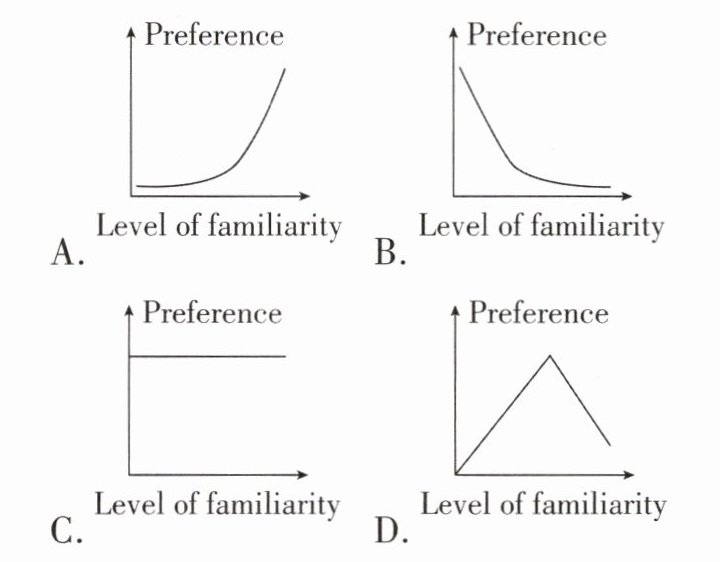
The mere exposure effect(纯粹接触效应) may explain this. It means the more familiar we are with something, the more likely we are to prefer it. When we are in our early teens, we usually spend a lot of time listening to popular music and discussing it with our friends. The new songs and singers during this time become familiar to us. After we turn 30 years old, we are busy working and raising our families. We don't have so much time to look for new music. Instead, we prefer to listen to our old favourites. According to studies, by the time we turn 33 years old, most of us will completely stop exploring new music.
But I think there is another reason for older people’s dislike of new music. Most new music, after all, is not written for them. It is made for young people. Some types of music began as a rebellion by young people against out-of-date ways of doing things. These types include punk, rap, hip-hop, heavy metal and more. They naturally interest younger listeners.
Do your parents dislike the music you like too? Now, after reading this article, you know there is nothing wrong with that.
(
①Because the new music sounds terrible.
②Because they are afraid of noise.
③Because most new music is not written for them.
④Because they are not familiar with the new music.
A.①② B.②③ C.③④ D.②④
(
(
A. purpose B. sense
C. praise D. disagreement
(
A. All new music is written for young people.
B. Most people no longer explore new music at the age of 33.
C. Teenagers usually spend a lot of time watching popular TV series.
D. Today’s music is terrible in all people’s eyes.
(
A. Why Don’t Your Parents Like the Music You Like?
B. What’s the Real Meaning of the Mere Exposure Effect?
C. When Do Most Young People Stop Exploring New Music?
D. How Do Young People Like Different Types of New Music?
情境3 林涛则分享了“薛谭学讴”的中国传统故事,借音乐学习的典故传递“学无止境”的文化智慧。
the same time, my father described the music that he liked as beautiful. As it turns out, they are not alone. As I grow older, I've often heard people of my age say, “Today’s music is terrible.” Many older people just don’t like new music. But why is that?
The mere exposure effect(纯粹接触效应) may explain this. It means the more familiar we are with something, the more likely we are to prefer it. When we are in our early teens, we usually spend a lot of time listening to popular music and discussing it with our friends. The new songs and singers during this time become familiar to us. After we turn 30 years old, we are busy working and raising our families. We don't have so much time to look for new music. Instead, we prefer to listen to our old favourites. According to studies, by the time we turn 33 years old, most of us will completely stop exploring new music.
But I think there is another reason for older people’s dislike of new music. Most new music, after all, is not written for them. It is made for young people. Some types of music began as a rebellion by young people against out-of-date ways of doing things. These types include punk, rap, hip-hop, heavy metal and more. They naturally interest younger listeners.
Do your parents dislike the music you like too? Now, after reading this article, you know there is nothing wrong with that.
(
C
)11. 新考法选项选择 Why do many older people dislike new music?①Because the new music sounds terrible.
②Because they are afraid of noise.
③Because most new music is not written for them.
④Because they are not familiar with the new music.
A.①② B.②③ C.③④ D.②④
(
A
)12. 新考法图示理解 Which of the following charts correctly shows “the mere exposure effect”? (Preference: 偏爱; Level of familiarity: 熟悉度)(
D
)13. Which word is closest in meaning to the underlined word “rebellion” in Paragraph 3?A. purpose B. sense
C. praise D. disagreement
(
B
)14. Which of the following is TRUE according to the passage?A. All new music is written for young people.
B. Most people no longer explore new music at the age of 33.
C. Teenagers usually spend a lot of time watching popular TV series.
D. Today’s music is terrible in all people’s eyes.
(
A
)15. Which can be the best title for the passage?A. Why Don’t Your Parents Like the Music You Like?
B. What’s the Real Meaning of the Mere Exposure Effect?
C. When Do Most Young People Stop Exploring New Music?
D. How Do Young People Like Different Types of New Music?
情境3 林涛则分享了“薛谭学讴”的中国传统故事,借音乐学习的典故传递“学无止境”的文化智慧。
答案
11—15 C A D B A
11. C 细节理解题。根据第二段的“The mere exposure effect may explain this… Instead, we prefer to listen to our old favourites.”可知,年长的人不熟悉新音乐,所以他们不喜欢新音乐;再根据第三段的“But I think there is another reason… Most new music, after all, is not written for them.”可知,大多数新音乐不是为年长的人写的。所以③④正确,故选 C 项。
12. A 推理判断题。根据第二段的“The mere exposure effect… It means the more familiar we are with something, the more likely we are to prefer it.”可知,纯粹接触效应意味着对某事物越熟悉,就越有可能偏爱它,A 选项符合题意。故选 A 项。
13. D 词义猜测题。根据画线词所在句子可知,一些类型的音乐是年轻人对过时做事方式的反抗,rebellion 意为“反抗”,与 disagreement 意思相近。故选 D 项。
14. B 细节理解题。根据第二段的“According to studies, by the time we turn 33 years old, most of us will completely stop exploring new music.”可知,大多数人到 33 岁就不再探索新音乐了,故选 B 项。
15. A 主旨大意题。文章主要探讨了为什么父母不喜欢孩子喜欢的音乐,A 选项最适合作标题。故选 A 项。
11. C 细节理解题。根据第二段的“The mere exposure effect may explain this… Instead, we prefer to listen to our old favourites.”可知,年长的人不熟悉新音乐,所以他们不喜欢新音乐;再根据第三段的“But I think there is another reason… Most new music, after all, is not written for them.”可知,大多数新音乐不是为年长的人写的。所以③④正确,故选 C 项。
12. A 推理判断题。根据第二段的“The mere exposure effect… It means the more familiar we are with something, the more likely we are to prefer it.”可知,纯粹接触效应意味着对某事物越熟悉,就越有可能偏爱它,A 选项符合题意。故选 A 项。
13. D 词义猜测题。根据画线词所在句子可知,一些类型的音乐是年轻人对过时做事方式的反抗,rebellion 意为“反抗”,与 disagreement 意思相近。故选 D 项。
14. B 细节理解题。根据第二段的“According to studies, by the time we turn 33 years old, most of us will completely stop exploring new music.”可知,大多数人到 33 岁就不再探索新音乐了,故选 B 项。
15. A 主旨大意题。文章主要探讨了为什么父母不喜欢孩子喜欢的音乐,A 选项最适合作标题。故选 A 项。
